
A private cloud provider is choosing a hypervisor for multi-tenant production workloads. One option installs directly on the server hardware; the other runs as an application on top of a general-purpose host operating system. From a security perspective, why is the first option usually preferred?
Select an answer to reveal the explanation.
Short Explanation
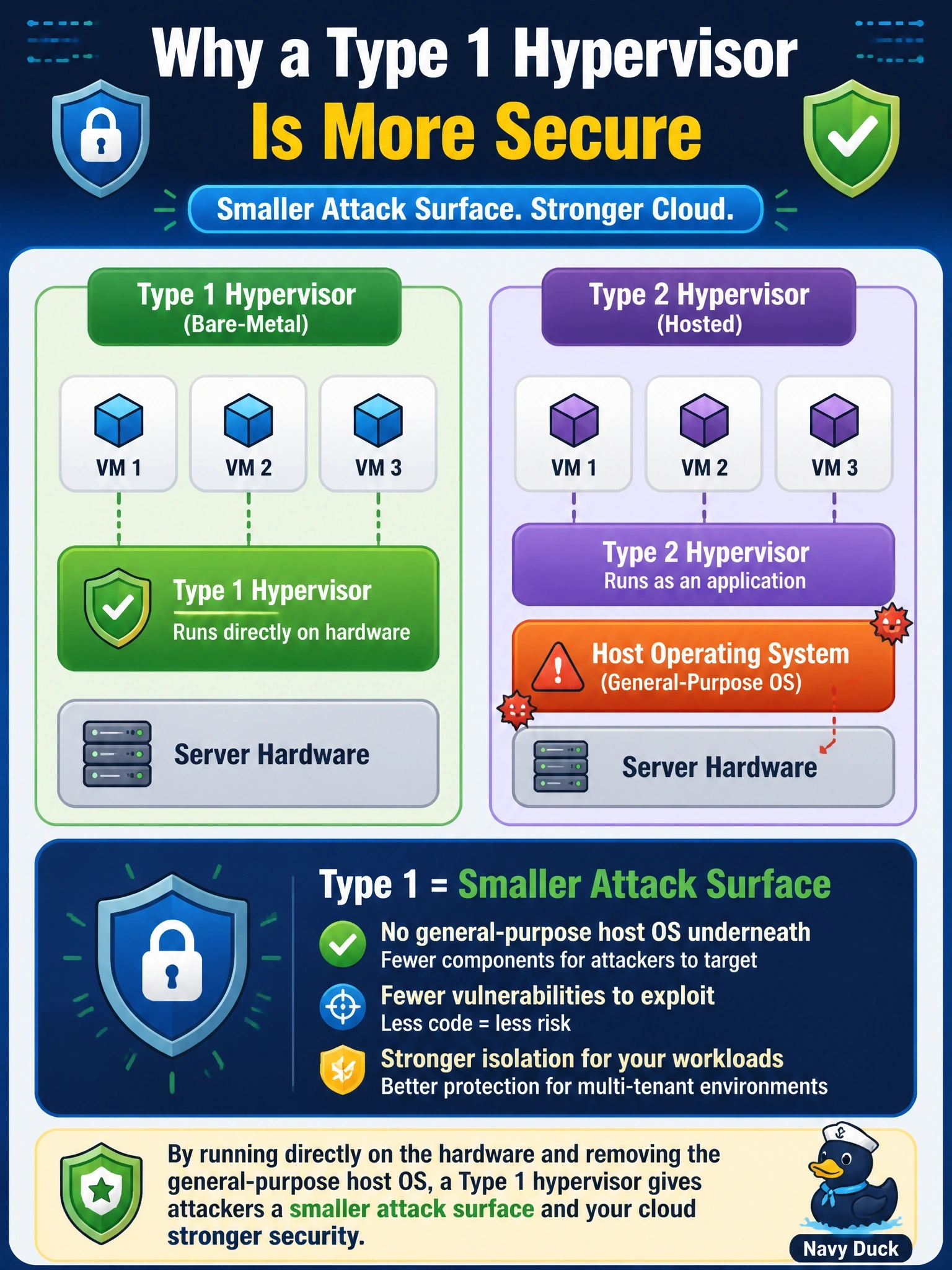
Every extra layer is another door a burglar can try. When you pick a bare-metal Type 1 hypervisor, you skip the whole general-purpose operating system, so there's simply less code to attack. Don't get tricked into thinking it never needs patches; it absolutely does.
Full Explanation
A Type 1, or bare-metal, hypervisor runs directly on the physical hardware and controls guest virtual machines without an intervening general-purpose operating system. A Type 2, or hosted, hypervisor runs as an application on a conventional OS, which means every vulnerability, service and user account on that host OS becomes a path to compromise the hypervisor and therefore every guest. The thinner code base of a Type 1 hypervisor reduces the attack surface and the opportunities for privilege escalation, which is why cloud providers use bare-metal hypervisors for multi-tenant production. Sharing memory pages directly between guests weakens isolation rather than strengthening it, and page sharing across tenants has been associated with side-channel risk; it does not speed tenant encryption. A Type 1 hypervisor still requires regular patching from its vendor, and treating it as maintenance-free would leave known vulnerabilities in place. Running desktop applications on the host describes a hosted hypervisor's convenience and is precisely the additional attack surface to avoid in production. Exam caveat: a smaller attack surface lowers risk but does not eliminate hypervisor escape threats, so hardening and patching still apply. Operational check: confirm the hypervisor build follows the vendor's hardening guidance and is current on security patches.