
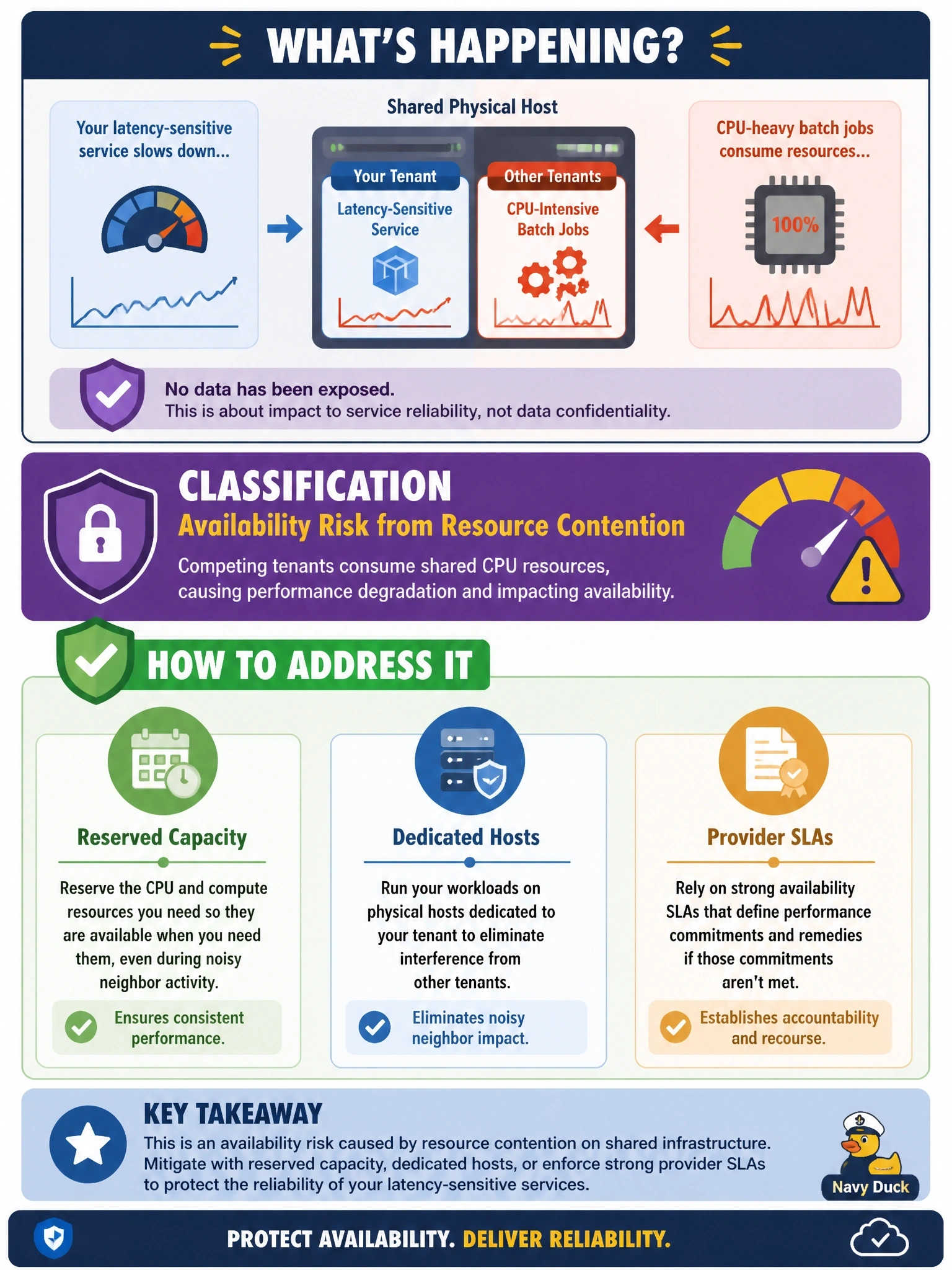
A tenant running a latency-sensitive service on shared IaaS compute notices that response times degrade whenever other tenants on the same physical hosts run CPU-intensive batch jobs. No data has been exposed. How should the security team classify this issue and address it?
Select an answer to reveal the explanation.
Short Explanation
It's the noisy neighbor in the apartment next door: nobody's stealing your stuff, but you can't get any sleep. Shared hardware means someone else's heavy job can eat into your performance, and that's an availability problem. You fix it with reserved capacity, dedicated hosts or SLA terms, not with incident response or checksums.
Full Explanation
Resource pooling and multi-tenancy let a provider place many tenants' workloads on shared physical hosts. When one tenant's workload consumes a disproportionate share of CPU, memory bandwidth, storage I/O or network capacity, other tenants experience degraded performance, commonly called the noisy neighbor problem. In security terms that is an availability concern, one leg of the CIA triad. The tenant's remedies are commercial and architectural: reserved or guaranteed capacity, dedicated or single-tenant hosts for sensitive workloads, choosing instance types with performance guarantees, and SLAs that define performance commitments and remedies. Treating it as a side-channel confidentiality breach is unsupported; the evidence shows performance degradation with no data exposure, so incident response and key rotation would be misdirected. Calling it a hypervisor vulnerability misreads both the cause and the responsibility; resource contention can occur on a fully patched hypervisor, and in IaaS the provider, not the tenant, patches the hypervisor. Checksums protect integrity of data, which is not affected by slower processing. Exam caveat: in multi-tenant environments, availability depends partly on the provider's scheduling and capacity management. Operational check: correlate the service's latency metrics with host-level contention indicators and confirm the chosen remedy holds latency within the required target.