
After a new third-party data feed was added to a cloud training pipeline, a classification model's accuracy dropped and it began mislabeling one category of inputs. The team suspects some of the new records were deliberately manipulated. Which practice would best have allowed the team to detect and roll back this problem?
Select an answer to reveal the explanation.
Short Explanation
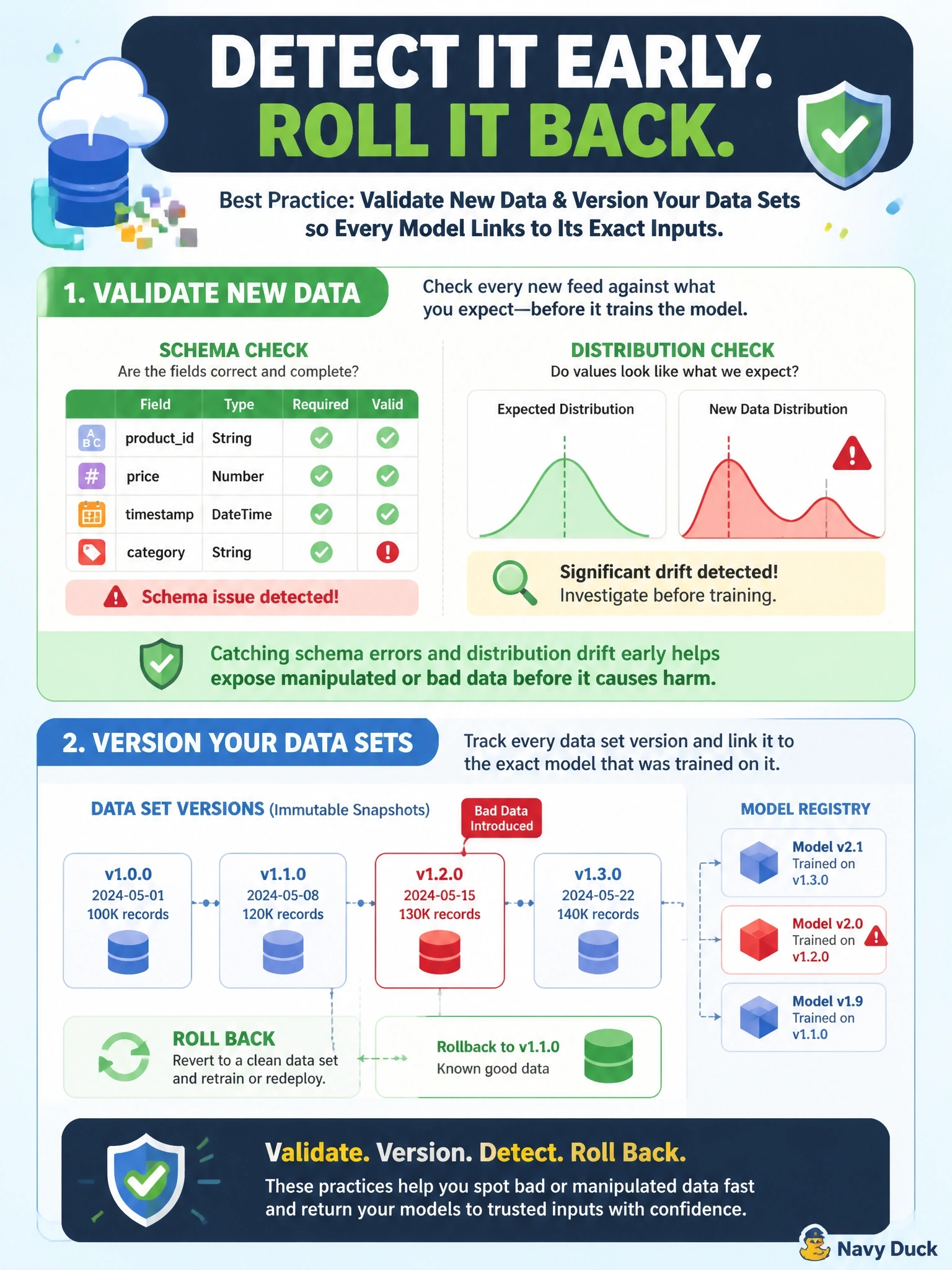
Poisoned data is like a bad batch of ingredients: you want to taste-test it before it goes in the pot and know exactly which delivery it came from. Validation catches the odd records, and versioning lets you roll the model back to the last clean data set. Encryption won't help you here, because the feed's records were already bad when they arrived.
Full Explanation
Data set security for machine learning relies on validation and verification of sources. Before new records join the training set, automated checks should confirm schema conformance, value ranges, label distributions and statistical similarity to trusted data, flagging anomalies such as a sudden shift in one category. Data set versioning records exactly which data produced each model, so when a poisoning attack is suspected the team can identify the offending feed, remove its records and retrain from the last known-good version, with lineage to support the investigation. Encrypting data in transit and at rest with rotated keys protects confidentiality and guards against tampering in storage, but here the manipulation arrived through an authorized feed, so encryption faithfully protects the poisoned records. Expanding compute shortens retraining time, yet without knowing which records are bad, faster retraining simply reproduces the problem. Dedicated single-tenant hosts address co-tenancy threats such as side channels, which are unrelated to the trustworthiness of the data supplier. Exam caveat: poisoning is an integrity attack on training inputs; validation, provenance and versioning are the matching controls. Operational check: confirm every production model's metadata references a specific data set version, and that new feeds pass validation gates before merging.