
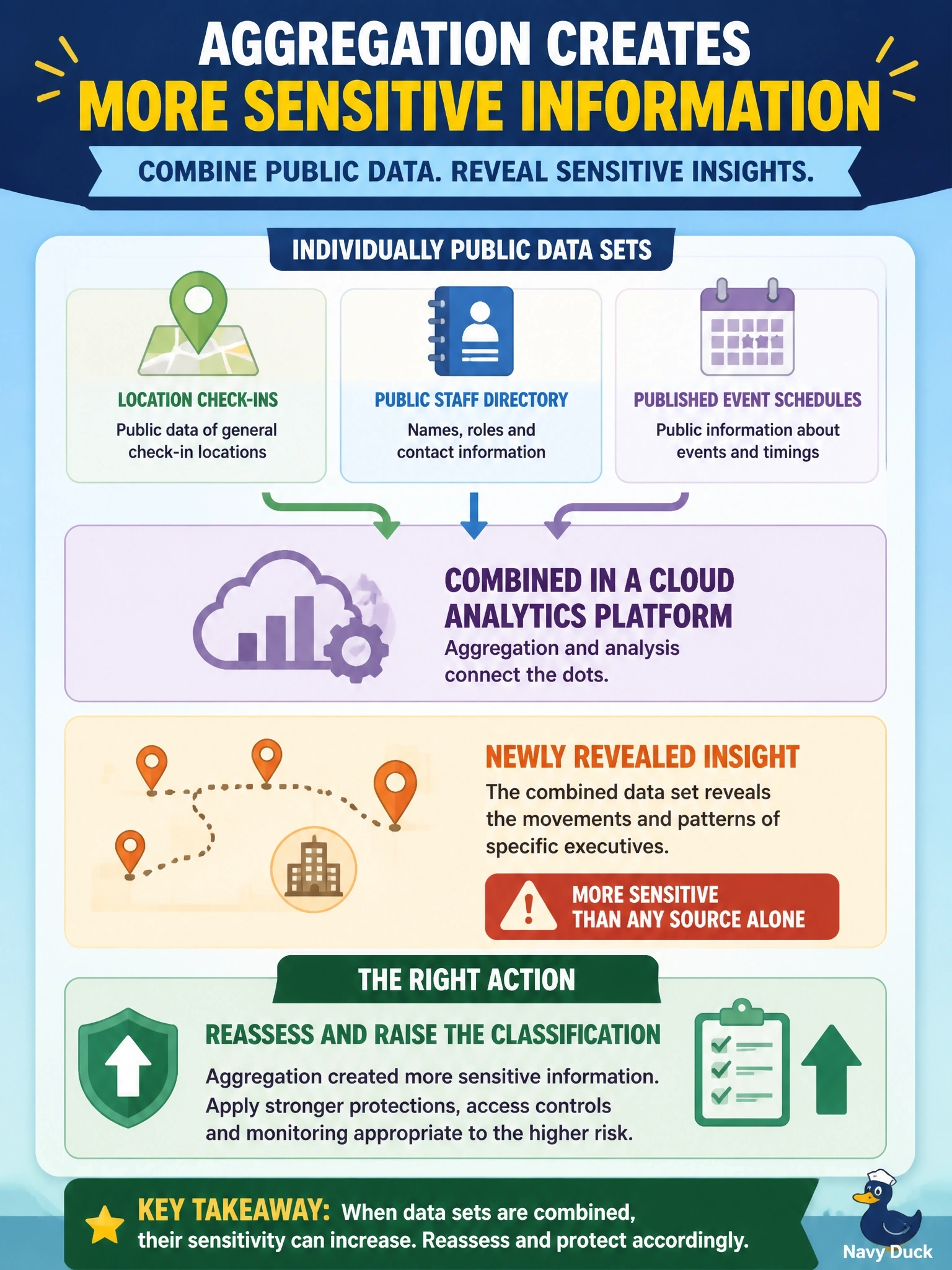
A research group combines several individually public data sets in a cloud analytics platform: location check-ins, a public staff directory and published event schedules. The combined output reveals the movements of specific executives. What should happen to the classification of the combined data set?
Select an answer to reveal the explanation.
Short Explanation
One puzzle piece tells you nothing; put the pieces together and suddenly you've got the whole picture. That's aggregation, and the combined result can be far more sensitive than anything it came from. Don't just inherit the 'public' label from the parts.
Full Explanation
Aggregation occurs when data that is harmless in isolation becomes sensitive when combined, because the combination reveals something no single source did. Here, public check-ins, a staff directory and event schedules together expose the movements of named executives, which creates physical security and privacy risks. Classification must follow the information actually present, so the combined output should be reassessed by its owner and assigned a higher classification with matching controls such as restricted access, limited sharing and monitoring. Keeping the output public because each source was public ignores the new information created by combination; prior approval of the sources does not cover a derived product with different sensitivity. Automatic tagging that simply inherits source labels would label the output public, which is exactly the failure aggregation produces, so derived data sets need their own review. Reclassifying the sources misplaces the problem; each source remains public and widely available, and changing their labels neither retracts them nor protects the combined result. Exam caveat: the related inference problem arises when sensitive facts can be deduced from less sensitive data. Operational check: require classification review for every new derived or joined data set before it is shared beyond the analytics team.