
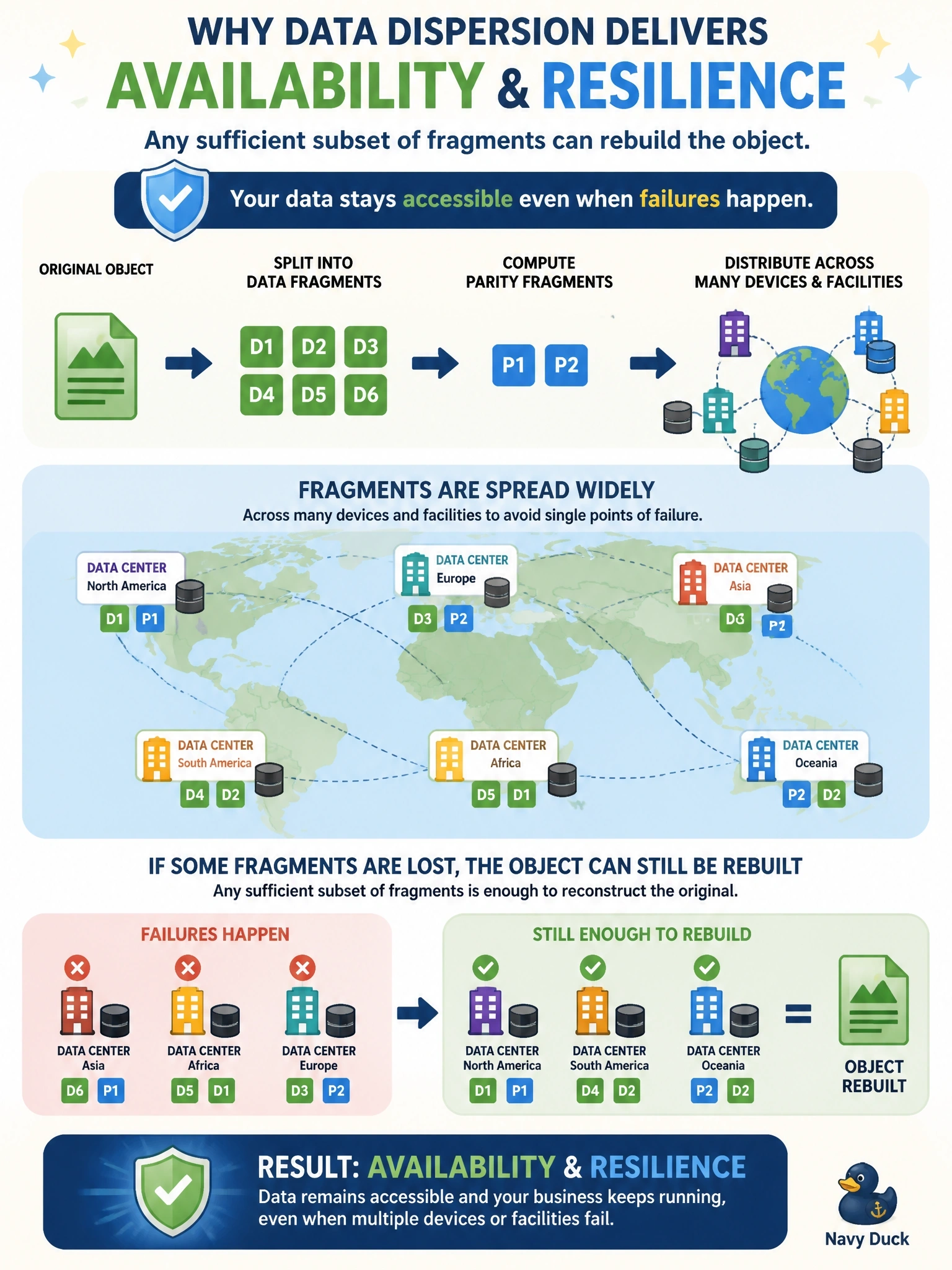
A provider's storage service splits each customer object into fragments, computes additional parity fragments, and writes all of them across many devices and facilities so that the object can be rebuilt even if several fragments are lost. What security benefit does this data dispersion technique mainly provide?
Select an answer to reveal the explanation.
Short Explanation
It's like tearing a treasure map into pieces, making a few spare pieces, and hiding them in different towns: lose a couple and you can still rebuild the map. That's data dispersion with parity, and its big win is availability. Watch the trap: parity is math for rebuilding, not encryption.
Full Explanation
Data dispersion, often implemented as erasure coding or bit splitting, divides data into fragments and adds parity fragments computed from them. The fragments are distributed across drives, racks or facilities, and the original object can be reconstructed from a sufficient subset. The security property this mainly delivers is availability and resilience: losing a disk, a node or even a site does not lose the data, and storage overhead is lower than keeping several full replicas. Parity is a redundancy calculation, not a cipher; a parity fragment does not encrypt anything, so confidentiality still depends on encryption applied to the data and on access control. Non-repudiation requires digital signatures bound to an identity, and fragment placement has nothing to do with proving who created or sent data. Data minimization is a privacy principle about collecting and retaining only what is necessary; splitting data does not reduce the amount retained, and parity actually adds bytes. Exam caveat: some texts note that a single fragment may be hard to interpret, but that is incidental and not a substitute for encryption. Operational check: confirm the provider documents its durability design and pair it with customer-controlled encryption for confidentiality.