
A manufacturer's data lifecycle mapping shows that engineering files are routinely sent from its cloud storage to external partners for review. Which set of controls is most closely aligned with this phase of the cloud secure data lifecycle?
Select an answer to reveal the explanation.
Short Explanation
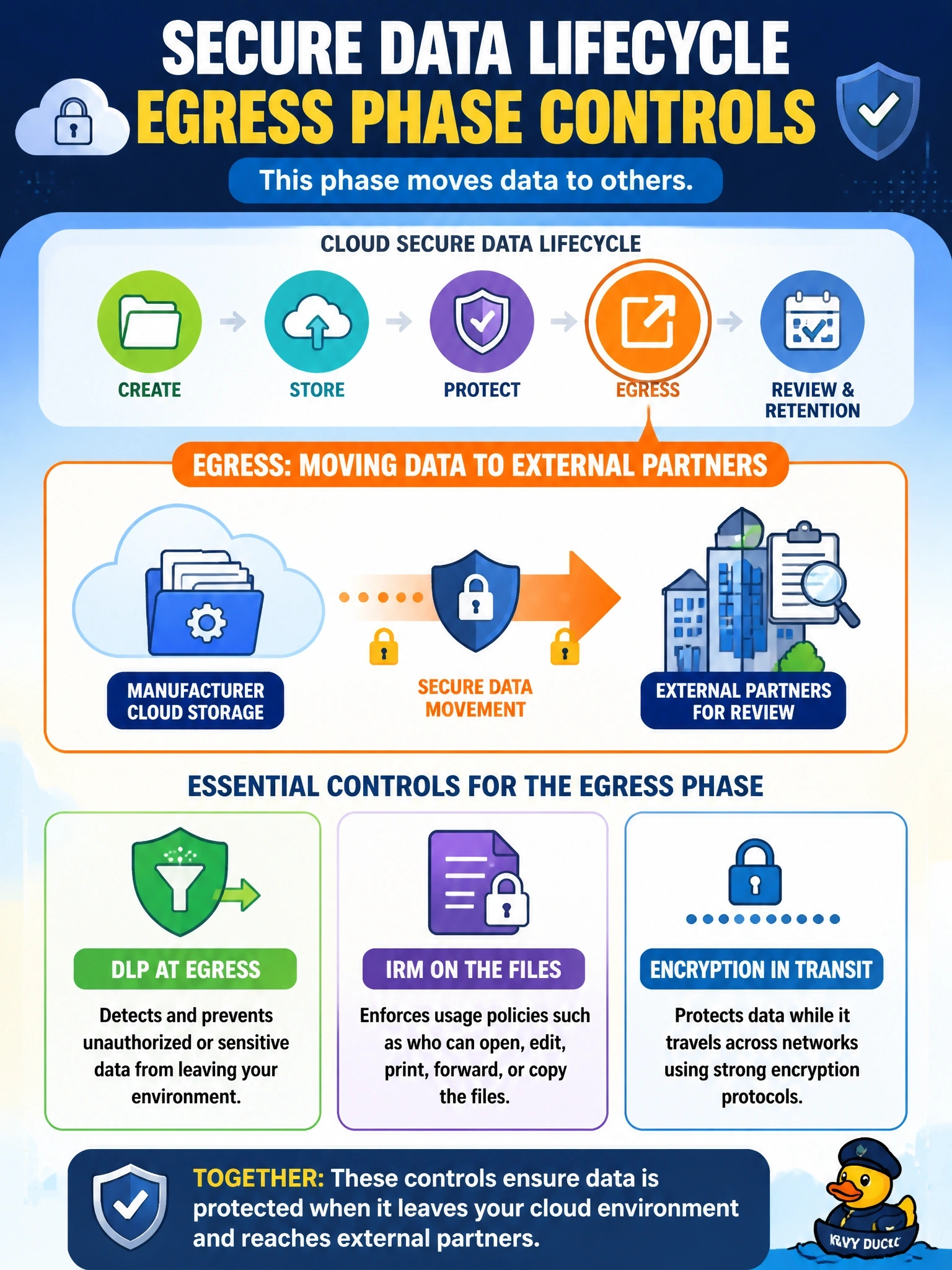
When the file walks out the door to a partner, you're in the Share phase, and you want guards on the door (DLP), a leash on the file (IRM) and an armored car for the trip (encryption in transit). Don't let the other phase names fool you: classification belongs to Create, shredding to Destroy and cold tiers to Archive.
Full Explanation
The cloud secure data lifecycle runs Create, Store, Use, Share, Archive and Destroy, and each phase has controls that fit what is happening to the data at that moment. Sending files to external partners is the Share phase: data leaves the organization's direct control and becomes available to other parties. The matching controls are DLP to detect and stop sensitive content leaving through unapproved paths, IRM to keep persistent usage rights attached to the files after they arrive, and encryption in transit to protect the transfer itself. Labeling and tagging are applied when data is generated or acquired, which is the Create phase; they inform Share controls but are not themselves the Share phase safeguard. Crypto-shredding and destruction certificates belong to Destroy, the end of the lifecycle. Archival tiers with retrieval controls serve the Archive phase, where data is retained for long periods with infrequent access. Exam caveat: phases are not strictly linear, and data can be shared, used and stored repeatedly, but each question still expects controls matched to the activity described. Operational check: for every partner exchange, confirm the egress path is monitored by DLP, files carry IRM policies and transfers use TLS.