
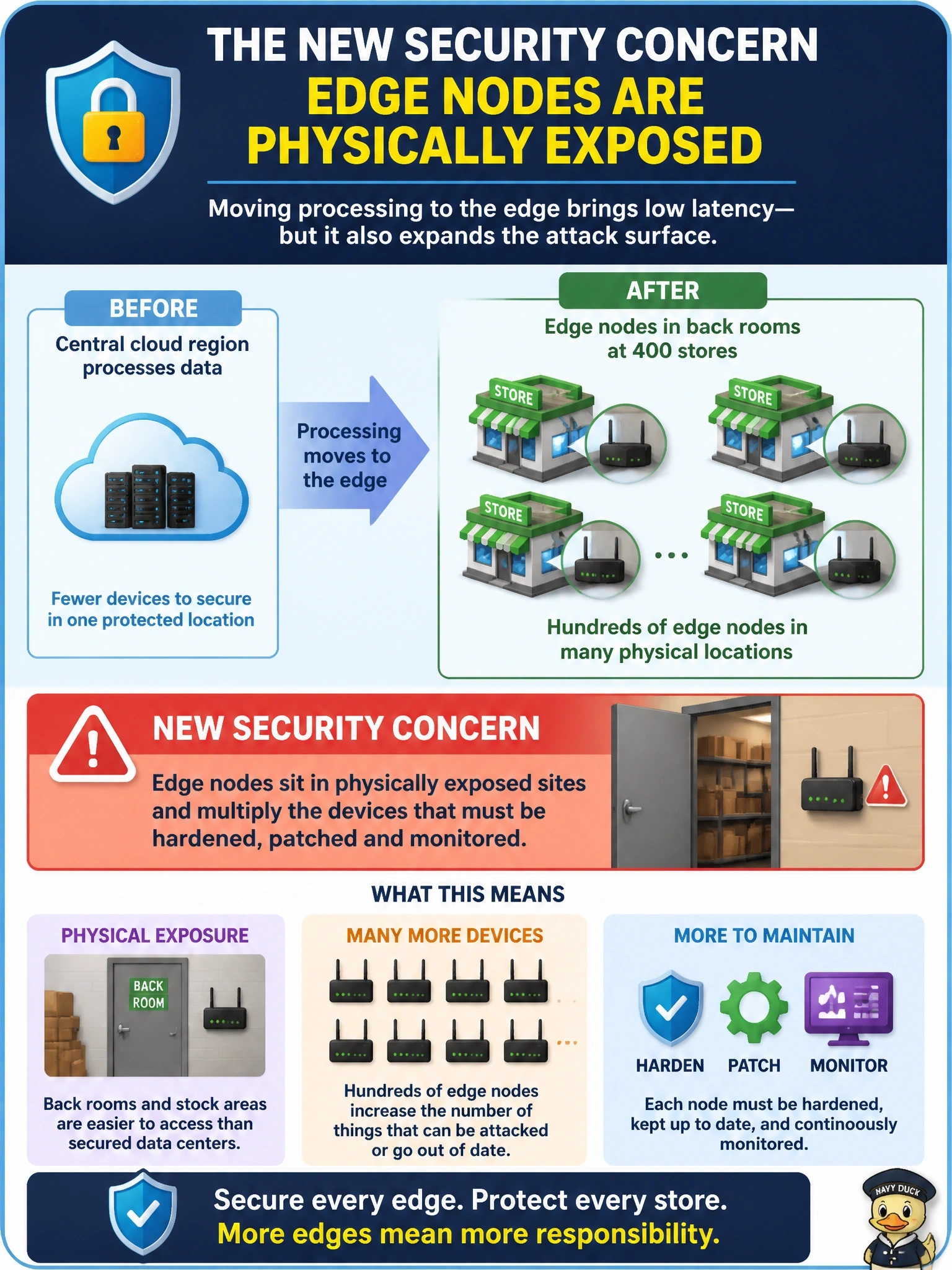
A retailer moves IoT data processing from a central cloud region to small edge nodes installed in back rooms at four hundred stores, so that inventory sensors can be analyzed locally with low latency. Which new security concern does this design most directly introduce?
Select an answer to reveal the explanation.
Short Explanation
Instead of one guarded vault, you now have four hundred little lockboxes sitting in back rooms. That's edge computing: more devices, weaker physical protection, more to patch. The trap is thinking local processing makes encryption or your own security duties go away.
Full Explanation
Edge computing places compute and storage close to where data is produced to reduce latency and bandwidth use. The security consequence is a large, distributed footprint in places with weak physical protection: back rooms are reachable by staff, contractors and sometimes the public, so devices can be tampered with, stolen or connected to rogue equipment. Every node also needs secure boot, hardening, patching, credential management and monitoring at scale, which is harder than managing a few central hosts. Dropping encryption because data stays local is wrong; edge nodes still communicate with the cloud and with sensors over networks that can be intercepted, and stolen devices expose data at rest. Saying edge concentrates processing in one region reverses the design, which distributes processing away from the central region. Shifting all node security to the platform vendor misreads shared responsibility; the retailer controls the physical sites, local networks and much of the configuration. Exam caveat: the outline lists edge computing among related technologies whose security impact you must understand, along with IoT and containers. Operational check: confirm every edge node has a hardware identity, encrypted storage, automated patch delivery, tamper alerts and central logging, and that a lost node can be revoked remotely.