
An engineering team must control exactly when operating system patches are applied, load custom kernel modules for a specialized network driver, and choose the guest OS hardening baseline. Which cloud service category meets these requirements?
Select an answer to reveal the explanation.
Short Explanation
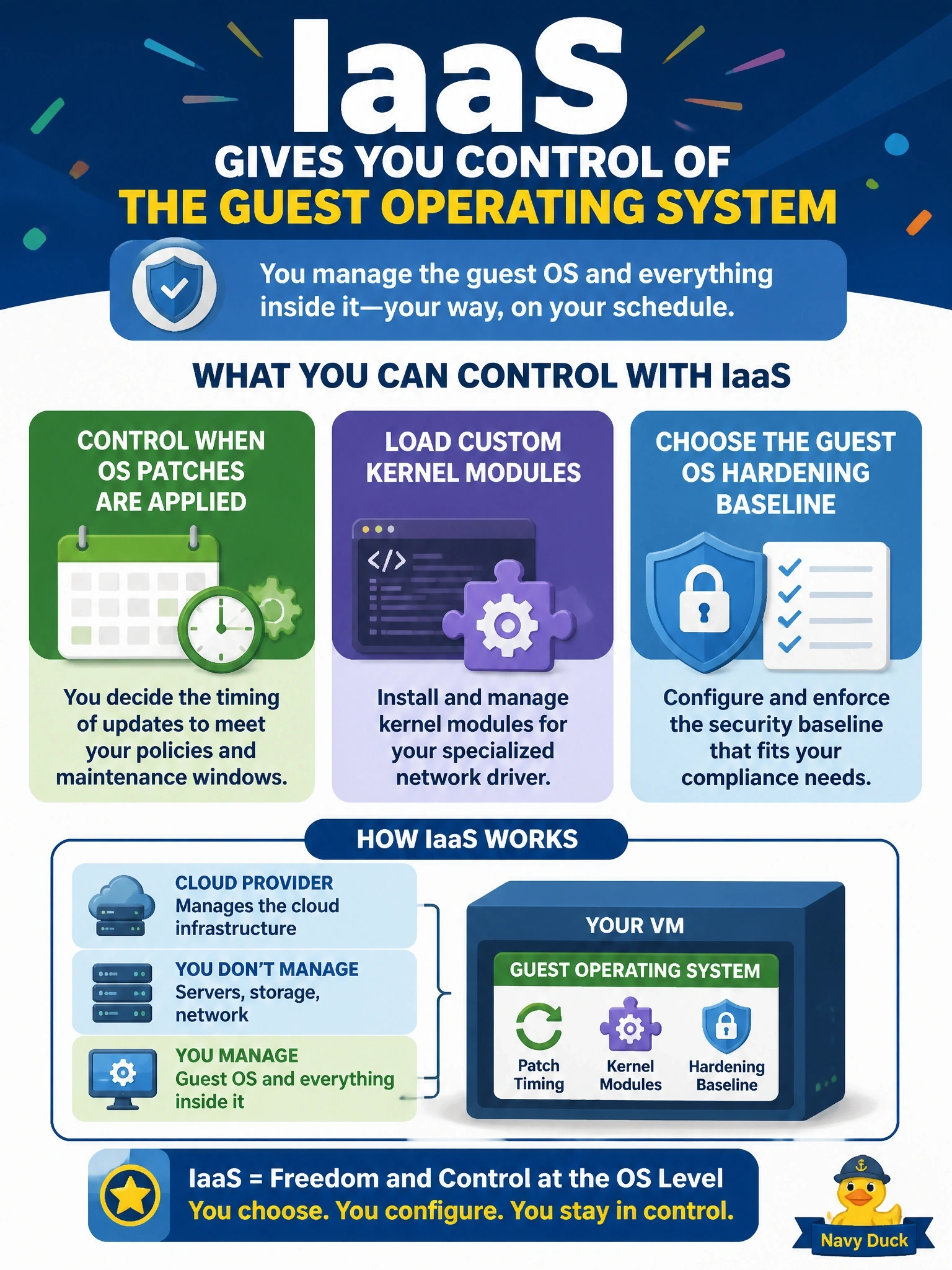
If you need to pick the engine oil and tune the motor yourself, you lease the car, not a taxi ride. IaaS hands you the operating system, kernel and all. The trap is PaaS or serverless, where the provider holds the keys to the OS and you can't load your own kernel modules.
Full Explanation
In Infrastructure as a Service the provider supplies processing, storage and networking, and the customer deploys and controls the operating system and everything above it. That control is exactly what the team needs: choosing patch timing, loading custom kernel modules and applying its own hardening baseline. The trade-off is responsibility, because the customer must now patch, harden and monitor the guest OS itself. Platform as a Service abstracts the operating system; the provider manages and patches the runtime and OS, so the customer cannot schedule OS patches or install kernel modules. Software as a Service delivers a finished application whose underlying platform is wholly the provider's, leaving configuration of the application and its data as the customer's only levers. Function as a Service, a serverless model, runs code in short-lived sandboxes the provider manages, with even less operating system control than PaaS. Exam caveat: control and responsibility move together, so a requirement for OS-level control always implies the customer also takes on OS-level security duties. Operational check: confirm the team has a documented patch process, a hardened image baseline and vulnerability scanning for the guest operating systems before the workload goes live.