
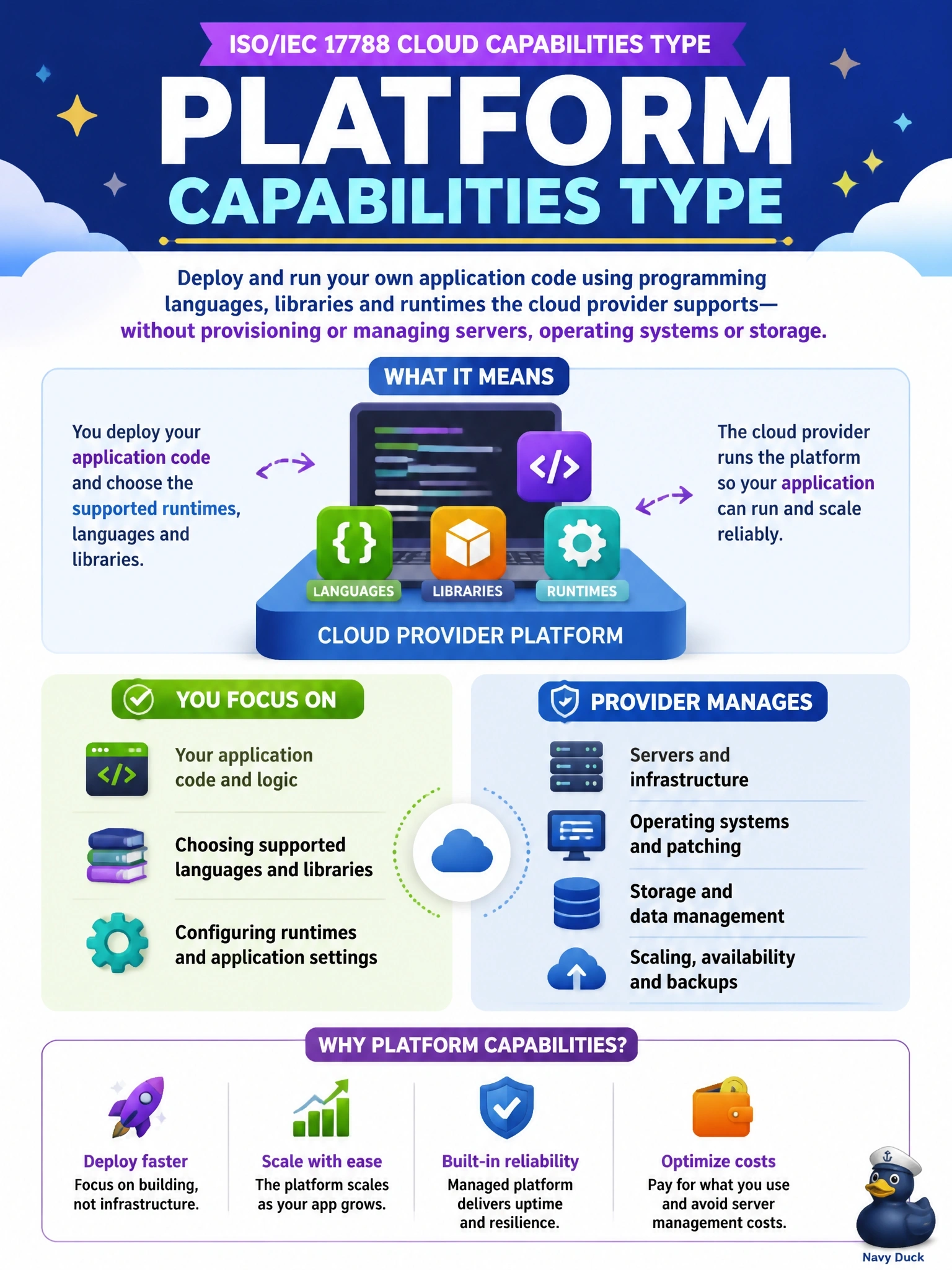
A development team wants to deploy and run its own application code using programming languages, libraries and runtimes that the cloud provider supports, without provisioning or managing servers, operating systems or storage. Which ISO/IEC 17788 cloud capabilities type does this describe?
Select an answer to reveal the explanation.
Short Explanation
Think of a fully equipped kitchen you rent by the hour: you bring the recipe, the kitchen supplies the ovens. That's the platform capabilities type, your code on their runtimes. The trap is the application type, where you'd be eating someone else's finished dish.
Full Explanation
ISO/IEC 17788 defines three cloud capabilities types. In the platform capabilities type, the cloud service customer can deploy, manage and run customer-created or customer-acquired applications using one or more programming languages and execution environments supported by the provider. The customer does not manage the underlying servers, operating systems or storage, which matches a team that brings code and relies on provider runtimes. The application capabilities type means the customer uses the provider's applications; the customer configures and consumes software but does not deploy its own code into a runtime. The infrastructure capabilities type means the customer can provision and use processing, storage or networking resources, typically including control of operating systems; the team explicitly does not want to manage those. A network capabilities type is not one of the three capability types; networking appears in ISO/IEC 17788 as a service category, a separate classification. Exam caveat: capability types describe what the customer can do, while service categories such as PaaS, SaaS and IaaS are named offerings, and the outline lists both. Operational check: for platform workloads, confirm which runtime versions the provider supports and patches, and which libraries packaged with the code remain the customer's to update.