
An employee disputes disciplinary action for misusing company systems, claiming never to have been told the rules. HR cannot show that the employee ever accepted the acceptable use policy. What would have BEST prevented this situation?
Select an answer to reveal the explanation.
Short Explanation
A sign at the pool saying no diving is fine, but a signed waiver proves you saw it. When it comes to discipline, you need evidence the person agreed to the rules. The trap is publishing the policy and assuming everyone read it.
Full Explanation
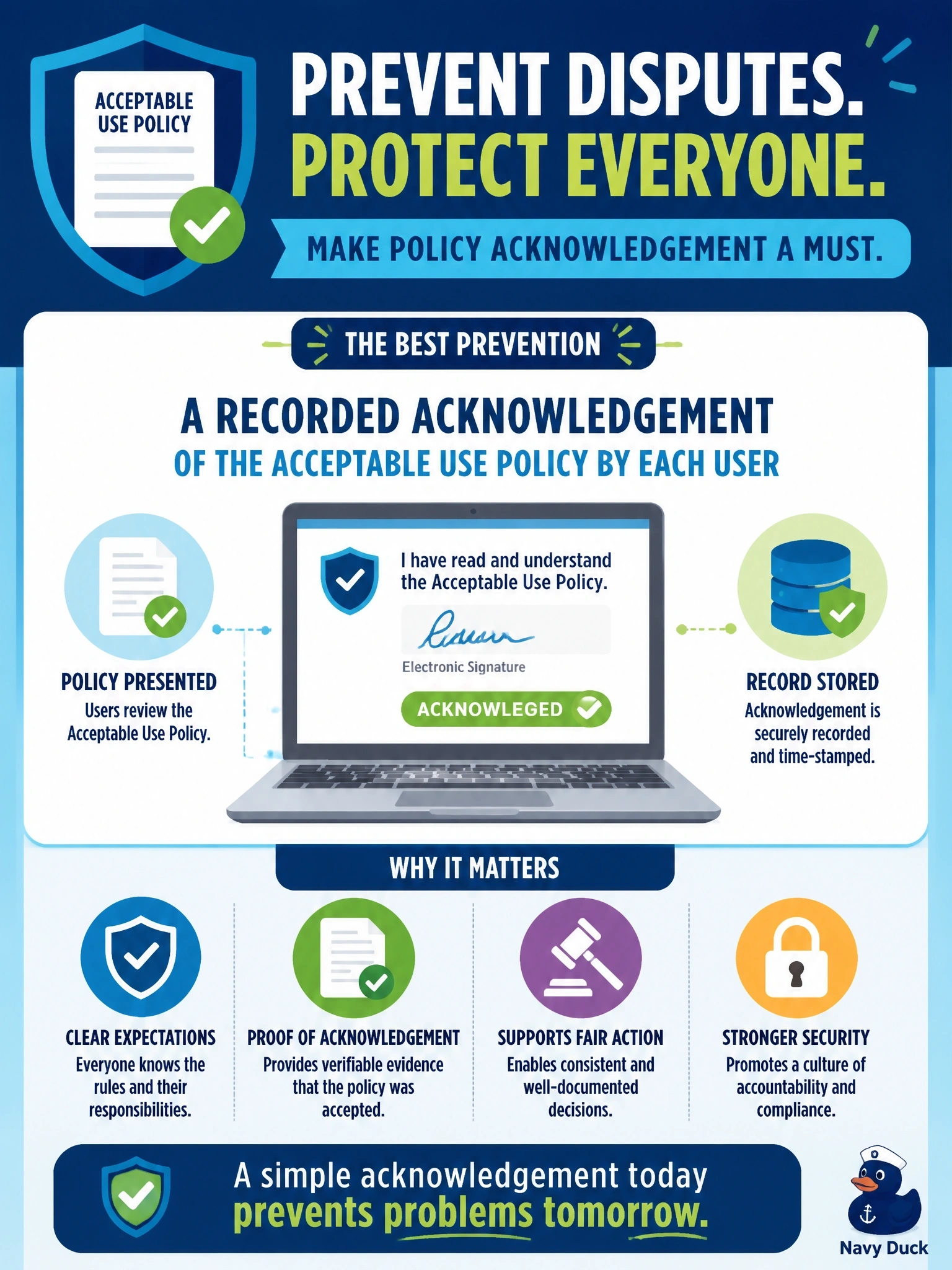
Accountability for following a policy depends on being able to show that the individual knew the rules and agreed to them. A recorded acknowledgement, signed on paper or captured electronically at onboarding and periodically thereafter, provides that evidence and gives HR a sound basis for enforcement, while also reinforcing the importance of the policy to each user. Publishing the policy on the intranet makes it available but provides no proof that any particular employee saw, read or accepted it, which is exactly the gap the employee is exploiting. Continuous monitoring of user activity may detect misuse and provide evidence of what happened, but it does not establish that the user was informed of the rules, so the dispute about awareness would remain; it may also raise privacy and legal considerations. Including a policy summary in the annual report addresses shareholders, not employees, and has no bearing on individual accountability. Exam caveat: legal and labor requirements vary by jurisdiction, so the acknowledgement process should be designed with HR and legal input and kept up to date when the policy changes. Operational check: confirm that acknowledgement is a mandatory step before access is activated, that records are retained and retrievable for each user, and that re-acknowledgement occurs when the policy is materially revised.