
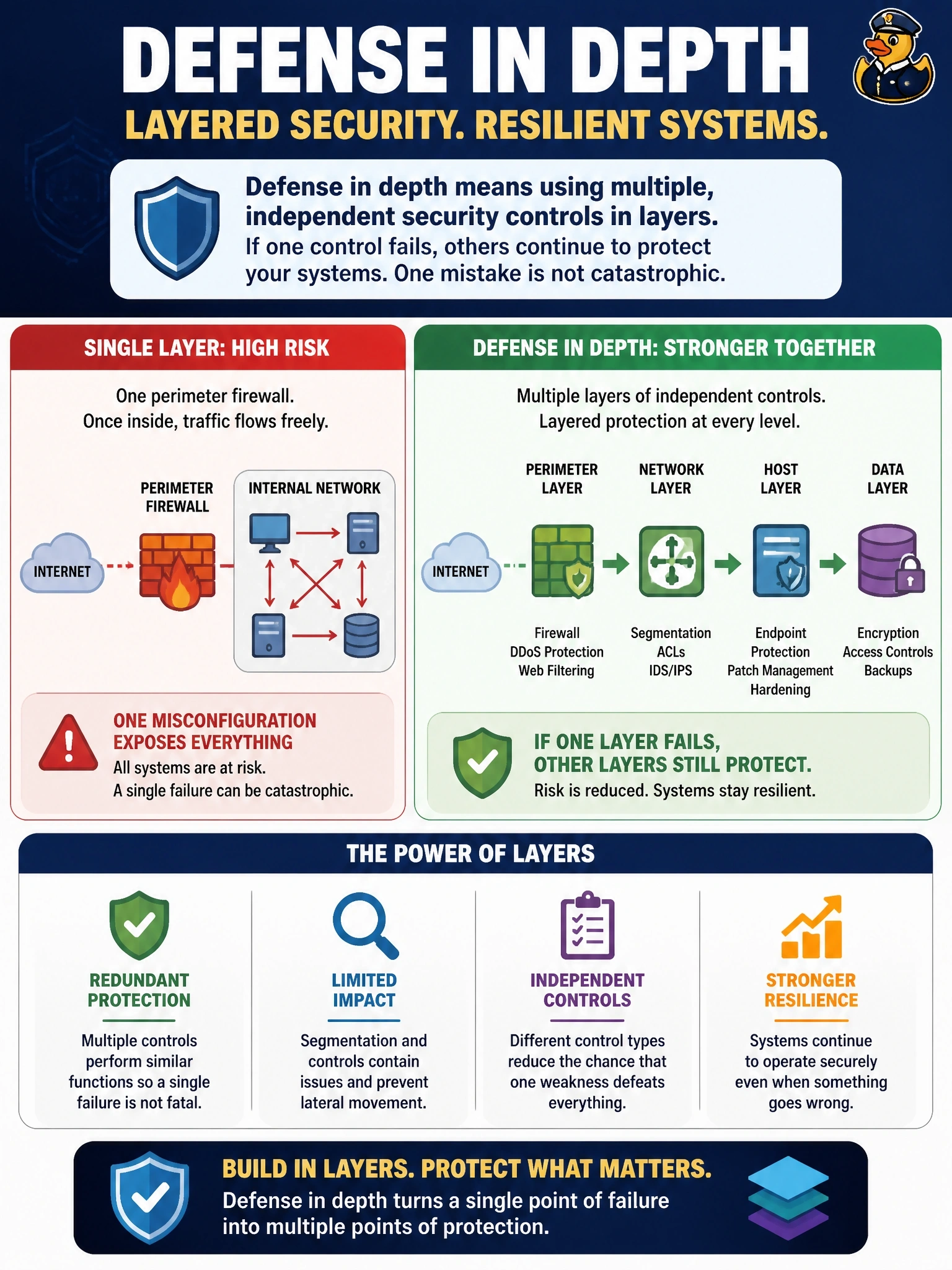
A company relies on a single perimeter firewall to protect all internal systems, and once traffic is inside, it flows freely between them. An assessment notes that one misconfiguration would expose every system. Which architectural principle BEST addresses this weakness?
Select an answer to reveal the explanation.
Short Explanation
A castle with one wall and nothing behind it falls the moment that wall is breached. You want a moat, inner walls and a keep. The trap is picking something that sounds like protection but still leaves one control standing between an attacker and everything.
Full Explanation
Defense in depth arranges multiple, independent layers of control, such as segmentation, host hardening, access control, monitoring and data protection, so that the failure or bypass of any one layer does not expose the whole environment. The assessment describes the opposite: a single control whose misconfiguration would leave every internal system reachable. Adding layers behind the perimeter directly removes that dependence. Security through obscurity relies on attackers not knowing details; hiding addresses may slow reconnaissance but provides no protection once the perimeter is misconfigured or bypassed, and it is not a substitute for real controls. A fail-open design deliberately allows traffic when a control fails, which increases exposure rather than reducing it; it is a resilience trade-off chosen for availability, not a security principle. Single sign-on simplifies authentication and can centralize identity, but authenticating once at the edge does nothing to restrict lateral movement among internal systems and can strengthen the all-or-nothing pattern. Exam caveat: at CISM level the answer is the principle and the management intent, not a specific product or configuration. Operational check: for each critical system, list the controls an attacker would need to defeat after passing the perimeter, and flag any system where that list is empty.