
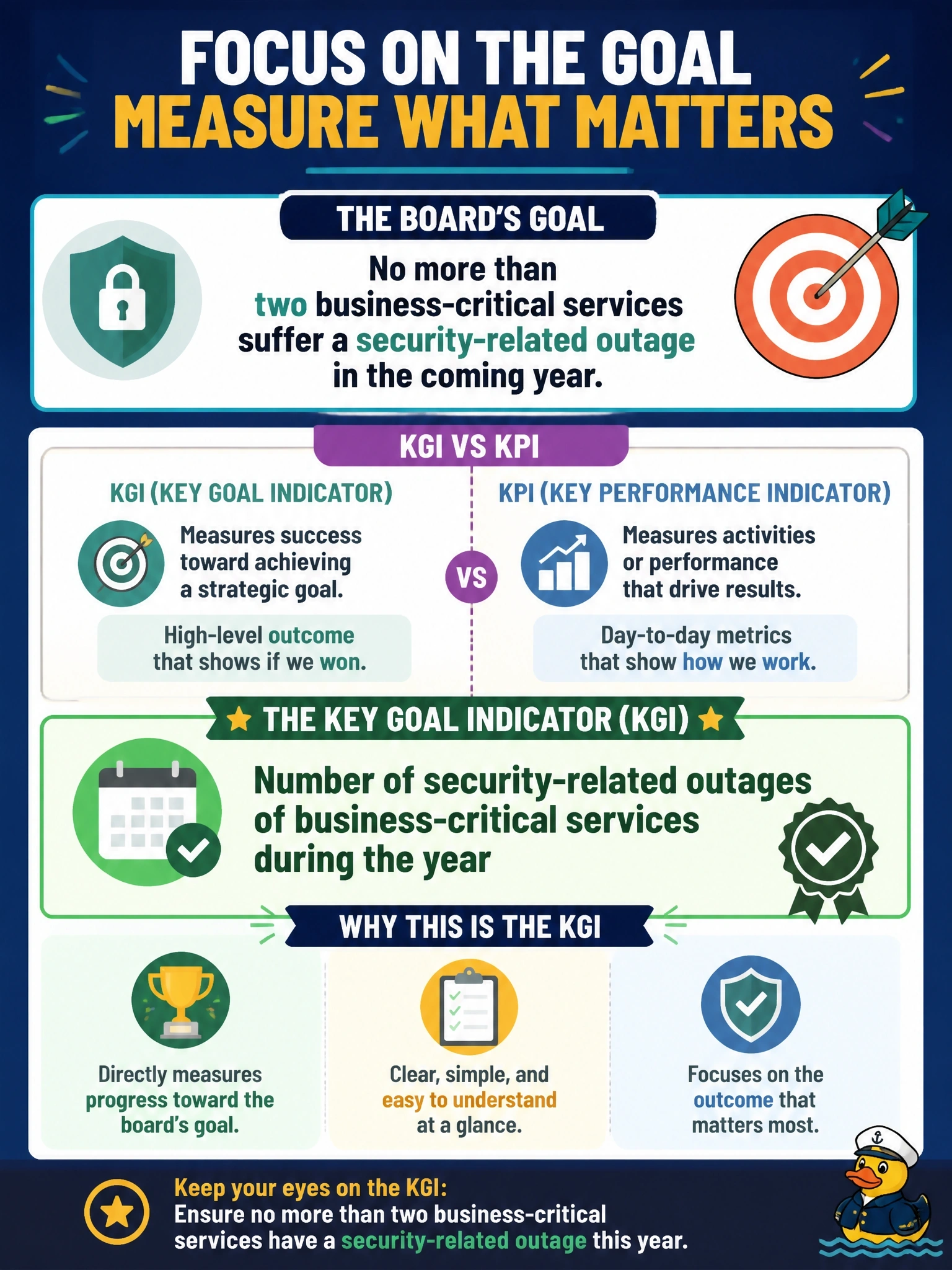
The board has set a goal that no more than two business-critical services suffer a security-related outage in the coming year. Which indicator is a key goal indicator (KGI) for this objective rather than a key performance indicator (KPI)?
Select an answer to reveal the explanation.
Short Explanation
Think of a road trip: the KGI asks, did you arrive? The KPIs ask how fast you're driving and whether you stopped for fuel. The trap is grabbing a process measure that sounds important; only one option actually tells the board whether its goal was met.
Full Explanation
A key goal indicator measures whether an objective has been achieved, after the fact, in the terms the objective was set. The board's goal is expressed as a count of security-related outages of business-critical services, so the count of such outages during the year is the indicator that shows whether the goal was met. Key performance indicators, by contrast, measure how well the processes that contribute to the goal are performing, and they are often leading signals that management can act on during the year. Patch timeliness for critical servers is a process measure; it influences the likelihood of outages but does not state whether the goal was achieved. Alert triage time measures the efficiency of a monitoring process and is equally a contributor rather than an outcome. The share of changes with a security review measures compliance with a change process and is likewise a performance measure. Exam caveat: some frameworks treat the same figure as a KGI at one level and a KPI at another, so read the stated objective and ask whether the indicator measures that objective directly. Operational check: for each board objective, record one outcome indicator phrased in the objective's own terms, then link the supporting process indicators to it so trends in performance can explain movement in the goal.