
A library offers public AI search. Which monitoring signal best indicates scraping abuse?
Select an answer to reveal the explanation.
Short Explanation
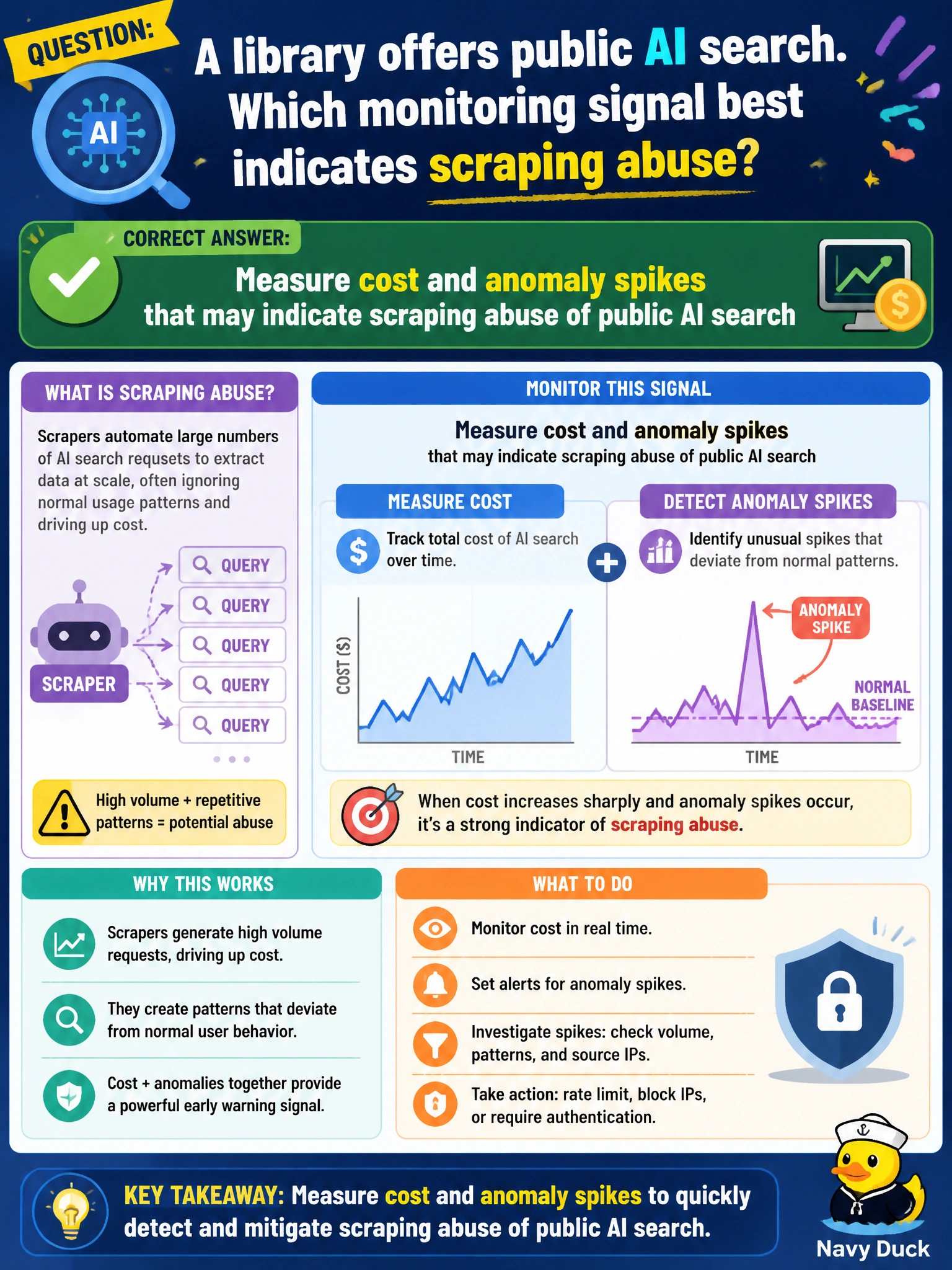
A sudden cost spike on your public AI search might be scrapers, not book lovers. You’ve got to measure those anomalies—that’s the security signal you need.
Full Explanation
Measuring cost and anomaly spikes that may indicate scraping abuse of public AI search is the monitoring signal that fits a library's public AI endpoint: scrapers and automated harvesters often announce themselves as sudden token spend, request-rate anomalies, or odd query patterns rather than polite patron traffic. The correct practice works because cost and anomaly telemetry convert economic and behavioral side effects of abuse into actionable security signals for throttling, blocking, or investigation. Measuring satisfaction rating trends that may indicate scraping abuse of public AI search fails to detect scraping abuse because satisfaction scores measure perceived answer quality rather than the automated request patterns, sudden token spend, or cost anomalies that reveal harvesters. Measuring query latency percentiles that may indicate scraping abuse of public AI search fails to indicate scraping abuse because latency measures responsiveness, not the economic and behavioral side effects such as runaway spend and odd query patterns that automated harvesting produces. Measuring peak-hour latency averages that may indicate scraping abuse of public AI search fails as an abuse signal because average response time does not expose the cost spikes or request-rate anomalies that scrapers and automated harvesters typically generate. Exam caveat: legitimate events (homework season, local news) can raise traffic, so correlate cost spikes with rate, geography, user-agent, and query-diversity features before declaring scraping. Operational check: export cost and request anomaly metrics to monitoring, baseline normal library AI search spend, alert on sustained spikes, pair alerts with rate-limit and WAF responses, and review weekly for false-positive tuning.
Prefer to study offline? Printable PDF study book + test engine ($7.50, unofficial). These questions stay free here.