
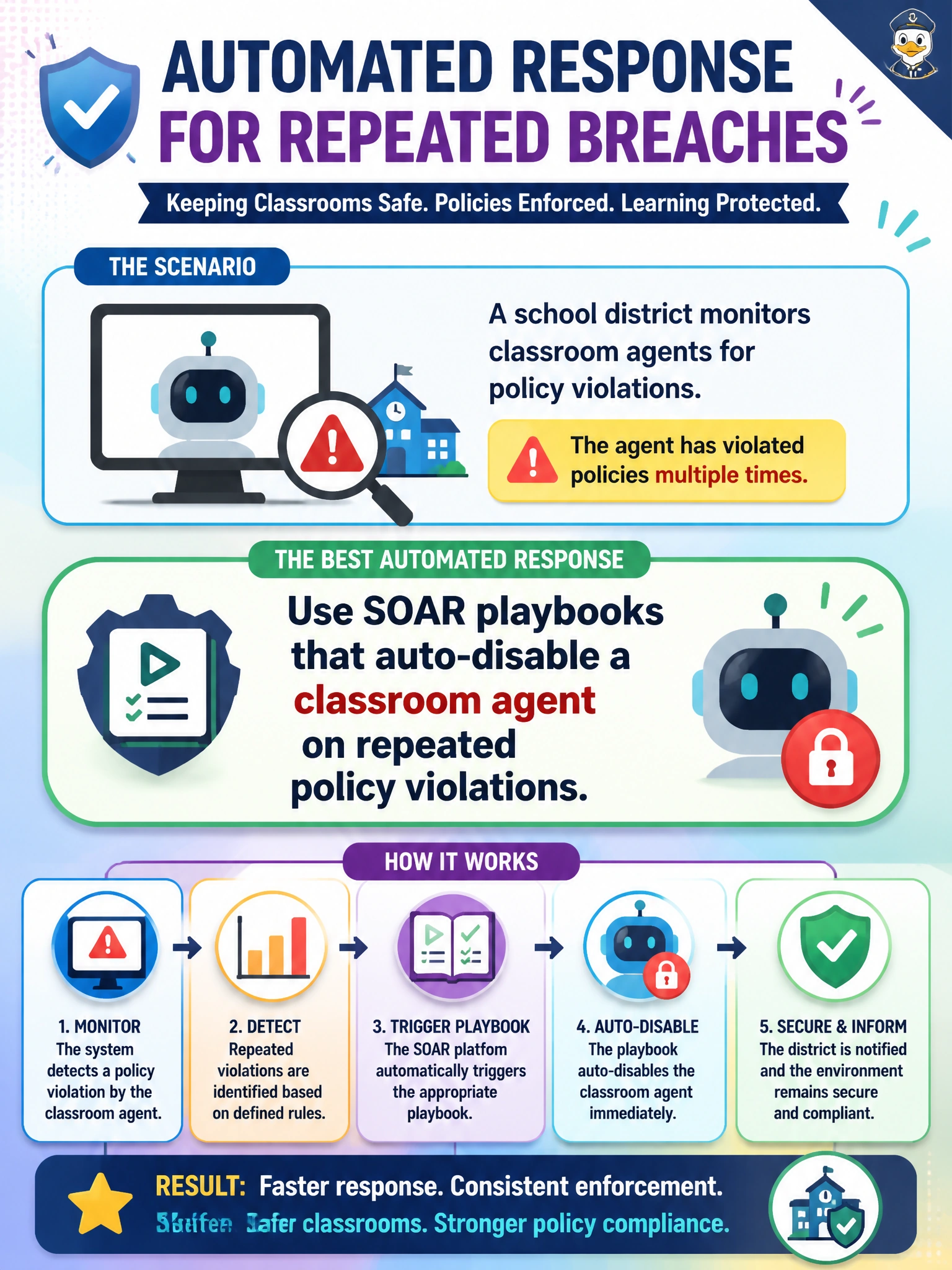
A school district monitors classroom agents for policy violations. Which automated response best fits repeated breaches?
Select an answer to reveal the explanation.
Short Explanation
Repeat policy hits on a classroom agent should pull the plug—not wait for a semester committee. SOAR playbooks that auto-disable close that loop.
Full Explanation
Using SOAR playbooks that auto-disable a classroom agent on repeated policy violations is the automated response that fits school-district monitoring: repeat breaches show the agent is not safely controllable under current prompts, tools, or permissions. The correct control works by closing the loop from detection to containment—disable stops further student exposure while humans investigate root cause, rather than accumulating violations until a slow governance meeting. Leaving violating agents running until a semester review board meets fails conceptually by accepting ongoing policy breach for calendar convenience in an environment that includes minors. Emailing a courtesy note and keeping the agent fully enabled fails as notification without containment. Raising only a low-priority ticket with no disable action fails by creating paperwork that does not reduce risk in real time. Exam caveat: auto-disable should be reserved for repeated or high-severity violations with clear playbook criteria so one-off false positives do not thrash classroom tools; include a documented re-enable path after remediation. Operational check: define violation thresholds that trigger SOAR disable, notify teachers and IT, quarantine the agent configuration, require remediation evidence before re-enable, and tabletop the playbook before the school year.
Prefer to study offline? Printable PDF study book + test engine ($7.50, unofficial). These questions stay free here.