
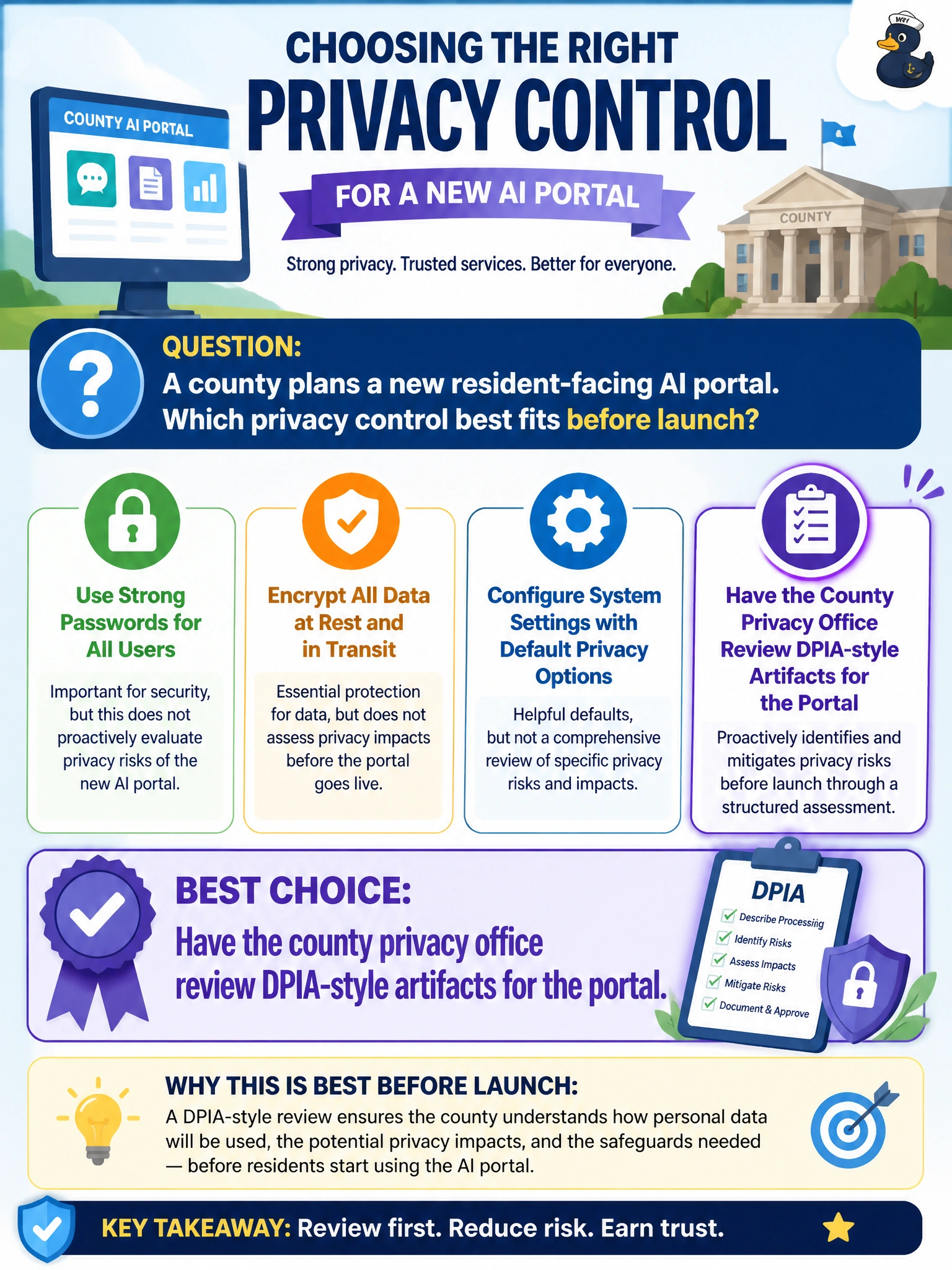
A county plans a new resident-facing AI portal. Which privacy control best fits before launch?
Select an answer to reveal the explanation.
Short Explanation
New resident-facing AI deserves a privacy paperwork check before the ribbon cutting. A DPIA-style review by the county privacy office is the grown-up control.
Full Explanation
Having the county privacy office review DPIA-style artifacts for a new resident-facing AI portal is the pre-launch privacy control that fits municipal AI: structured impact assessment examines data categories, lawful basis, retention, sharing, resident rights, and residual risks before the system goes public. The correct practice works because privacy review is preventive governance—findings can force minimization, vendor contract clauses, or architecture changes while change is still cheap. Requesting a SOC 2 Type II report for the portal cloud hosting provider fails as the pre-launch privacy control because it attests to the hosting provider's general controls rather than reviewing the portal's specific resident-data processing, and it cannot substitute for the county privacy office's DPIA-style review before go-live. Providing targeted privacy training to county support staff for the portal fails as the pre-launch privacy control because it readies staff to support residents but does not examine the portal's data categories, lawful basis, or resident rights before launch. Configuring automated resident request fulfillment workflow for the portal fails as the pre-launch privacy control because it automates handling of resident rights requests after launch but does not identify or mitigate privacy risks before the portal goes live. Exam caveat: a DPIA-style review is necessary but not sufficient—security testing, accessibility, and records-retention alignment still matter, and some jurisdictions prescribe specific assessment formats. Operational check: require a completed DPIA-style packet covering data map, risks, mitigations, and residual risk acceptance, signed by the privacy office as a launch gate; store it with the portal's change record; and reopen the assessment when purposes, vendors, or data categories expand.
Prefer to study offline? Printable PDF study book + test engine ($7.50, unofficial). These questions stay free here.