
Fire/EMS uses AI for protocol suggestions. Which oversight control best fits low-confidence outputs?
Select an answer to reveal the explanation.
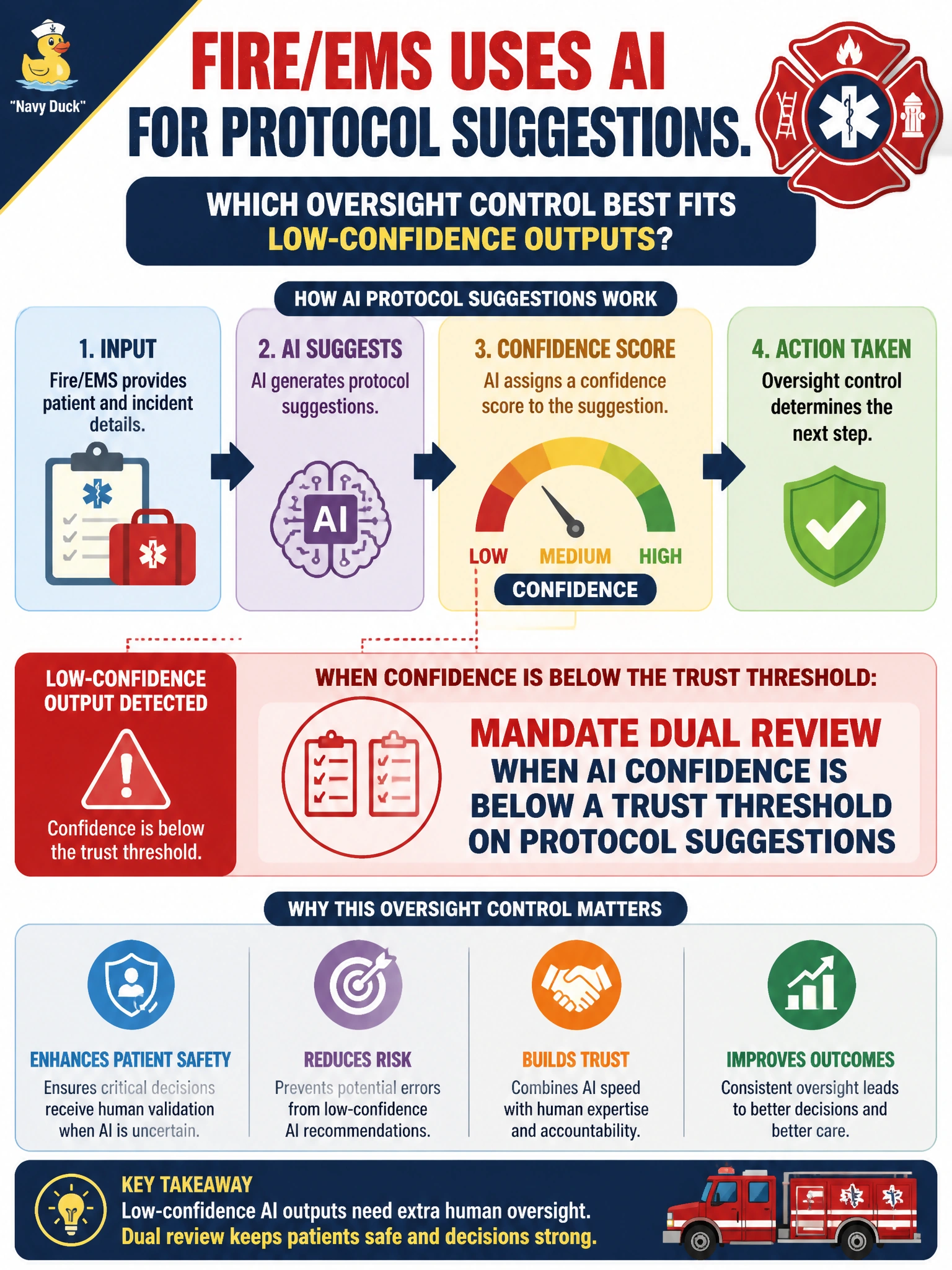
Short Explanation
When the AI’s confidence dips below the trust line, two humans should still look. Dual review on low-confidence protocol suggestions is how Fire/EMS keeps safety in the loop.
Full Explanation
Mandating dual review when AI confidence is below a trust threshold on Fire/EMS protocol suggestions implements confidence-based human oversight for safety-critical recommendations. The correct control works because low model confidence is an explicit uncertainty signal; requiring two qualified reviewers before acting on such suggestions reduces single-point human error and blocks automatic acceptance of weak outputs in time-sensitive clinical or operational contexts. Requiring solo sign-off when AI confidence is below a trust threshold on protocol suggestions fails because it leaves the uncertain output to a single reviewer's judgment exactly when risk is highest, preserving single-point error instead of adding the needed second reviewer. Paging the medical director when AI confidence is below a trust threshold on protocol suggestions fails because it escalates every low-confidence suggestion to a single scarce leader, creating delay and a bottleneck in time-sensitive care rather than enabling immediate dual review by available qualified clinicians. Requiring device confirmation when AI confidence is below a trust threshold on protocol suggestions fails because an automated device check adds no independent human clinical judgment to evaluate the weak suggestion. Exam caveat: dual-review thresholds must be calibrated; an overly high bar can create alert fatigue, while an overly low bar leaves dangerous low-confidence suggestions under-reviewed. Operational check: define the confidence trust threshold with clinical leadership, enforce dual-signoff workflow in the protocol tool when below threshold, log overrides, and periodically audit whether low-confidence suggestions were acted on without the mandated second review.
Prefer to study offline? Printable PDF study book + test engine ($7.50, unofficial). These questions stay free here.