
Elections officials want a ballot-help assistant. Which architecture decision best isolates that high-sensitivity workload?
Select an answer to reveal the explanation.
Short Explanation
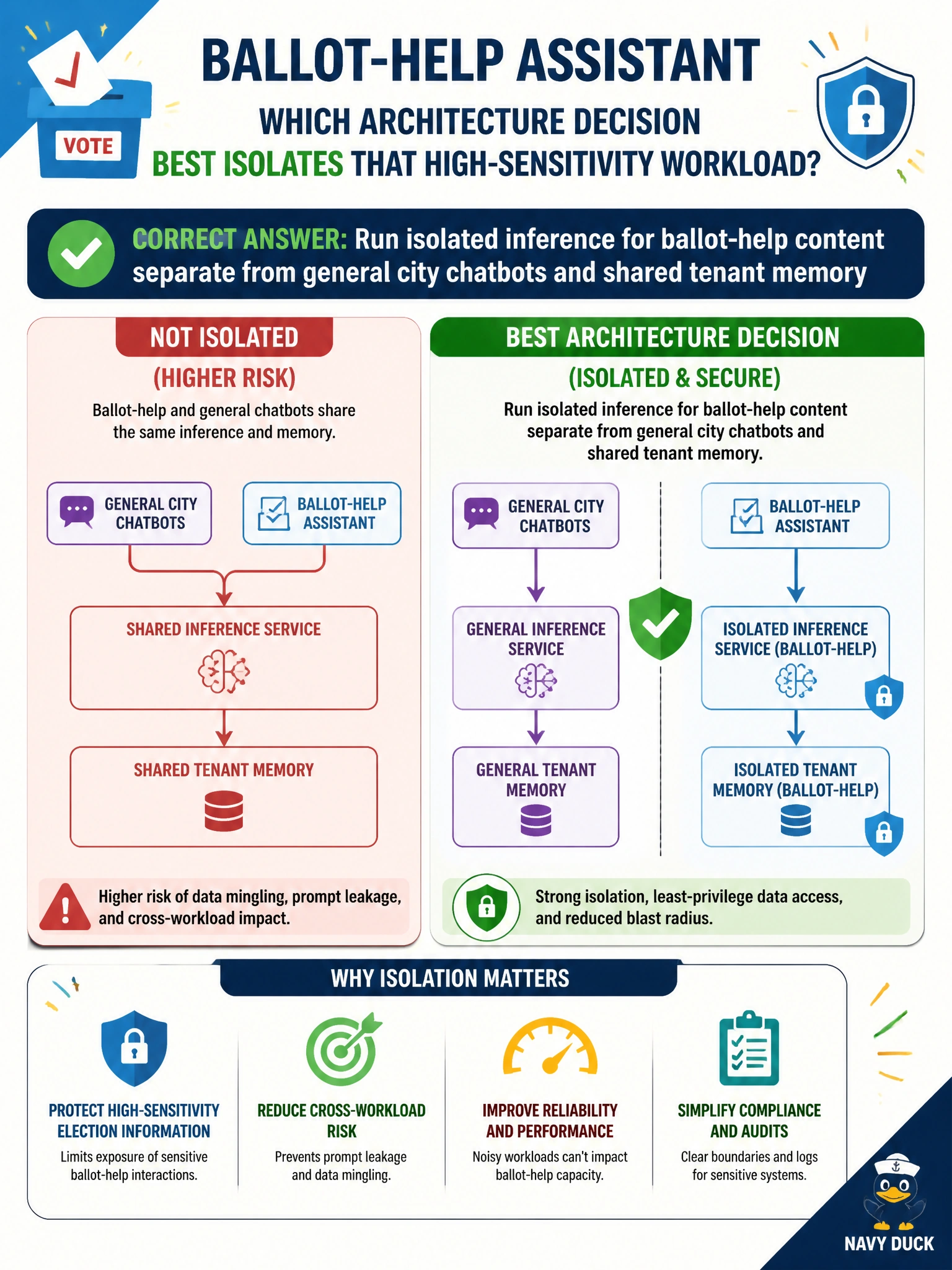
Keep election help in its own lane — you'll still risk bleed if you've only got dedicated guardrails separate from general city chatbot dialogue handling, and dedicated curated retrieval separate from general city knowledge sources won't isolate inference. A dedicated skill interface separate from general city chatbot session orchestration and routing still isn't isolation. Isolation is how you shrink the blast radius around ballot content.
Full Explanation
Ballot-help assistants are high-sensitivity civic workloads: content accuracy, integrity, and isolation from unrelated city chatter matter for public trust in elections. Running isolated inference for ballot-help content separate from general city chatbots and shared tenant memory best isolates that workload, shrinking cross-contamination, prompt-memory bleed, and change-control coupling with parks or tourism bots. Isolation is an architecture decision that reduces blast radius around election-related assistance. Deploying dedicated prompt guardrails for ballot-help content separate from general city chatbot dialogue handling fails because guardrails only separate dialogue-handling rules and do not isolate inference or tenant memory; the workload can still share inference and memory space with parks and tourism traffic, leaving cross-talk and uneven change risk across unrelated domains. Routing ballot-help queries through dedicated curated election retrieval separate from general city knowledge sources fails because curated retrieval only isolates the knowledge source and does not isolate inference or separate shared tenant memory, allowing prompt-memory bleed and cross-contamination from unrelated municipal traffic. Offering a dedicated ballot-help skill interface separate from general city chatbot session orchestration and routing fails conceptually—a separate interface does not isolate inference or memory, so election content can still bleed into or be influenced by general city chatbot traffic. Exam caveat: High-sensitivity election AI should be architecturally isolated from general municipal assistants and shared memory; co-tenancy is the distractor. Operational check: Deploy ballot-help in a dedicated inference tenant/environment, disable shared memory with other city bots, restrict fine-tunes to change-controlled approvers, and monitor for cross-tenant data paths.
Prefer to study offline? Printable PDF study book + test engine ($7.50, unofficial). These questions stay free here.