
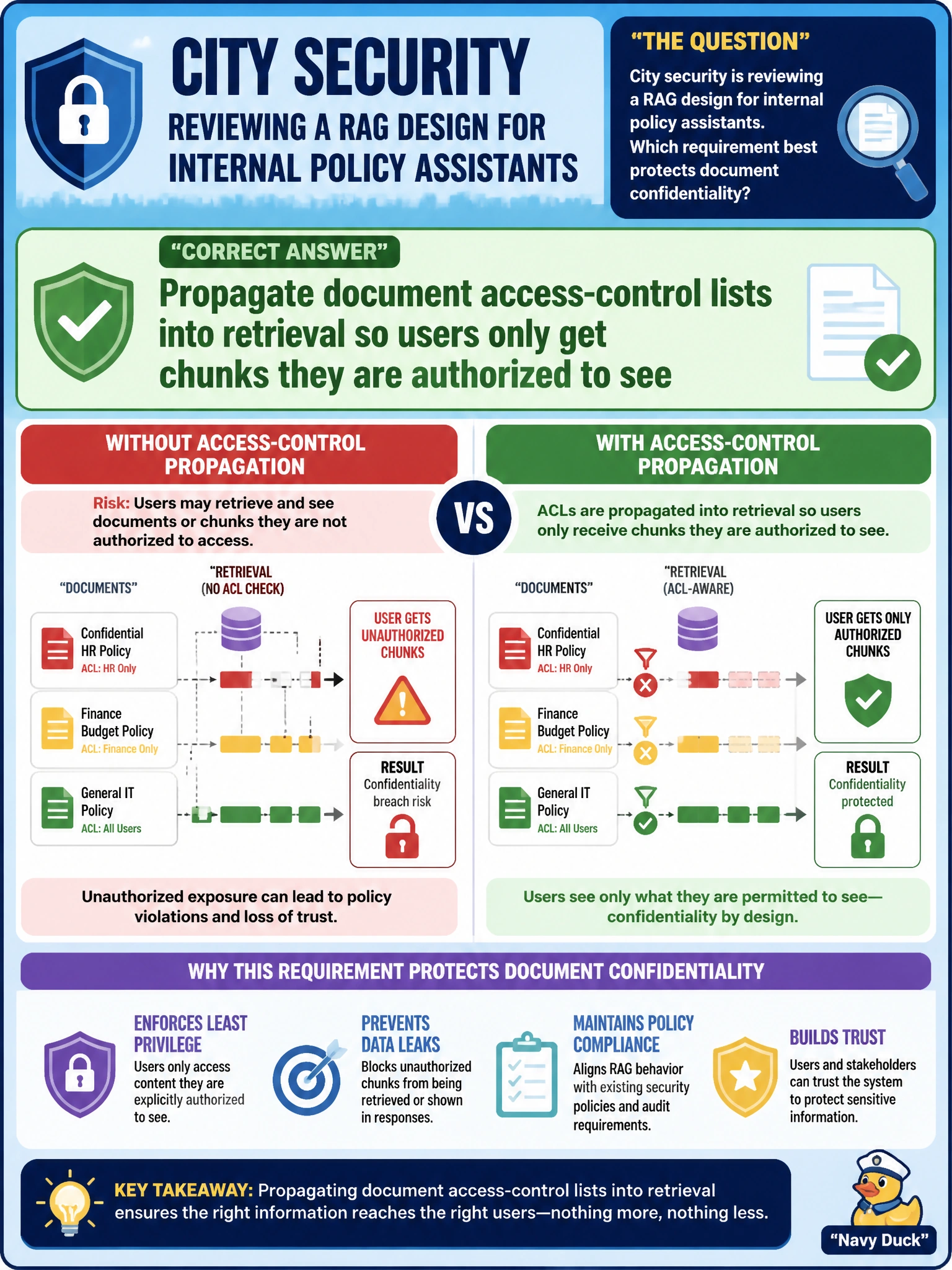
City security is reviewing a RAG design for internal policy assistants. Which requirement best protects document confidentiality?
Select an answer to reveal the explanation.
Short Explanation
Retrieval has to remember who can see which policy—otherwise the smart search becomes a leaky filing cabinet. Stripping ACLs or serving top chunks to anyone breaks the city’s access rules.
Full Explanation
Internal policy assistants built with RAG can leak restricted municipal documents if retrieval ignores who is asking. Propagating document access-control lists into retrieval so users only get chunks they are authorized to see best protects document confidentiality: similarity scores alone must not override clearance. ACL-aware retrieval keeps embeddings and returned passages aligned with existing records controls instead of creating a parallel search path that bypasses them.
Indexing every restricted policy into one open vector store searchable by all staff fails because it flattens authorization into 'anyone on the intranet can retrieve it.' Stripping ACL metadata during ingestion to simplify ranking scores fails by discarding the very attributes needed to enforce least privilege at query time. Returning the highest-scoring chunks regardless of the requester’s clearance fails conceptually—relevance without authorization is a confidentiality breach.
Exam caveat: Secure municipal RAG requires ACL propagation into retrieval, not open indexes or clearance-blind top-k returns.
Operational check: Ingest policies with ACL metadata intact, filter retrieval by requester identity/clearance before ranking final context, test with users who lack access to restricted policies, and forbid a single open vector corpus for all sensitivity levels.
Prefer to study offline? Printable PDF study book + test engine ($7.50, unofficial). These questions stay free here.