
An assessor’s office is deploying vector search over parcel documents. How should crypto architecture be handled?
Select an answer to reveal the explanation.
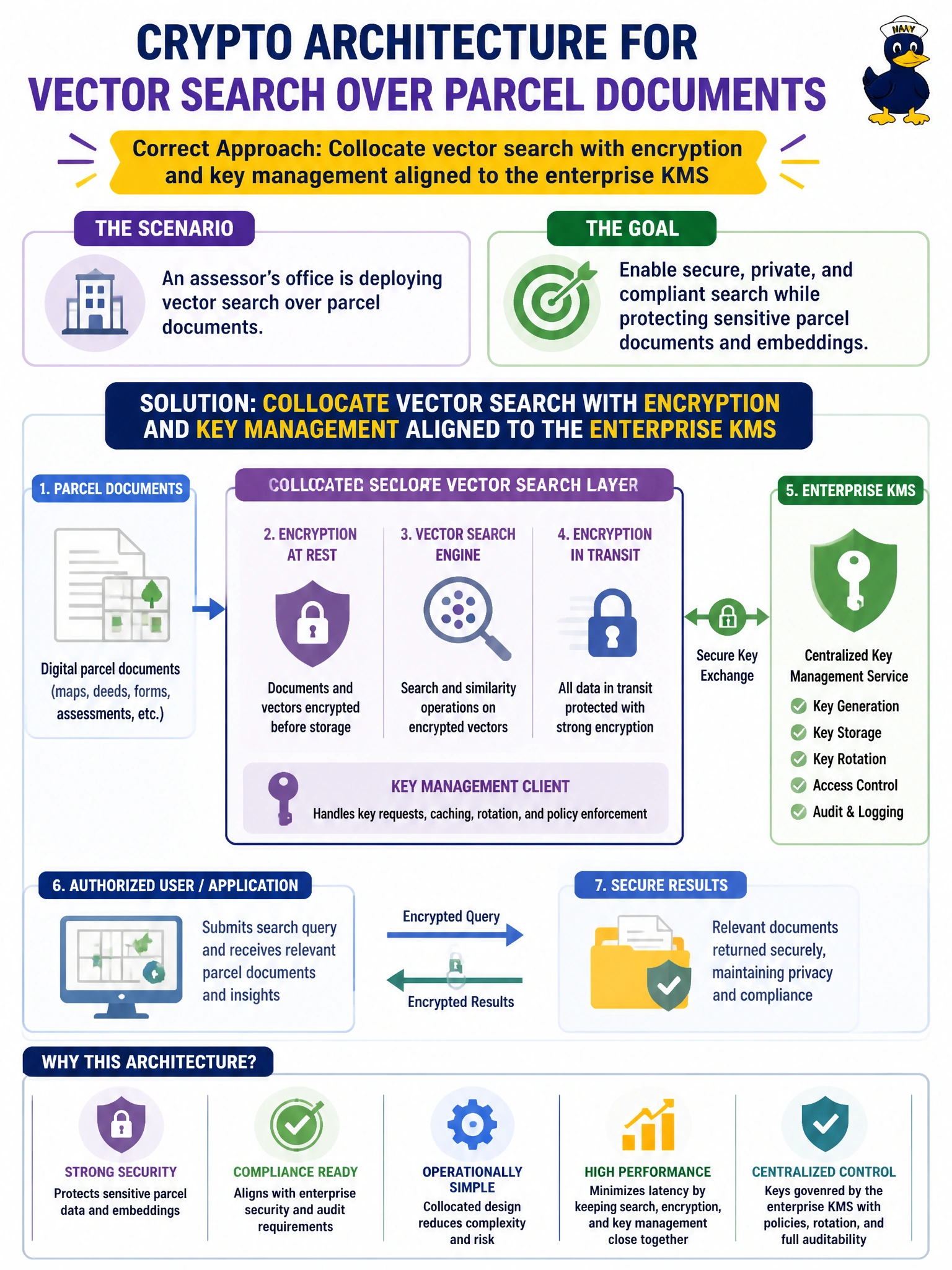
Short Explanation
Treat the vector store like any other sensitive civic database: encrypt it and hang the keys on the real enterprise KMS. Don't settle for an isolated application KMS, rotation left to vendor defaults, or keys tied to database backups — you'll lose enterprise rotation and audit control.
Full Explanation
Assessor parcel documents and their embeddings remain sensitive civic records even after vectorization. Crypto architecture should collocate vector search with encryption and key management aligned to the enterprise KMS so indexes, embeddings, and related secrets follow the same protection, rotation, and audit standards as other municipal data stores. Aligning to enterprise KMS avoids isolated application KMS silos, rotation delegated to index vendor defaults, and key management synchronized to database backup keys that weaken confidentiality of parcel search infrastructure.
Collocating vector search with encryption and key management via isolated application KMS fails because it places key material outside controlled storage and key lifecycle processes. Collocating vector search with encryption and key rotation delegated to index vendor defaults fails because it surrenders rotation intervals and audit visibility to vendor timelines rather than enterprise KMS policies. Collocating vector search with encryption and key management synchronized to database backup keys fails because backup keys follow backup retention and recovery lifecycles, not the live protection, rotation, and access controls required for vector indexes and embeddings.
Exam caveat: Vector stores are data stores; AAISM expects encryption and KMS integration, not isolated application KMS silos, vendor-default rotation, or backup-key synchronization outside enterprise control.
Operational check: Encrypt vector indexes at rest with enterprise KMS-managed keys, restrict key access via roles, bring derived embeddings into key scope, and include the vector platform in the same crypto standards review as other assessor databases.
Prefer to study offline? Printable PDF study book + test engine ($7.50, unofficial). These questions stay free here.