
311 operations relies on an AI SaaS platform. Which monitoring approach best manages ongoing vendor AI control risk?
Select an answer to reveal the explanation.
Short Explanation
You can't catch real-time drift with just SOC 2 reports and quarterly reviews. You'll miss ongoing control changes if you only collect a questionnaire at onboarding and reassess at renewal. You'll only track feature updates if you subscribe to release notes, not control effectiveness.
Full Explanation
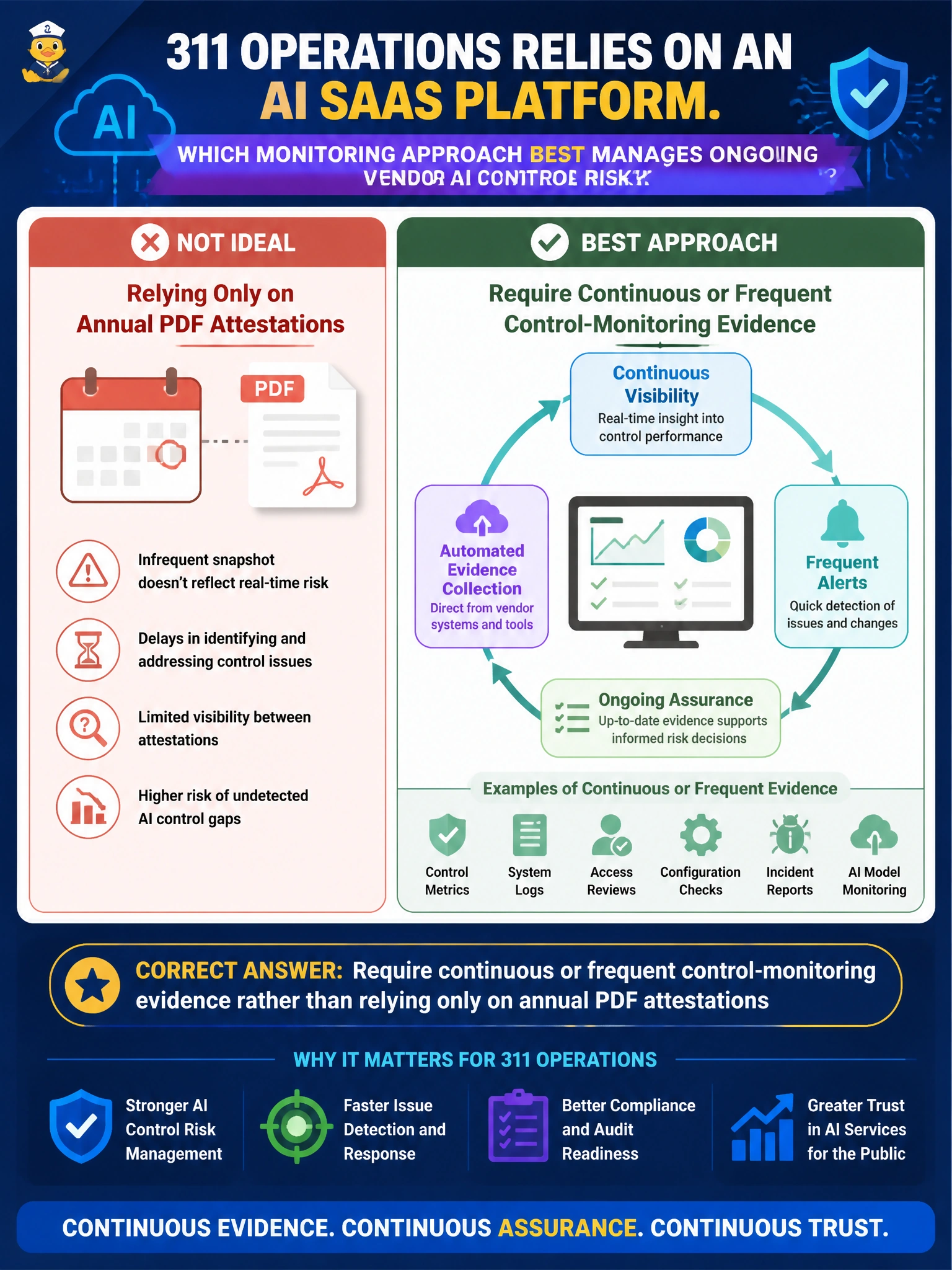
311 operations relying on an AI SaaS platform should require continuous or frequent control-monitoring evidence rather than relying only on annual PDF attestations. That monitoring approach best manages ongoing vendor AI control risk because models, features, subprocessors, and prompts change faster than yearly paper cycles. Fresher evidence—control extracts, config diffs, incident metrics, and periodic attestations—detects drift while 311 AI remains in active civic use.
Relying solely on SOC 2 Type II reports at renewal and quarterly governance reviews fails because periodic paperwork can't catch real-time AI drift and control regressions. Collecting a security questionnaire at onboarding and reassessing only at renewal fails because it misses continuous changes in AI models and subprocessors. Subscribing to model release notes and change logs fails because version updates don't equate to control effectiveness or evidence of ongoing monitoring.
Exam caveat: continuous evidence still needs interpretation; raw telemetry without thresholds and owners becomes noise.
Operational check: define a monitoring cadence and artifact list for the 311 AI vendor, assign an owner to review evidence, escalate control regressions within SLA, and don't treat SOC 2 Type II reports and quarterly governance reviews as a substitute for continuous evidence.
Prefer to study offline? Printable PDF study book + test engine ($7.50, unofficial). These questions stay free here.