
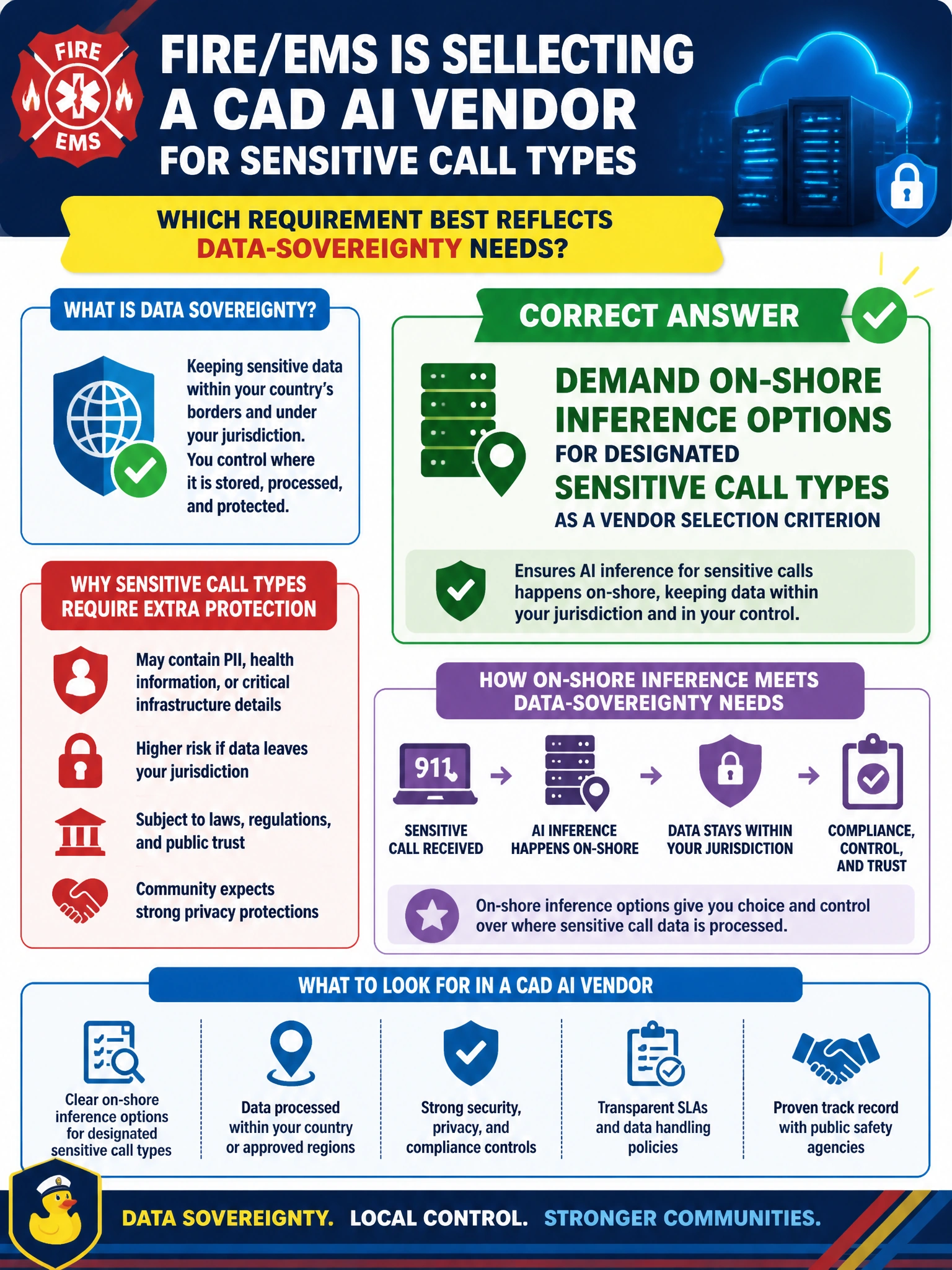
Fire/EMS is selecting a CAD AI vendor for sensitive call types. Which requirement best reflects data-sovereignty needs?
Select an answer to reveal the explanation.
Short Explanation
Some EMS call content shouldn’t roam the globe for inference. Make on-shore processing options a must for those sensitive types. Tight role-based access for those sensitive types won’t keep inference on-shore.
Full Explanation
Fire/EMS selecting a CAD AI vendor for sensitive call types should demand on-shore inference options for designated sensitive call types as a vendor selection criterion. That requirement best reflects data-sovereignty needs because emergency-call content can include location, medical, and identity details that municipal and legal policy may restrict to domestic processing. Making on-shore inference a scored criterion prevents selecting a platform that cannot meet sovereignty constraints for the highest-sensitivity workloads. Requiring encrypted cross-region replication for designated sensitive call types as a vendor selection criterion fails conceptually because it spreads sensitive data across regions rather than constraining where inference for sensitive emergency calls is processed, so it does not enforce data-sovereignty constraints. Specifying low-latency edge inference for designated sensitive call types as a vendor selection criterion fails because it optimizes response speed without constraining where sensitive emergency-call data is stored or processed, leaving residency unmanaged. Mandating role-based access controls for designated sensitive call types as a vendor selection criterion fails because access governance controls who can view data, not whether inference for designated sensitive call types stays on-shore. Exam caveat: “on-shore” must be defined (country/region, including backups, logs, and support access), or vendors will claim compliance while telemetry still leaves the boundary. Operational check: list sensitive call types requiring on-shore inference, require the vendor to demonstrate enforceable routing/residency controls for those types, and verify support and log locations in the same review before award.
Prefer to study offline? Printable PDF study book + test engine ($7.50, unofficial). These questions stay free here.