
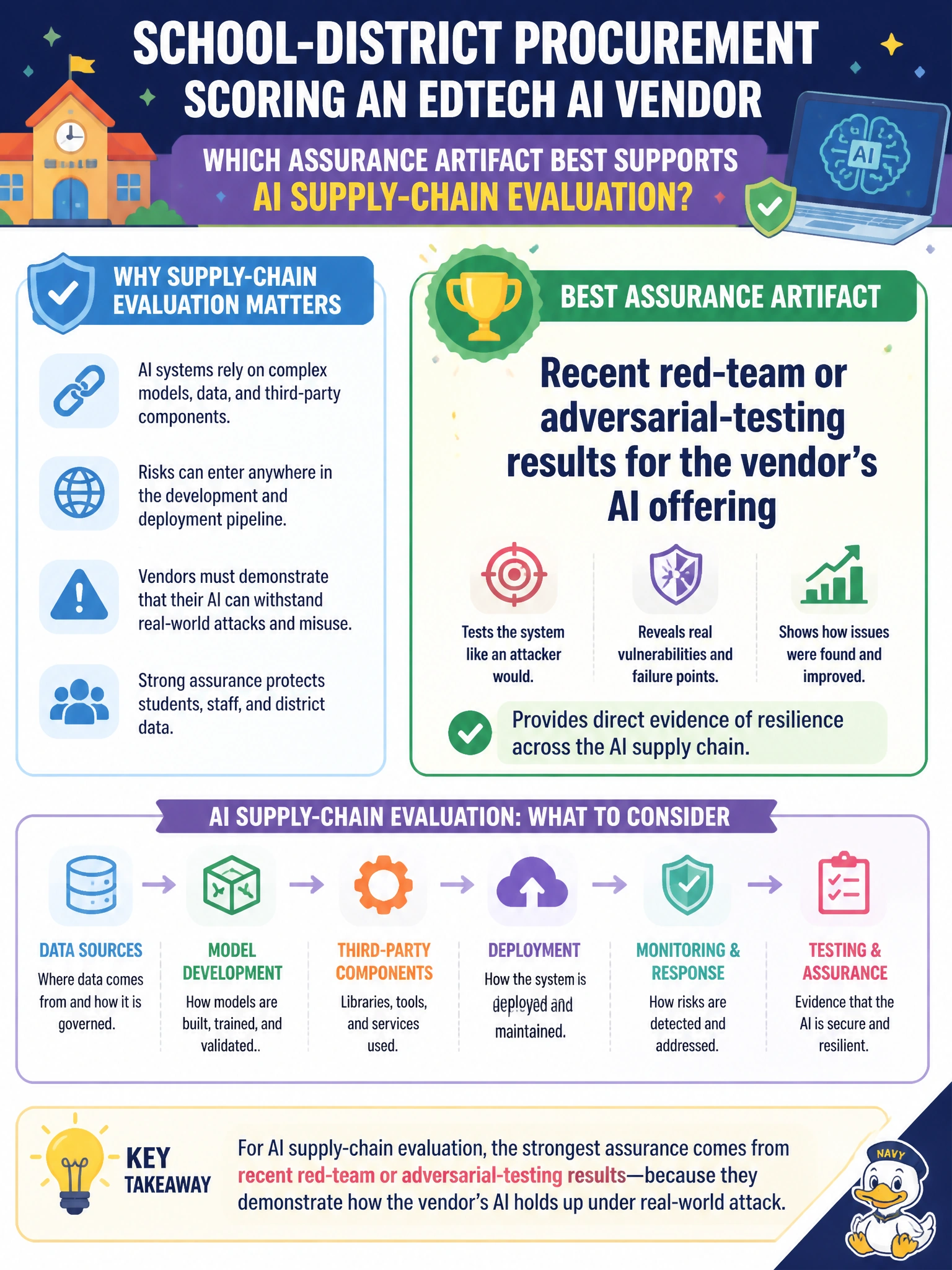
School-district procurement is scoring an edtech AI vendor. Which assurance artifact best supports AI supply-chain evaluation?
Select an answer to reveal the explanation.
Short Explanation
Ask the edtech vendor to show how their AI held up under attack testing—not just a smile photo. Red-team evidence helps you judge real resilience. Verbal ‘trust us’ isn’t procurement assurance.
Full Explanation
School-district procurement scoring an edtech AI vendor should prioritize recent red-team or adversarial-testing results for that AI offering as an assurance artifact. That artifact best supports AI supply-chain evaluation because adversarial testing exercises prompt injection, jailbreaks, data exfiltration via outputs, and unsafe tool use under conditions closer to real abuse than marketing claims. Recent results also show whether the vendor’s AI defenses are current rather than historical.
A stock photo of students smiling near laptops fails conceptually because imagery is marketing, not security evidence about the AI system under evaluation. A verbal assurance that the product is safe without evidence fails because unsupported assertions cannot be scored, compared, or audited. An outdated firewall rule printout unrelated to the AI product fails because network ACL snapshots do not demonstrate resistance to AI-specific attack techniques against the edtech offering.
Exam caveat: red-team reports vary in rigor; districts must read scope, methodology, and residual findings rather than accepting a “passed” stamp at face value. Operational check: require recent adversarial-test evidence covering defined AI threat scenarios, score residual high findings as blockers or conditions, and tie remediation deadlines to contract award or go-live for student-facing AI.
Prefer to study offline? Printable PDF study book + test engine ($7.50, unofficial). These questions stay free here.