
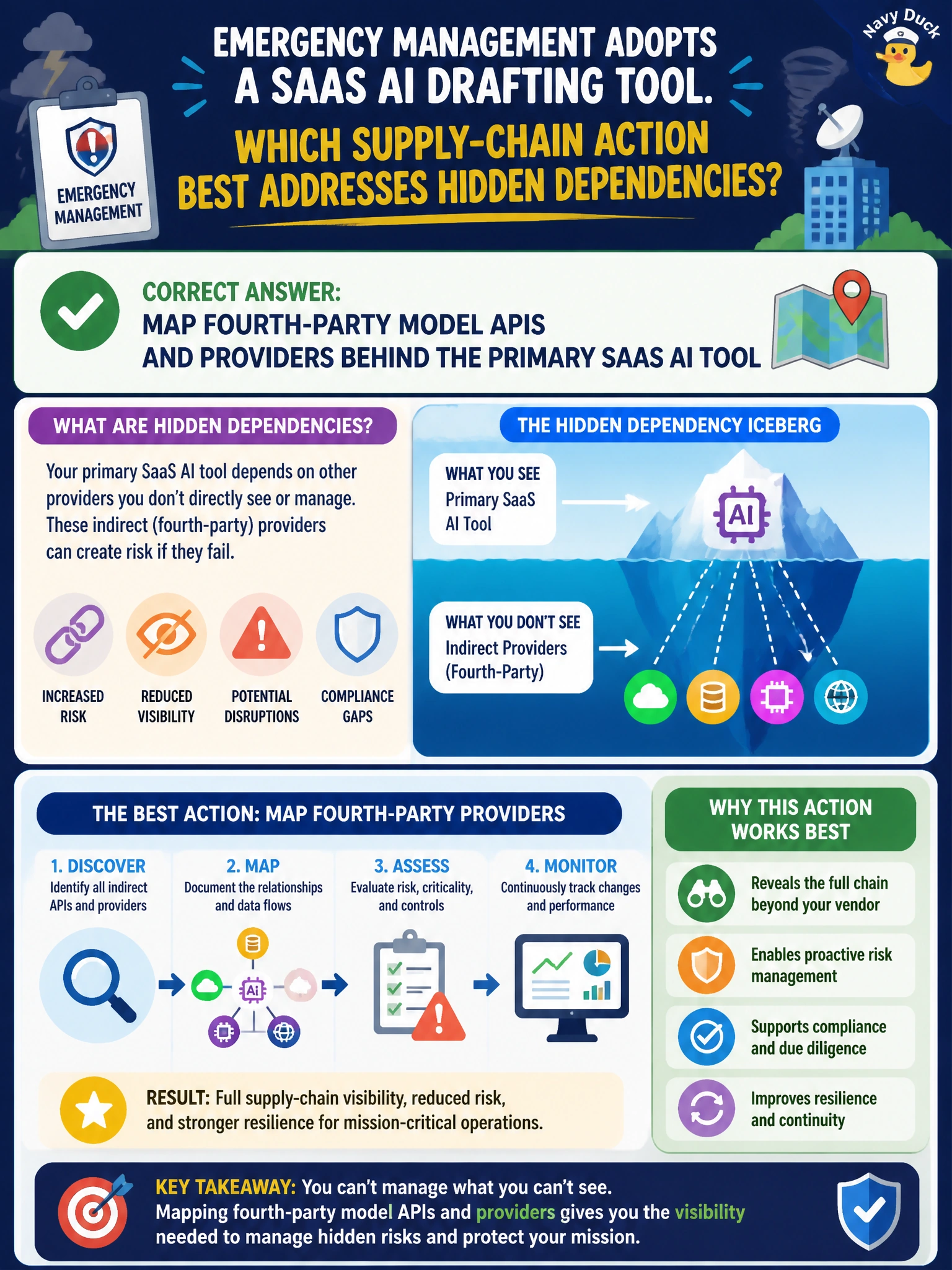
Emergency management adopts a SaaS AI drafting tool. Which supply-chain action best addresses hidden dependencies?
Select an answer to reveal the explanation.
Short Explanation
Mapping downstream customer tenants receiving your drafts won't show you the model APIs behind the tool. Map the fourth-party model APIs behind that emergency SaaS so risk isn't a surprise. First-tier reseller contracts won't show you the hidden providers behind your drafts.
Full Explanation
Emergency management adopting a SaaS AI drafting tool should map fourth-party model APIs and providers behind the primary SaaS AI tool. That supply-chain action best addresses hidden dependencies because the user-facing vendor may call external model hosts, embeddings services, or logging pipelines that process emergency-related drafts. Visibility into those APIs and providers enables residency checks, breach scoping, concentration-risk analysis, and contractual flow-down of municipal requirements. Mapping downstream customer tenants receiving outputs from the drafting tool fails conceptually because it only tracks outward distribution of drafts and does not expose the fourth-party model APIs and providers behind the AI drafting tool. Inventorying first-tier reseller contracts for the primary SaaS AI tool fails because sales-channel contracts do not inventory the data paths or fourth-party providers that process emergency drafts. Cataloging model APIs licensed directly by the primary SaaS AI vendor fails because cataloging direct licenses does not inventory the fourth-party model APIs and providers or their security posture. Exam caveat: a point-in-time fourth-party map ages quickly when the SaaS vendor swaps model backends; mapping needs change-notification hooks. Operational check: require the SaaS AI vendor to disclose model API providers used for emergency drafts, prohibit undisclosed subprocessors for designated content, and refresh the dependency map at renewal or after material feature changes.
Prefer to study offline? Printable PDF study book + test engine ($7.50, unofficial). These questions stay free here.