
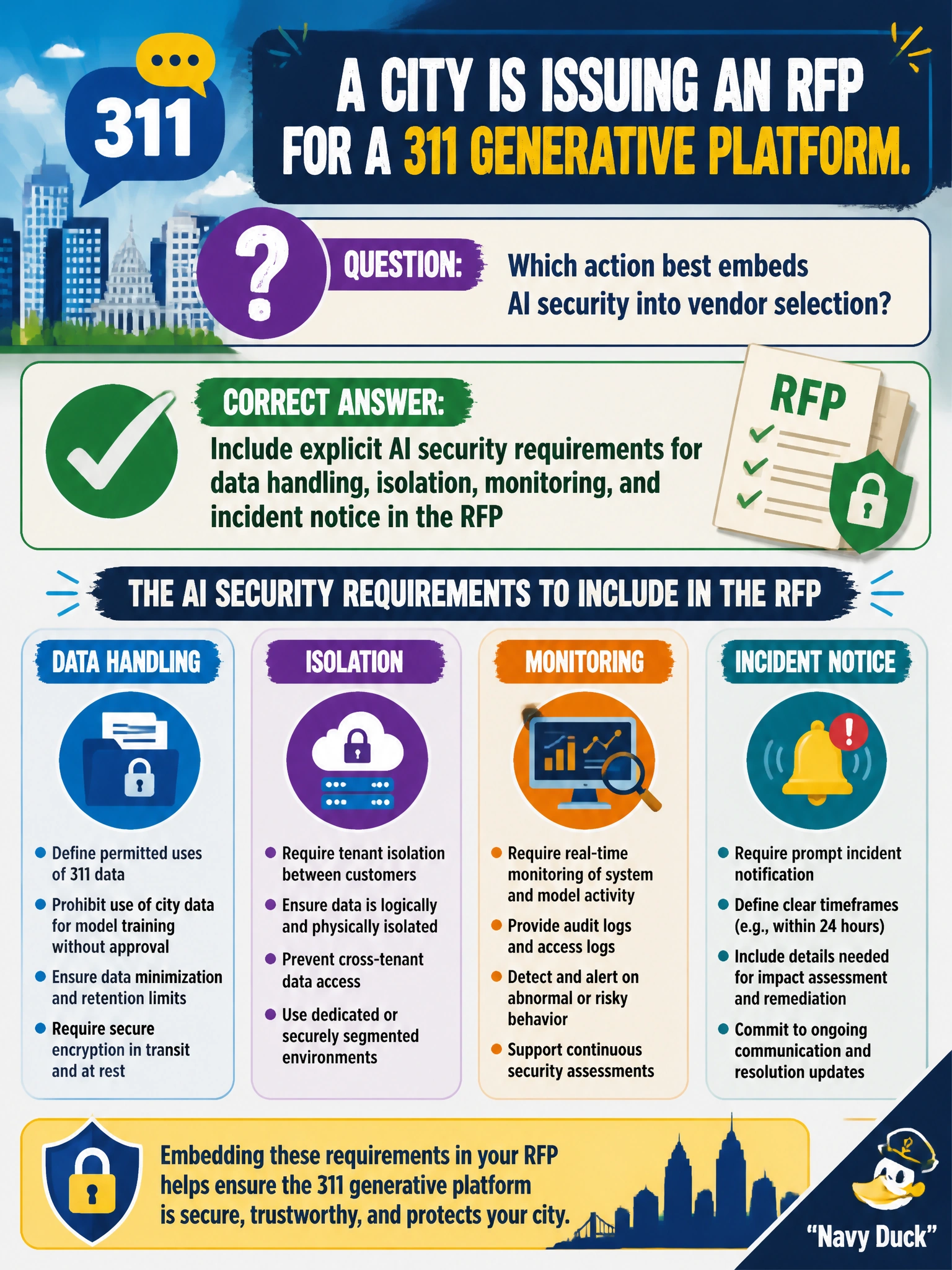
A city is issuing an RFP for a 311 generative platform. Which action best embeds AI security into vendor selection?
Select an answer to reveal the explanation.
Short Explanation
If security isn’t in the RFP, you won’t get it later for free. Spell out AI data handling, isolation, monitoring, and breach notice up front. Tracking on-time scans and red-team reports doesn’t give you isolation, monitoring, and breach notice.
Full Explanation
A city issuing an RFP for a 311 generative platform best embeds AI security into vendor selection by including explicit AI security requirements for data handling, isolation, monitoring, and incident notice in the RFP. That action works because procurement language sets enforceable expectations before award; without written AI requirements, vendors optimize for price and features while the municipality loses leverage to demand tenant isolation, training-use restrictions, logging, and breach notification after signature. Explicit RFP criteria also enable comparable scoring across proposers. Requiring SOC 2 Type II attestation with encryption and centralized access controls for vendor selection in the RFP fails conceptually because generic attestations and baseline controls do not address generative-AI risks such as tenant isolation, training-use restrictions, logging, or breach notification, leaving the municipality without enforceable AI-specific security requirements before award. Including explicit AI security training for helpdesk staff with phishing simulations and password hygiene in the RFP fails because workforce awareness activities do not impose enforceable platform requirements for AI data handling, isolation, monitoring, or incident notice, leaving vendor security unscored and unawarded. Including service-level targets for model scan completion and red-team report delivery in the RFP with quarterly reviews fails because delivery-timeline metrics track whether assessments are produced on schedule but do not establish enforceable AI security controls for data handling, isolation, monitoring, or incident response capability. Exam caveat: RFP requirements must be testable and ranked; vague “secure AI” wording invites checkbox responses without verifiable controls. Operational check: publish mandatory AI security clauses (data handling, isolation, monitoring, incident notice), map each to evaluation scores and contract exhibits, and require proposers to evidence how they meet each clause before shortlisting.
Prefer to study offline? Printable PDF study book + test engine ($7.50, unofficial). These questions stay free here.