
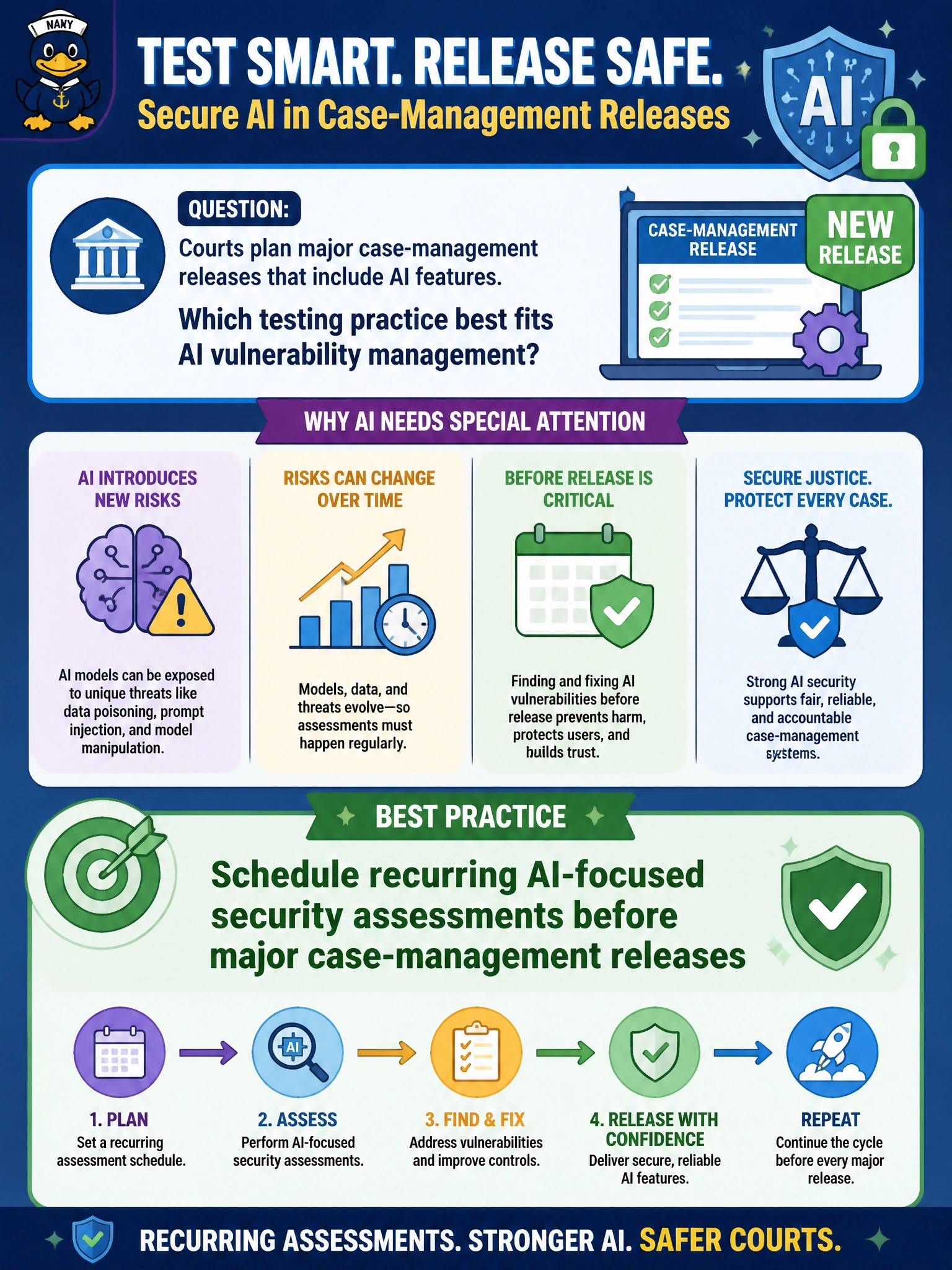
Courts plan major case-management releases that include AI features. Which testing practice best fits AI vulnerability management?
Select an answer to reveal the explanation.
Short Explanation
You need recurring AI security checks, not just standardized infrastructure scans during courthouse maintenance windows. Schedule AI-focused security assessments before big releases. Docketing UAT or a vendor SOC 2 report isn’t a penetration test for AI risks like prompt injection.
Full Explanation
Courts planning major case-management releases that include AI features should schedule recurring AI-focused security assessments before those releases. That testing practice fits AI vulnerability management because each release can change prompts, retrieval corpora, tool plugins, model versions, and data flows—introducing prompt injection, over-disclosure, and privilege paths that a one-time check cannot catch. Conducting only standardized infrastructure vulnerability scans during routine courthouse maintenance windows fails because generic infrastructure checks do not exercise AI-specific surfaces such as prompts, retrieval corpora, tool plugins, or model versions; release-specific AI risk demands focused assessments before major releases. Validating AI features through functional user acceptance testing of docketing workflows fails because UAT verifies business functionality rather than AI-specific security flaws like prompt injection, over-disclosure, or privilege paths; it cannot substitute for direct technical assessment of the AI components. Reviewing vendor SOC 2 reports at contract milestones fails because a SOC 2 attestation addresses general service controls at a point in time, not release-specific AI threats in the court’s deployment; it cannot replace pre-release testing of prompts, RAG, model versions, and data flows.
Exam caveat: recurring assessments still need scoped objectives; shallow checkbox scans that never exercise prompt, RAG, or tool abuse will create false confidence before go-live. Operational check: add an AI security assessment gate to the court release checklist, require evidence of tests against defined AI threat scenarios, and block production promotion when critical AI findings remain open without an approved risk decision.
Prefer to study offline? Printable PDF study book + test engine ($7.50, unofficial). These questions stay free here.