
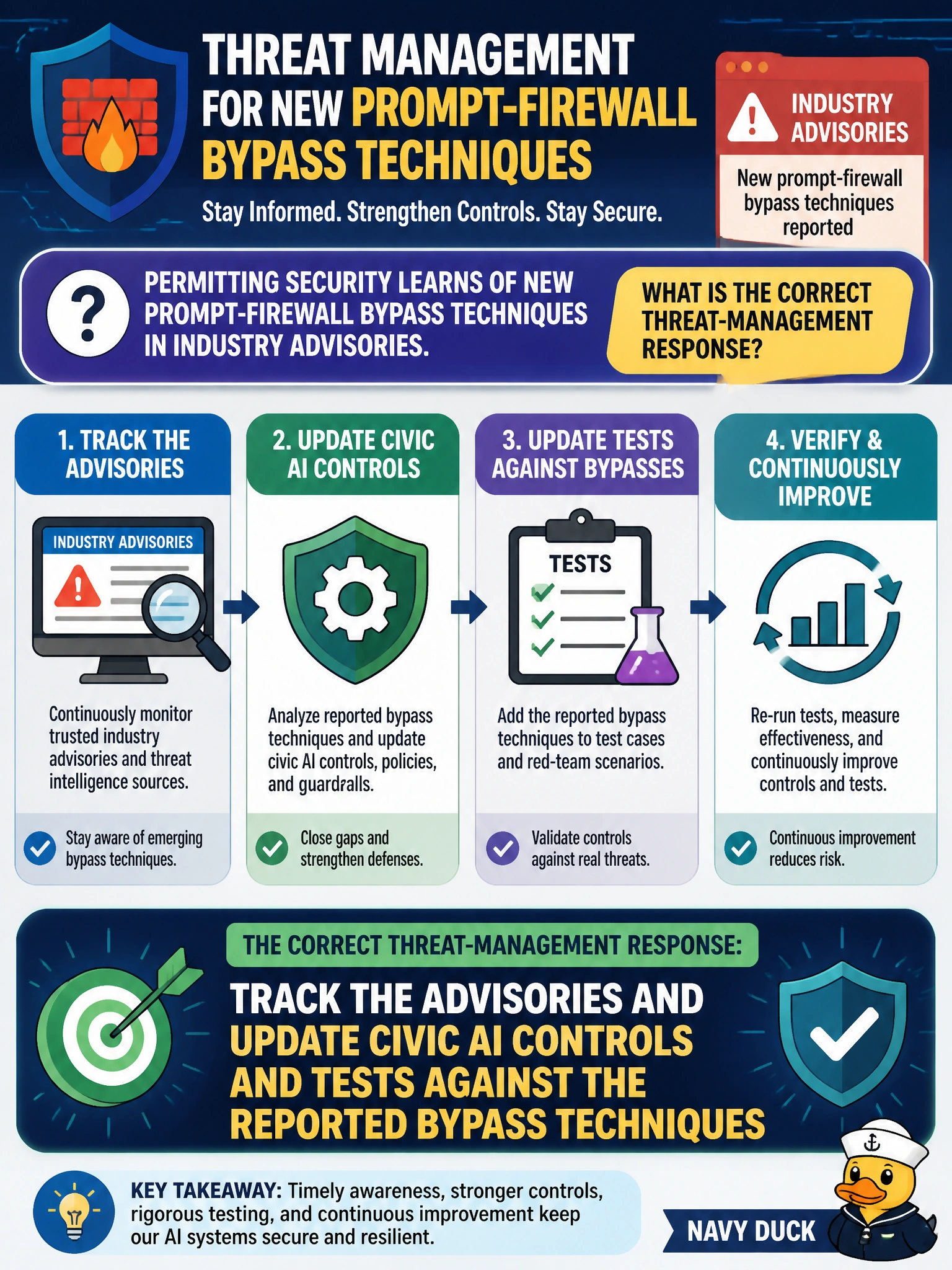
Permitting security learns of new prompt-firewall bypass techniques in industry advisories. What is the correct threat-management response?
Select an answer to reveal the explanation.
Short Explanation
When the industry posts new ways around prompt firewalls, bring that intel home and retest your permitting bot. Immunity by municipal pride isn’t a control. Turning the firewall off ‘solves’ nothing.
Full Explanation
When industry advisories describe new prompt-firewall bypass techniques, the correct threat-management response is to track those advisories and update civic AI controls and tests against the reported methods. Threat intelligence for AI must flow into municipal defenses the same way traditional CVE intel does: evaluate applicability, patch or retune controls, and add regression tests so permitting assistants do not remain open to known bypasses.
Ignoring external advisories because municipal systems are uniquely immune fails because attackers reuse techniques across sectors; civic branding confers no special immunity. Waiting until bypasses appear in social media memes fails because popular awareness lags specialist disclosure and leaves a preventable exposure window. Disabling the prompt firewall entirely so bypass research becomes irrelevant fails conceptually: removing the control maximizes prompt-injection success rather than addressing the new techniques.
Exam caveat: not every research bypass applies to every architecture—retrieve relevance based on your firewall type, model, and plugins—but ‘track and evaluate’ is mandatory even when the final decision is ‘not applicable’ with rationale. Operational check: subscribe to AI security advisories, open tickets for applicable bypasses, update firewall rules/filters, add the bypass patterns to red-team suites for the permitting bot, and record residual risk if full mitigation is delayed.
Prefer to study offline? Printable PDF study book + test engine ($7.50, unofficial). These questions stay free here.