
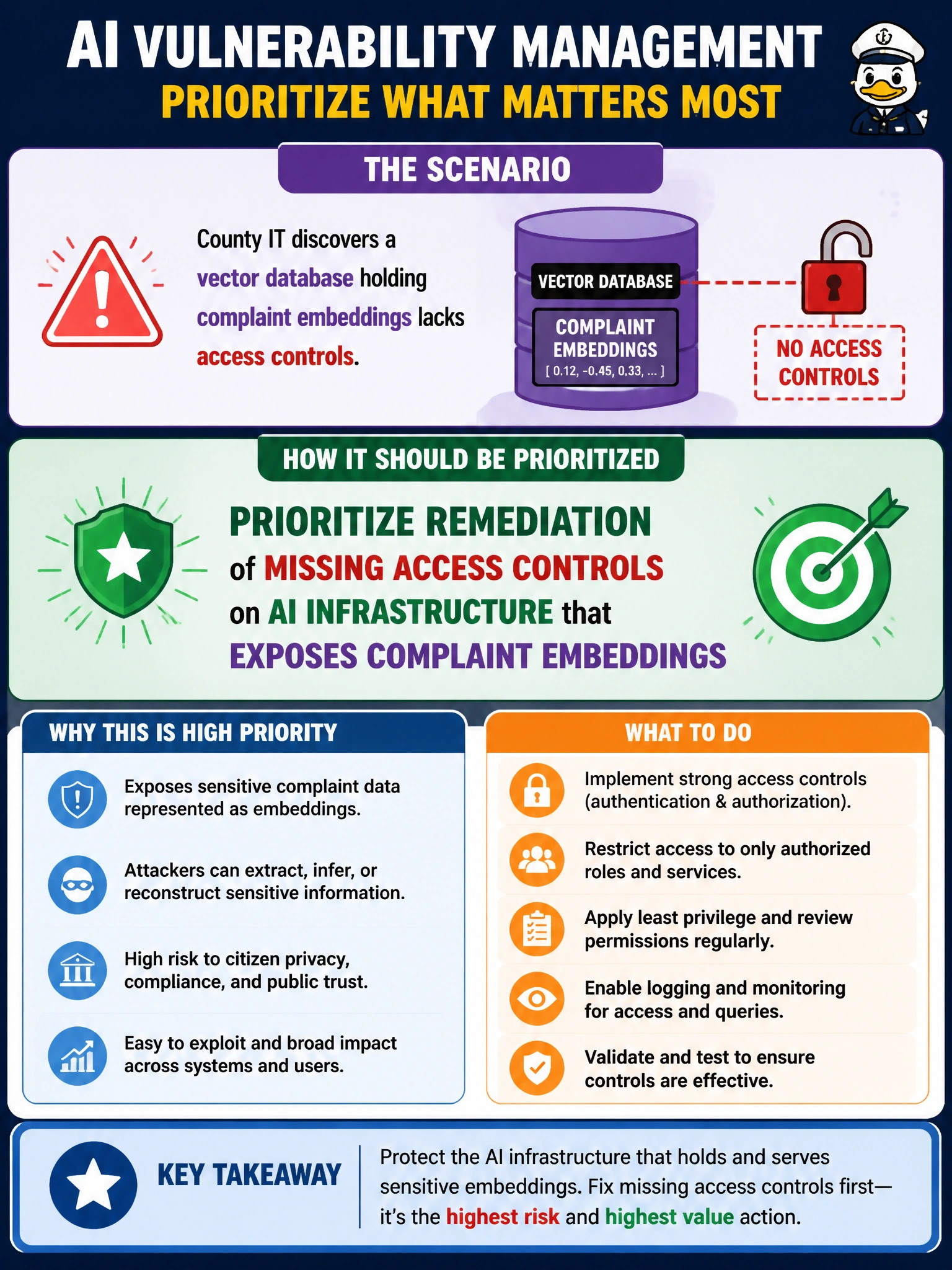
County IT discovers a vector database holding complaint embeddings lacks access controls. How should AI vulnerability management prioritize this?
Select an answer to reveal the explanation.
Short Explanation
Embeddings aren’t harmless confetti—they can leak complaint context. You lock down the live vector DB first; fixing access on the evaluation notebooks won’t close that open store, and encrypting the offline backups won’t fix its missing authentication. You’ll still be exposed if you only lock down the batch pipelines that generate the embeddings.
Full Explanation
A vector database holding complaint embeddings without access controls is a high-priority AI infrastructure vulnerability. Embeddings can encode sensitive complaint context and enable reconstruction or linkage attacks; exposing them threatens confidentiality of residents’ civic complaints. Prioritizing remediation of authentication and authorization on that store works because AI vulnerability management covers the supporting data plane—not only the chat UI—and weak vector-DB controls are a direct confidentiality failure.
Prioritizing remediation of missing access controls on model evaluation notebooks that analyze complaint embeddings fails because the finding is the exposed live vector store, not notebook access; hardening the analysis environment leaves anonymous query paths to the embeddings open. Prioritizing remediation of missing encryption controls on offline backup archives that store complaint embeddings fails because encrypting offline copies does not restore authentication and authorization on the live queryable vector database, so the active confidentiality exposure remains. Prioritizing remediation of missing access controls on batch inference pipelines that generate complaint embeddings fails because the vulnerability is read access to the stored embeddings in the vector database, not access to the generation jobs, and securing the pipeline does not close the exposed store.
Exam caveat: encryption at rest helps but does not replace identity-based access control and query auditing for vector stores. Operational check: place the vector DB behind authenticated service accounts with least privilege, segment networks, enable audit logs for similarity queries, classify embeddings per source complaint sensitivity, and retest anonymous access paths after remediation before closing the finding.
Prefer to study offline? Printable PDF study book + test engine ($7.50, unofficial). These questions stay free here.