
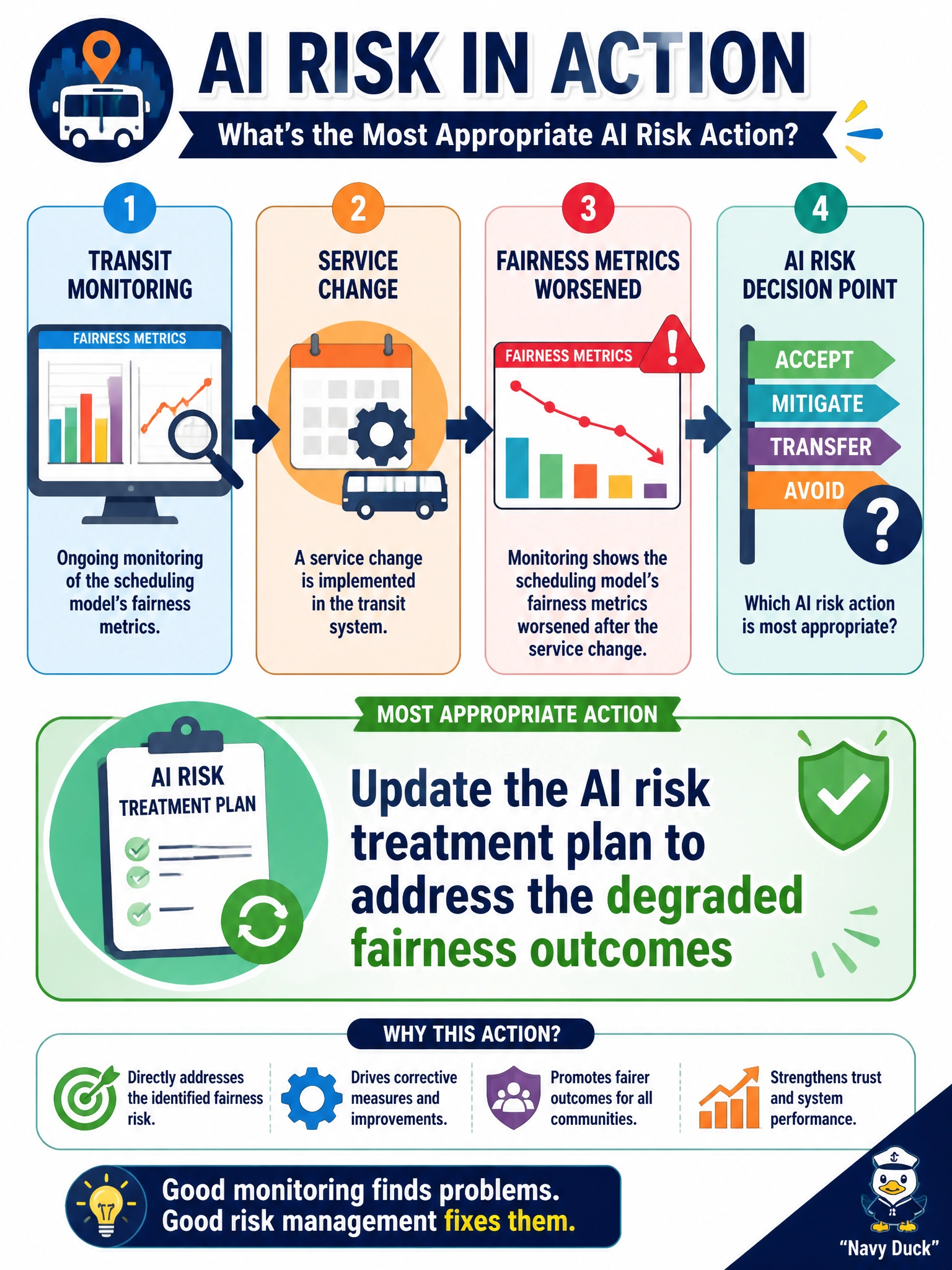
Transit monitoring shows a scheduling model’s fairness metrics worsened after a service change. Which AI risk action is most appropriate?
Select an answer to reveal the explanation.
Short Explanation
When fairness numbers slide after a service change, the treatment plan has to move too. Don't just update the assessment report to document it, retrain on pre-change data, or add controls in the registry — you'll document or tinker without fixing the live inequity. Update controls and oversight—monitoring only helps if it feeds action.
Full Explanation
Transit AI risk management closes the loop from monitoring to treatment. When fairness metrics for a scheduling model worsen after a service change, the appropriate action is to update the AI risk treatment plan—revising controls, human oversight, deployment constraints, data pipelines, or rollback criteria so degraded equity outcomes are addressed rather than merely observed. The correct action works because monitoring without treatment updates leaves rising residual risk unmitigated while leadership may falsely believe dashboards alone equal control. Updating the AI risk assessment report to document the degraded fairness outcomes fails because it revises risk analysis on paper without activating treatment, leaving degraded equity outcomes unmitigated and allowing residual risk to grow unchecked. Retraining the scheduling model on pre-change data to restore fairness levels fails because it reverts to outdated conditions that no longer reflect the post-change service, so current inequity remains unaddressed and overall relevance can degrade without updated controls and oversight. Updating the model registry with enhanced fairness controls for the scheduling model fails because the registry only inventories the model and its listed controls rather than implementing treatment, so it does not establish revised oversight, constraints, or remediation to reduce residual risk. Exam caveat: a metric dip warrants investigation—root cause may be data shift, policy change, or instrumentation error—but ‘investigate’ still belongs inside an updated treatment plan with owners and timelines, not indefinite observation. Operational check: open a treatment-plan change record citing the fairness degradation, assign remediation and interim mitigations (manual review bands, constrained automation), retest fairness after the service change stabilizes, and report residual risk to transit leadership before expanding autonomy.
Prefer to study offline? Printable PDF study book + test engine ($7.50, unofficial). These questions stay free here.