
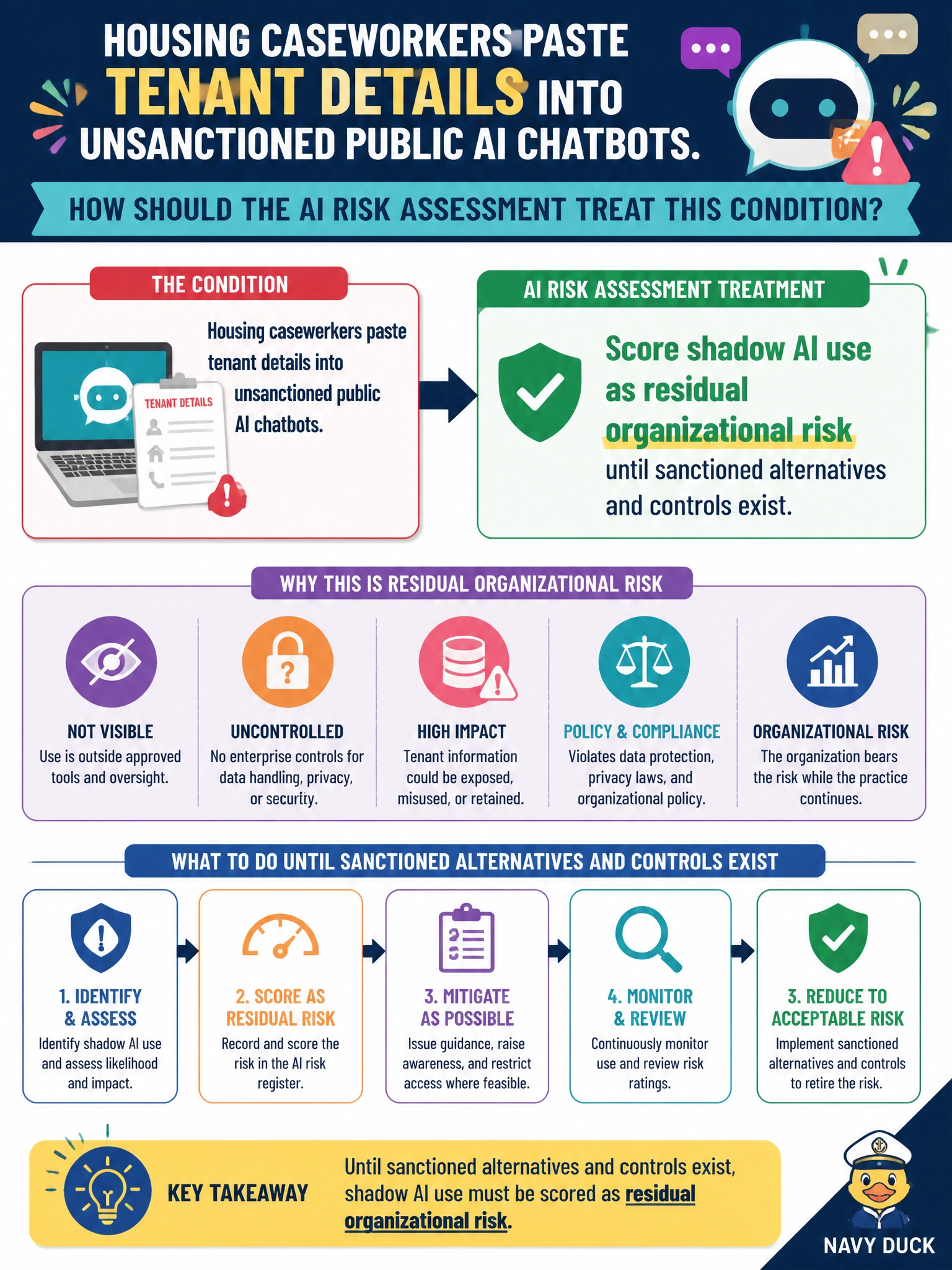
Housing caseworkers paste tenant details into unsanctioned public AI chatbots. How should the AI risk assessment treat this condition?
Select an answer to reveal the explanation.
Short Explanation
Shadow AI isn’t invisible just because IT didn’t approve it. Score it as residual risk on the books until you’ve got sanctioned tools and training that actually stick. Scoring it as mitigated just because you’ve got redaction guidance to strip tenant names isn’t a treatment plan.
Full Explanation
Housing caseworkers pasting tenant details into unsanctioned public AI chatbots create organizational residual risk: sensitive resident data may leave municipal control, enter third-party training or logging pipelines, and violate privacy, contractual, or regulatory expectations. Scoring shadow AI use as residual risk until sanctioned alternatives and controls exist works because risk assessments must reflect actual practice, not only approved architecture diagrams. Capturing the exposure drives funded treatments—approved tools, DLP or browser controls, training, monitoring, and progressive enforcement—rather than pretending the behavior is invisible.
Scoring shadow AI risk as vendor-managed risk covered by the public chatbot's published security documentation fails because vendor documentation does not establish municipal control over resident data, does not replace an internal residual-risk score, and cannot assure compliance with privacy, contractual, or regulatory obligations for unsanctioned pastes. Scoring shadow AI use as mitigated residual risk following prompt-redaction guidance for caseworkers fails because removing names does not eliminate other sensitive tenant details, does not address data already logged or used for training by the public chatbot, and leaves the unsanctioned exposure unmanaged rather than treated as residual risk. Scoring chatbot use as output accuracy risk controlled through case file audits of housing letters fails because the core exposure is uncontrolled resident data leaving municipal control through unsanctioned AI, not merely inaccurate output, and the practice belongs on the municipal AI risk register as an organizational residual risk.
Exam caveat: scoring shadow AI does not require perfect measurement on day one—reasonable estimates and confirmed incident samples are enough to prioritize treatment. Operational check: inventory sanctioned AI paths for housing casework, block or warn on known public AI domains for case systems, train staff on approved alternatives, and update the residual-risk rating only after controls and adoption metrics show sustained reduction in unsanctioned pastes.
Prefer to study offline? Printable PDF study book + test engine ($7.50, unofficial). These questions stay free here.