
Fire/EMS leadership must prioritize AI risk treatment across several assistants. Which use case should receive treatment first?
Select an answer to reveal the explanation.
Short Explanation
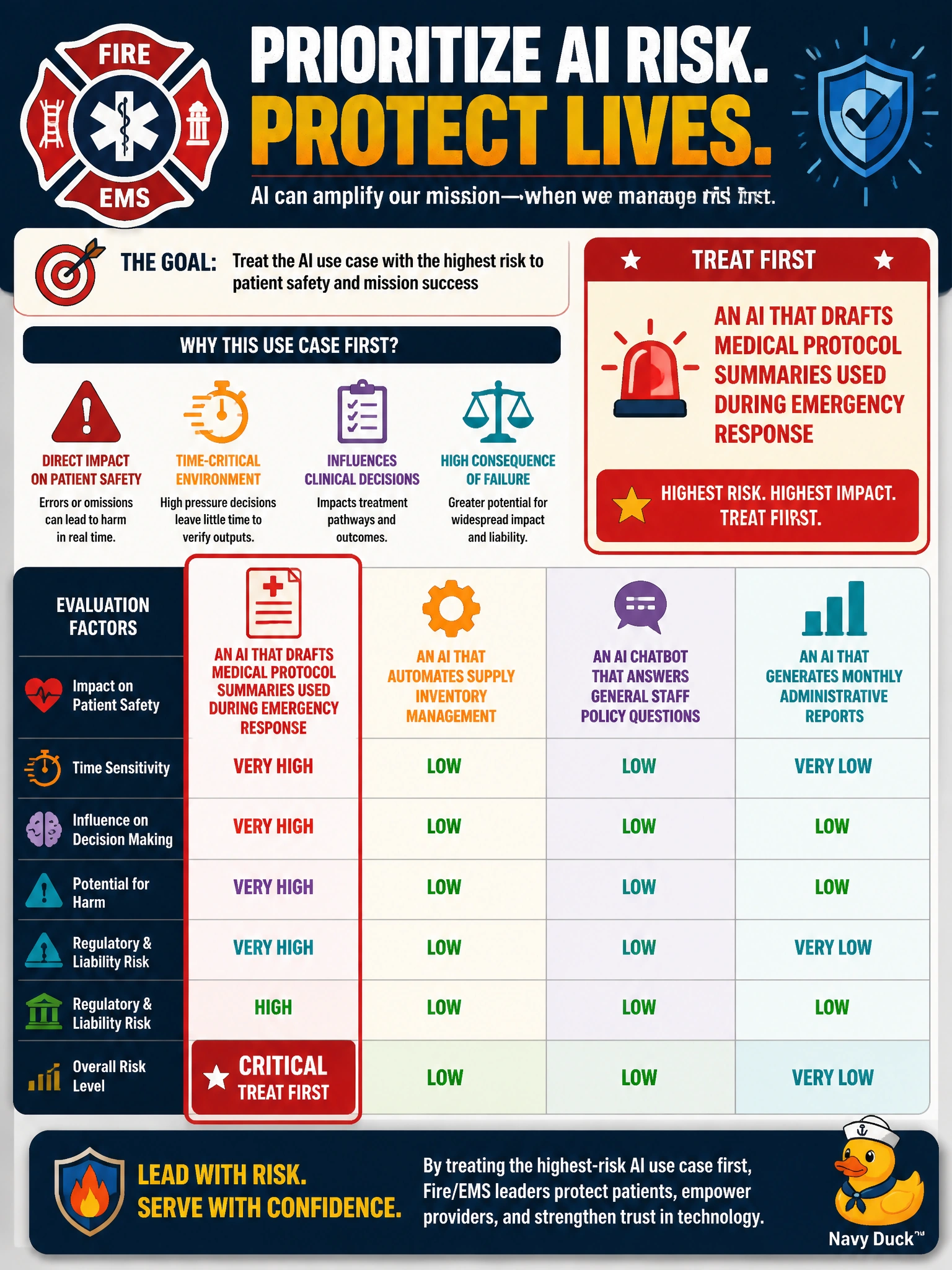
When everything wants funding, put the life-safety helper at the front of the line. An assistant that drafts medical protocols can shape what crews do under stress, so treat that risk before the AI that drafts apparatus staging summaries used during emergency response, since it's staging logistics you'll still see on scene, not direct patient-care decisions. Civic risk treatment follows how much harm a wrong answer can cause.
Full Explanation
AI risk treatment prioritization in Fire/EMS must follow potential harm to life-safety outcomes, not departmental visibility or convenience. An assistant that drafts medical protocol summaries used during emergency response can shape clinical or operational actions under time pressure; incorrect or outdated protocol language may cascade into harmful field decisions. That impact profile justifies first-wave assessment, control design, human-in-the-loop requirements, residual-risk acceptance criteria, and monitoring before lower-consequence tools consume the same scarce review capacity. The correct choice works because treatment sequencing is an impact-based governance control: municipal leaders reduce expected civic harm by closing the highest-severity AI risk pathways first.
An AI that drafts apparatus staging summaries used during emergency response fails the prioritization test because staging errors affect vehicle positioning and scene efficiency rather than directly dictating clinical care, so they present lower acute life-safety severity than incorrect protocol language. An AI that creates hydrant access route briefs used during emergency response fails because access-route errors can delay water supply operations but do not directly shape emergency medical decisions and should not displace life-safety protocol AI treatment. An AI that summarizes dispatch channel logs used during emergency response fails because log-summary errors impair situational awareness yet are less directly linked to harmful clinical field actions than protocol guidance used in response.
Exam caveat: prioritization first does not mean other assistants are out of scope forever—deferred items still need inventory, basic controls, and scheduled reassessment as use expands. Operational check: maintain a ranked Fire/EMS AI register with impact tiers (life-safety, operational continuity, administrative), require documented treatment owners and due dates for the top tier, and verify before each major incident season that protocol-drafting AI has completed assessment, control testing, and residual-risk sign-off.
Prefer to study offline? Printable PDF study book + test engine ($7.50, unofficial). These questions stay free here.