
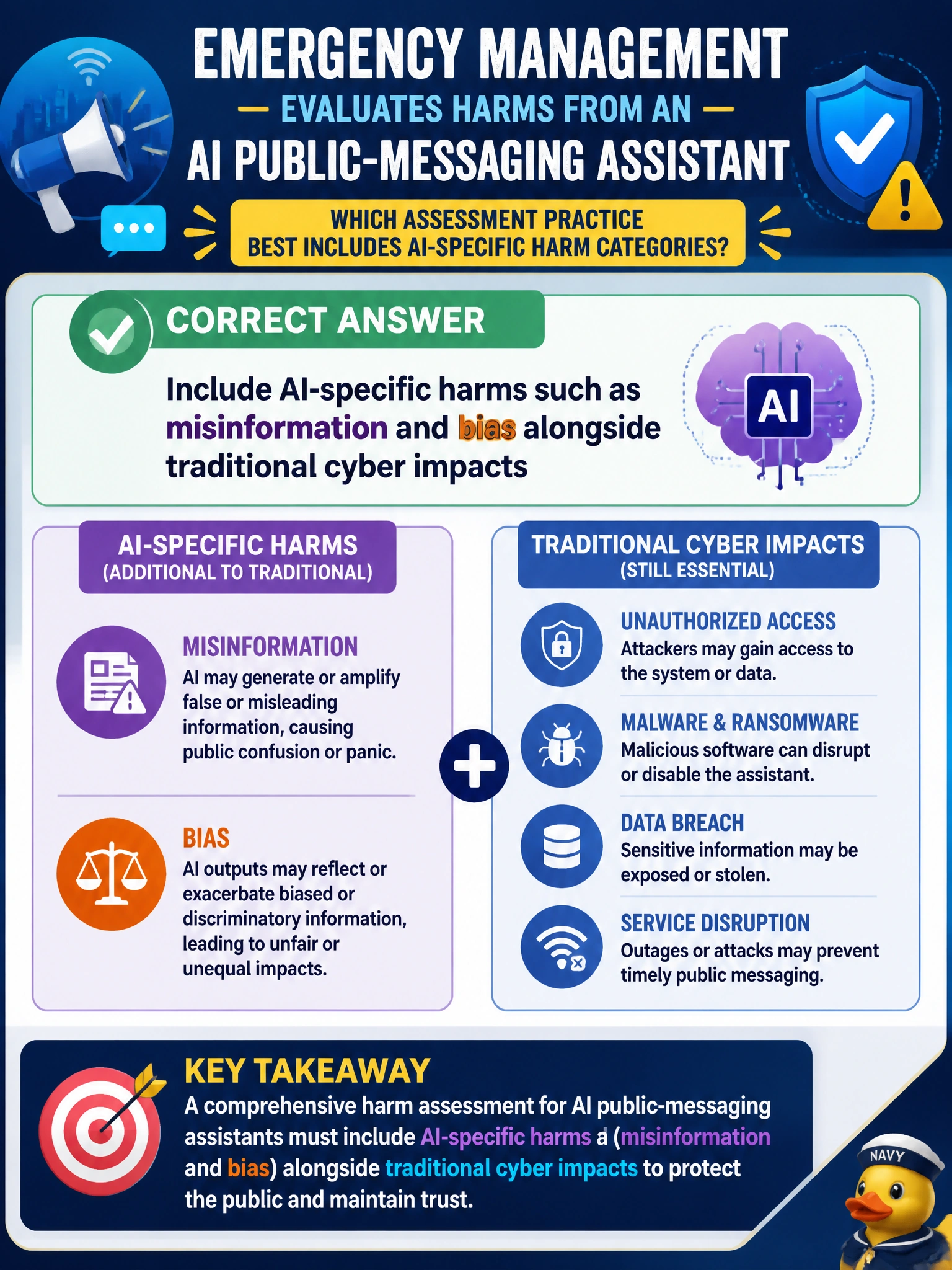
Emergency management evaluates harms from an AI public-messaging assistant. Which assessment practice best includes AI-specific harm categories?
Select an answer to reveal the explanation.
Short Explanation
For emergency messaging AI, a wrong rumor can hurt as much as a leaked file. Score misinformation and bias next to the usual confidentiality stuff. You can't spot false or biased alerts from vendor attestations and access logs since they don't check the message itself.
Full Explanation
Emergency public-messaging assistants can cause harm beyond classic confidentiality breaches: false evacuation instructions, biased targeting of alerts, and reputational misinformation that sends residents the wrong direction. Including AI-specific harms such as misinformation and bias alongside traditional cyber impacts produces a risk picture that matches how generative messaging actually fails in civic emergencies.
Mapping misinformation and bias events to confidentiality integrity availability severity scales forces false-content and equity harms into cyber categories that do not measure truthfulness or fairness, understating safety risk for public alerts. Tracking misinformation and bias risk through system uptime latency and error rate metrics relies on operational availability signals that cannot show whether alert content is false or inequitable, missing the actual civic harm. Inferring misinformation and bias levels from vendor security attestations and access logs mistakes security paperwork and access records for direct evaluation of message content, leaving whether the alert itself is wrong untested.
Exam caveat: AI-specific harm categories should be defined with enough clarity for consistent scoring across assessors, not as unbounded rhetoric. Operational check: for the messaging assistant risk assessment, require at least one scored misinformation scenario and one bias scenario with likelihood, impact, and treatment, in addition to confidentiality and availability ratings.
Prefer to study offline? Printable PDF study book + test engine ($7.50, unofficial). These questions stay free here.