
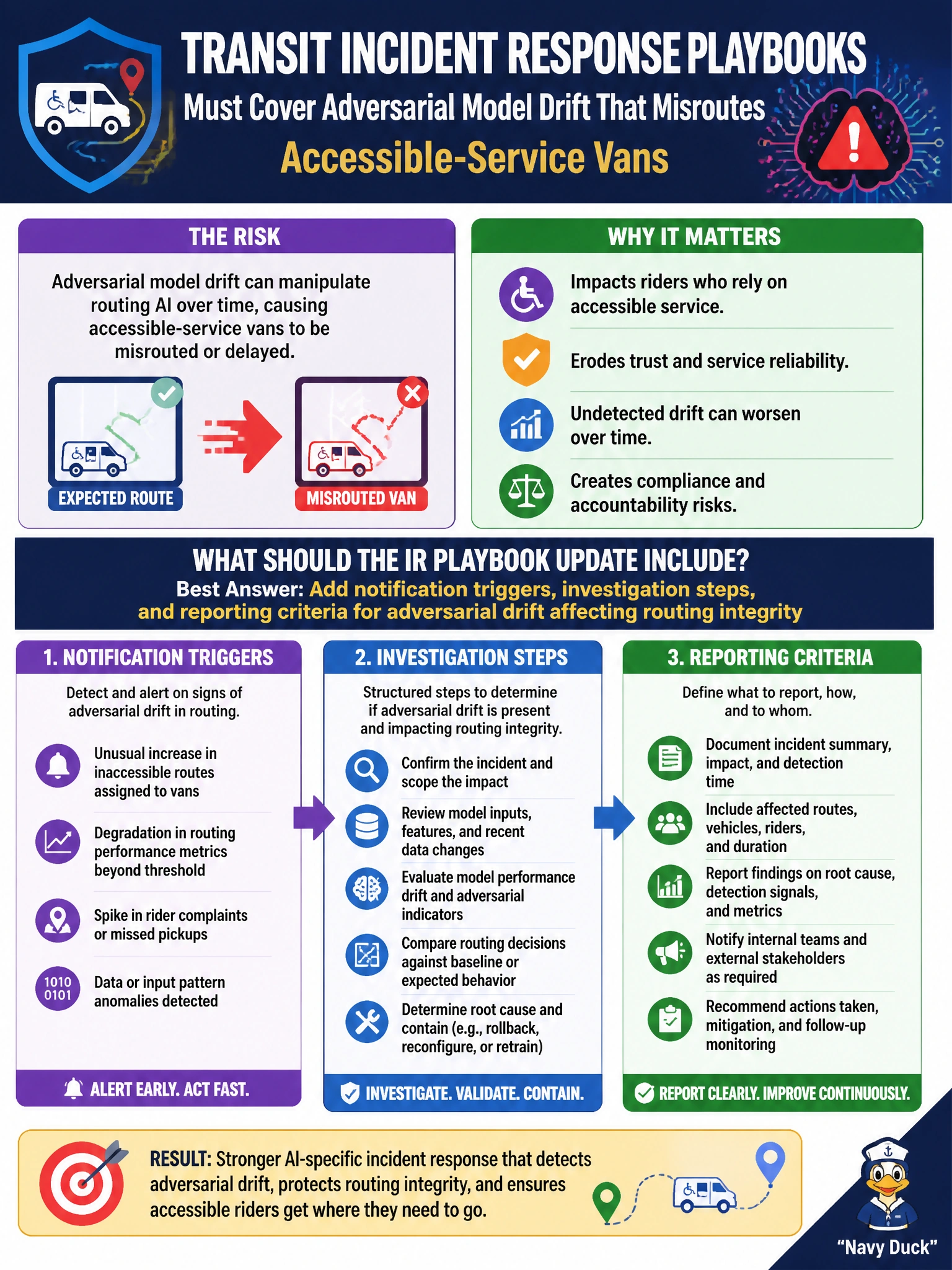
Transit incident response playbooks must cover adversarial model drift that misroutes accessible-service vans. Which IR update best supports AI-specific investigation and reporting?
Select an answer to reveal the explanation.
Short Explanation
If drift starts sending accessible vans the wrong way, that’s an AI integrity incident—not a shrug-worthy GPS hiccup. You need notify, investigate, and report triggers in the playbook so ops can catch and document it. Ignore the model’s behavior and you’ll leave riders stranded and auditors empty-handed.
Full Explanation
Adversarial or integrity-driven model drift that misroutes accessible-service vans is an AI security and service-integrity incident for transit operations. Updating the IR playbook with notification triggers, investigation steps, and reporting criteria for adversarial drift affecting routing integrity ensures operators treat anomalous routing outcomes as reportable AI events. Investigation may compare recent model/input changes, telemetry of van assignments, and rider impact, while reporting criteria define when safety, ADA service obligations, and leadership must be informed.
Adding retraining triggers, dashboard review steps, and availability reports for adversarial drift affecting routing integrity fails because it treats algorithmic integrity as a maintenance and monitoring task rather than an incident; retraining triggers and dashboard reviews provide no notification triggers, investigation steps, or reporting criteria, and availability reports track uptime rather than routing integrity, so adversarial drift can continue without AI-specific investigation. Adding GPS alert triggers, infrastructure steps, and impact criteria for adversarial drift affecting routing integrity fails because it directs response toward GPS and infrastructure faults rather than adversarial drift; infrastructure steps cannot resolve contradictory routing advice from a compromised model, and without investigation steps and reporting criteria there is no AI-specific inquiry path. Adding log retention triggers, availability steps, and uptime criteria for adversarial drift affecting routing integrity misses the mark because those are record-keeping and infrastructure-availability tasks, not AI incident response; they add no notification triggers, investigation steps, or reporting criteria for adversarial drift affecting routing integrity.
Exam caveat: adversarial drift investigation may involve vendor cooperation and model-card or change-log review, but the municipality still owns service integrity and rider safety obligations. Operational check: define at least one measurable trigger (for example, accessible-van misroute rate above threshold or confirmed contradictory routing advice) that opens an AI integrity incident with assigned investigators.
Prefer to study offline? Printable PDF study book + test engine ($7.50, unofficial). These questions stay free here.