
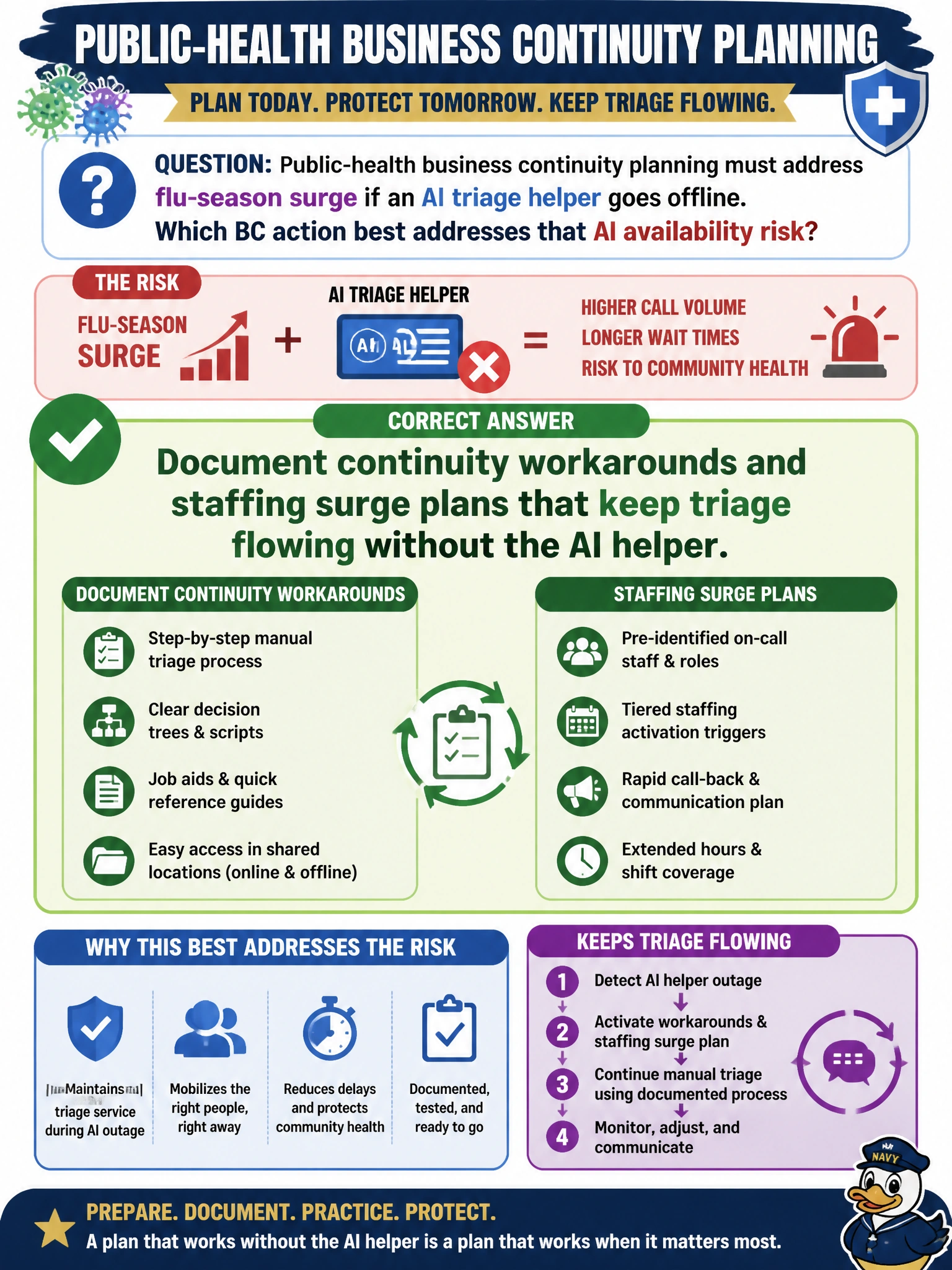
Public-health business continuity planning must address flu-season surge if an AI triage helper goes offline. Which BC action best addresses that AI availability risk?
Select an answer to reveal the explanation.
Short Explanation
Picture flu season with the triage helper dark—nurses still need a path. Write the workarounds and surge staffing into the BC plan so care doesn’t depend on the model staying up. Tracking SLA metrics and escalation contacts won’t triage patients; you’ll still need your continuity plan to keep the clinic moving.
Full Explanation
Public-health triage during flu-season surge is an availability-critical civic function. When an AI triage helper can go offline, business continuity must document how clinicians and intake staff keep patients moving without that helper: paper or EHR fallback workflows, surge staffing roles, call-tree backups, and decision criteria for when to invoke them. Writing those workarounds into the BC plan converts vendor dependency into a managed continuity scenario rather than an improvised outage response under peak load.
Tracking vendor uptime SLA metrics and escalation contacts that monitor AI helper availability commitments fails because an SLA is a commercial commitment, not a municipal continuity design; metrics and contacts do not triage patients when the helper is dark. Recording recovery time objectives and restoration tasks that rebuild triage databases after storage failures misses the point: RTOs for database rebuilds address data restoration, not the immediate need for fallback workflows and surge staffing that keep triage running when the AI helper is unavailable. Scheduling recurring model accuracy audits and bias reviews that sustain triage precision after service recovery does not solve an availability outage: audits improve model performance after restoration, but they give clinicians no way to keep patients moving when the helper goes dark during flu season.
Exam caveat: documenting workarounds does not mean the AI helper is optional forever; it means residual availability risk is treated with compensating procedures until resilience improves. Operational check: in the next BC tabletop, take the triage helper offline for a simulated surge hour and verify named staff can execute the documented workaround without waiting for vendor restoration.
Prefer to study offline? Printable PDF study book + test engine ($7.50, unofficial). These questions stay free here.