
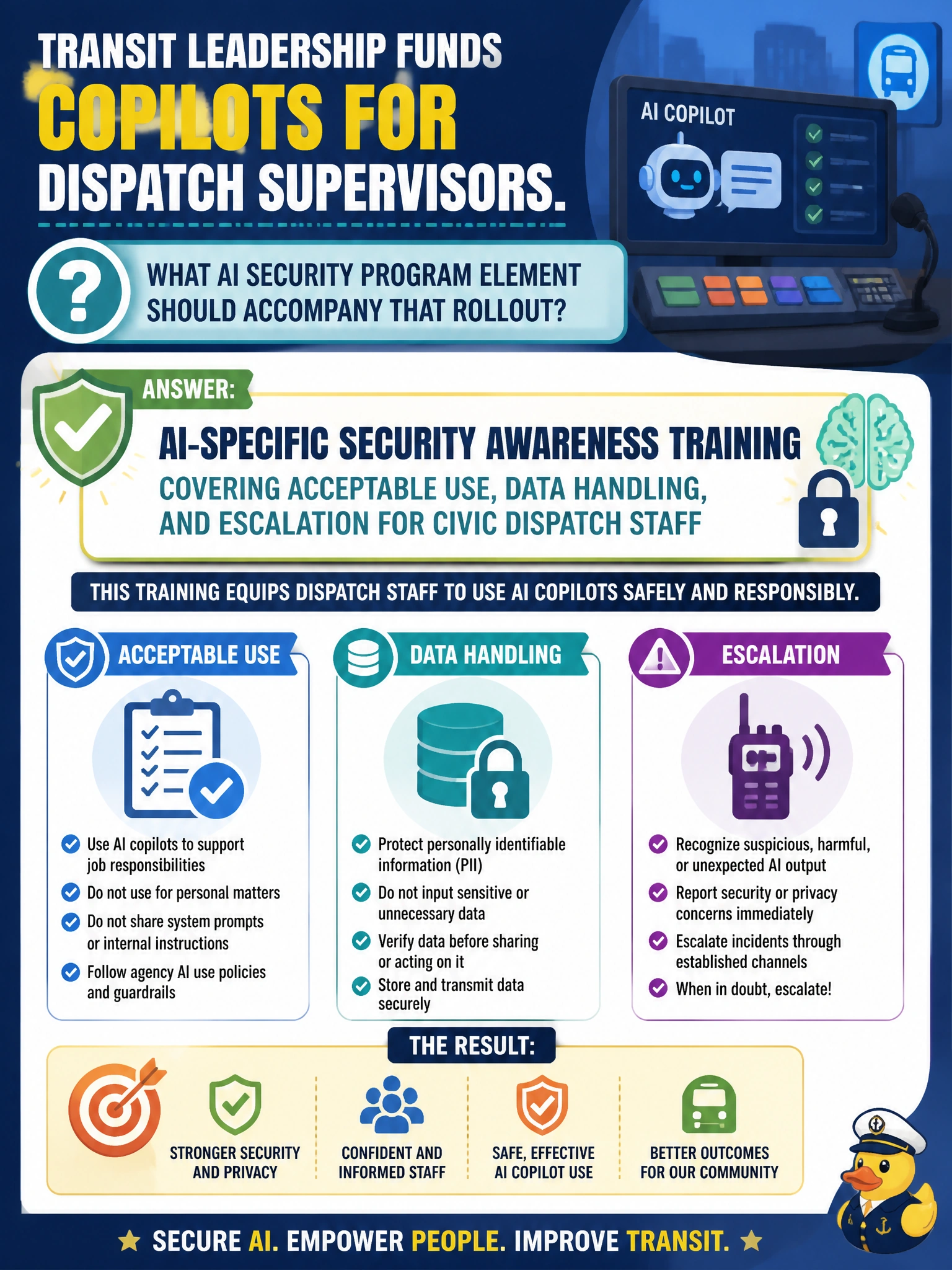
Transit leadership funds copilots for dispatch supervisors. What AI security program element should accompany that rollout?
Select an answer to reveal the explanation.
Short Explanation
Dispatch supervisors need to know what data they can safely paste into the copilot, when to trust it, and when to override. Training must cover these security expectations clearly.
Full Explanation
Providing AI-specific security awareness training covering acceptable use, data handling, and escalation procedures for copilot recommendations is the action that prepares supervisors for safe operation. Dispatch copilots are decision-support tools that can accelerate decisions but can also hallucinate or misroute critical information. Supervisors must understand: (1) what information is safe to paste into the copilot (unit status, generic traffic alerts, yes; personal details or confidential tactics, no), (2) how confident the copilot's recommendations are (when to trust, when to second-guess), and (3) escalation procedures (if the copilot recommends an unsafe dispatch, who reviews and approves the override). Training is the mechanism that establishes a shared language for copilot governance.
AI-specific security awareness training covering model testing, red-team techniques, and safety metrics for civic dispatch staff is mismatched: it teaches evaluator testing skills but does not prepare dispatch supervisors for copilot data handling or the public-safety consequences of AI mistakes. Supervisors cannot afford to learn AI security through tester-focused red-teaming instead of targeted copilot training. AI-specific security awareness training covering secure coding, data pipelines, and model deployment for civic dispatch staff is mismatched: it teaches engineering build controls, not supervisor acceptable use, data handling, and escalation for copilot recommendations. This engineering training emphasizes building models, not the risk and oversight copilot dispatch requires. AI-specific security awareness training covering board oversight, risk appetite, and policy exceptions for civic dispatch staff is mismatched: it covers executive governance but omits copilot acceptable use, AI data-handling limits, and escalation for unsafe recommendations. A board-oversight briefing alone is not enough; training must be mandatory and must address frontline AI security expectations explicitly.
Operational check: within 60 days, conduct dispatch supervisor training on the copilot that: (1) presents examples of safe vs. unsafe data (ride requests with unit IDs are safe; passenger medical histories are not), (2) defines confidence thresholds for recommendation trust, and (3) practices override scenarios. After training, audit a sample of supervisor dispatches for compliance with data-handling rules.
Prefer to study offline? Printable PDF study book + test engine ($7.50, unofficial). These questions stay free here.