
A city CISO wants AI security managed as more than ad-hoc project advice. Which program action best establishes sustained coverage?
Select an answer to reveal the explanation.
Short Explanation
AI security is not a one-off project. The CISO needs a permanent team focused on AI risks, controls, and incidents—part of the growing security mission. You'll still leave gaps with only quarterly red-team exercises, an annual inventory, or vendor checkpoints, since none of them manages all AI risks year-round.
Full Explanation
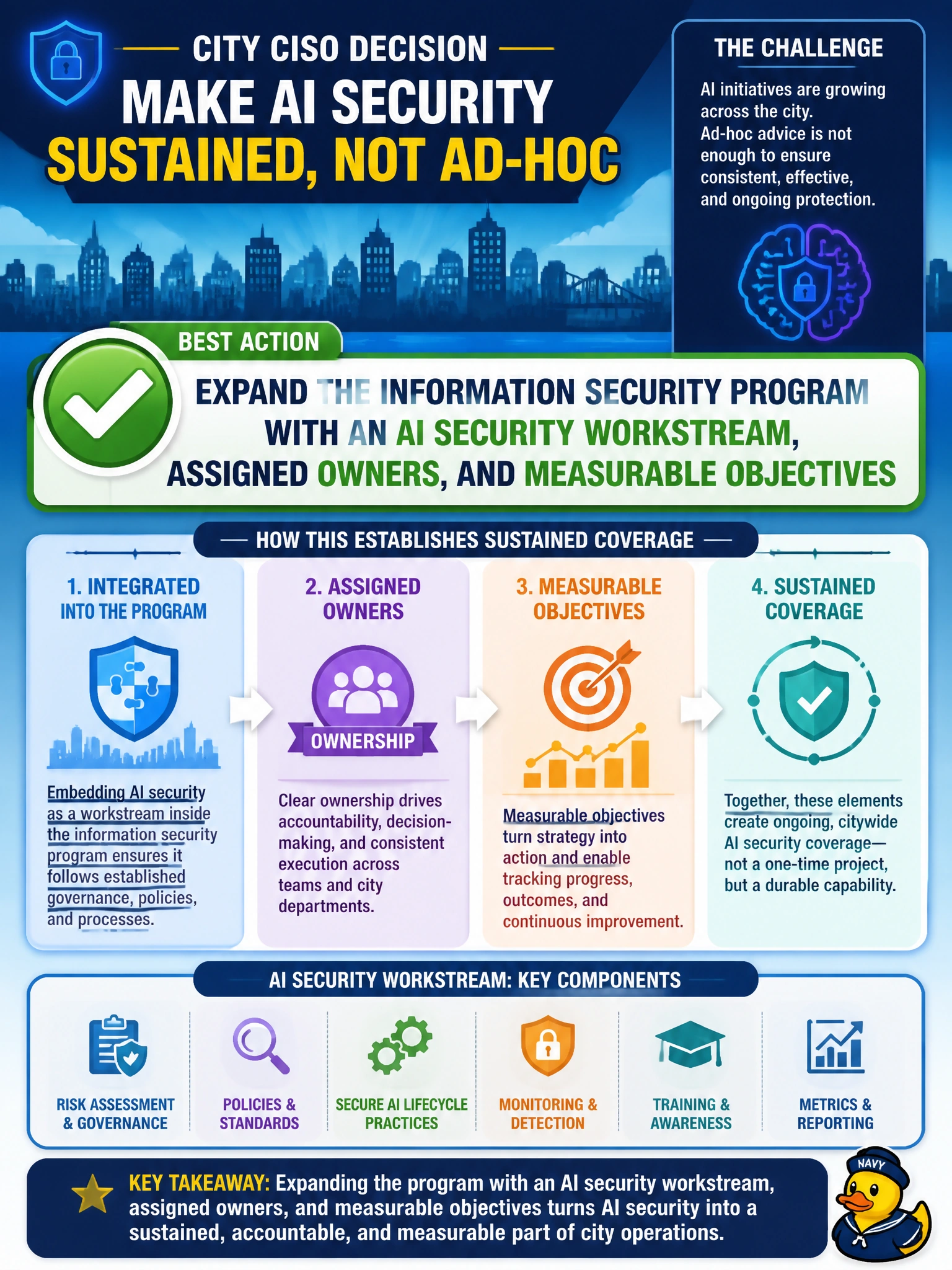
Expanding the information security program with an AI security workstream that has assigned owners and measurable objectives is the action that makes AI security sustainable and professional. The CISO's mandate now includes models, not just traditional IT. An AI workstream is a team (or expanded role assignment) that owns AI risk assessment, model governance, vendor review, performance monitoring for AI systems, and AI-specific incident response—with a named owner and objectives leadership can track quarter over quarter. This workstream integrates with existing ISMS processes (risk committee, change management, incident escalation) so AI is not siloed. Full-time staffing and budget are essential; AI security is ongoing, not episodic.
Expanding with only an AI red-team capability, with assigned testers and quarterly exercise schedules, tests models for adversarial weaknesses but does not establish sustained coverage; no one owns broader AI risk assessment, model governance, vendor review, or continuous monitoring, so risks outside the exercise scope go unmanaged. Expanding with only an AI asset inventory, with assigned custodians and annual attestation reviews, improves visibility of what AI exists but does not manage its risk; an inventory alone provides no ongoing risk assessment, governance, or incident response, so it gives awareness without sustained protection. Expanding with only an AI vendor review process, with assigned analysts and procurement checkpoints, strengthens third-party screening at purchase time but leaves internally built models, continuous performance monitoring, and AI-specific incident response uncovered. Procurement checkpoints alone cannot substitute for a full workstream with owners and measurable objectives across the AI lifecycle.
Operational check: within 90 days, the CISO has: (1) named an AI security lead or assigned AI workstream ownership to an existing security role, (2) allocated budget for AI security (at least one FTE), (3) established AI risk assessment and vendor review procedures within the ISMS, and (4) documented escalation paths for AI-specific incidents.
Prefer to study offline? Printable PDF study book + test engine ($7.50, unofficial). These questions stay free here.