
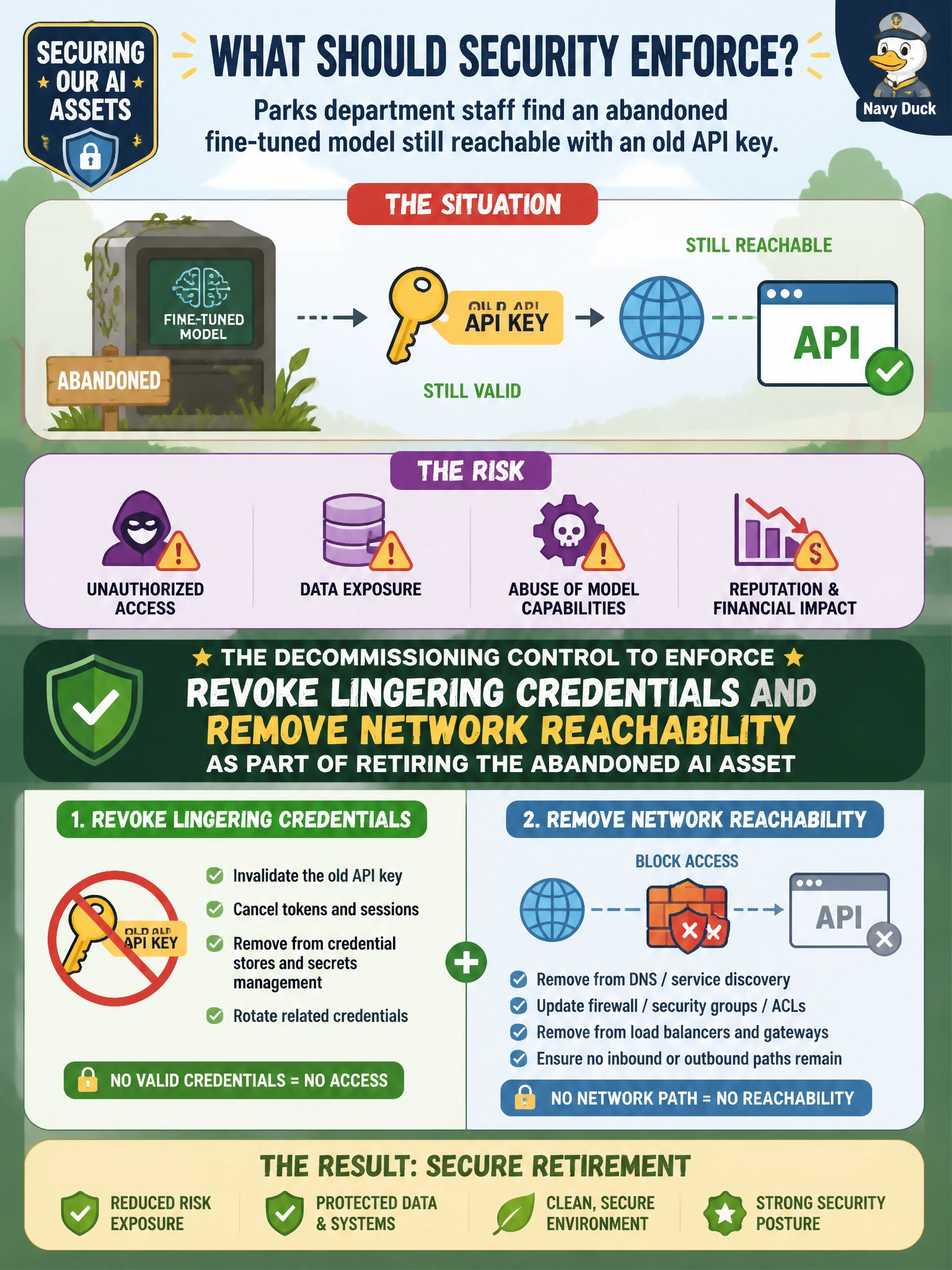
Parks department staff find an abandoned fine-tuned model still reachable with an old API key. What decommissioning control should security enforce?
Select an answer to reveal the explanation.
Short Explanation
An abandoned model with a live key is a door left propped open behind the shed. Revoke the credential and cut reachability when you retire the asset. Decommissioning means nobody can still wander in.
Full Explanation
When parks staff find an abandoned fine-tuned model still reachable with an old API key, decommissioning must revoke lingering credentials and remove network reachability as part of retiring the AI asset. An abandoned endpoint with a live key is an unmanaged inference surface that can leak turf schedules, internal prompts, or further fine-tuning hooks. Credential revocation without reachability removal—or the reverse—leaves residual access paths. Leaving the API key active so historical schedules remain on the public internet intentionally preserves unauthorized exposure. Rotating the key into a shared social-media password manager without disabling the endpoint keeps the service live under weak shared custody and does not complete retirement. Documenting the model as a cultural artifact exempt from access reviews invents a museum exception that security lifecycle management does not grant for reachable production endpoints. Exam caveat: check CI/CD secrets, serverless functions, and partner integrations for copies of the same key, not only the parks desktop password file. Operational check: revoke the key at the identity provider, disable or delete the endpoint, remove DNS and firewall allowances, update the AI inventory to retired, and verify external scans no longer reach the model.
Prefer to study offline? Printable PDF study book + test engine ($7.50, unofficial). These questions stay free here.