
A permitting director wants AI to reduce fraud without bypassing human plan reviewers. Which strategy choice best fits?
Select an answer to reveal the explanation.
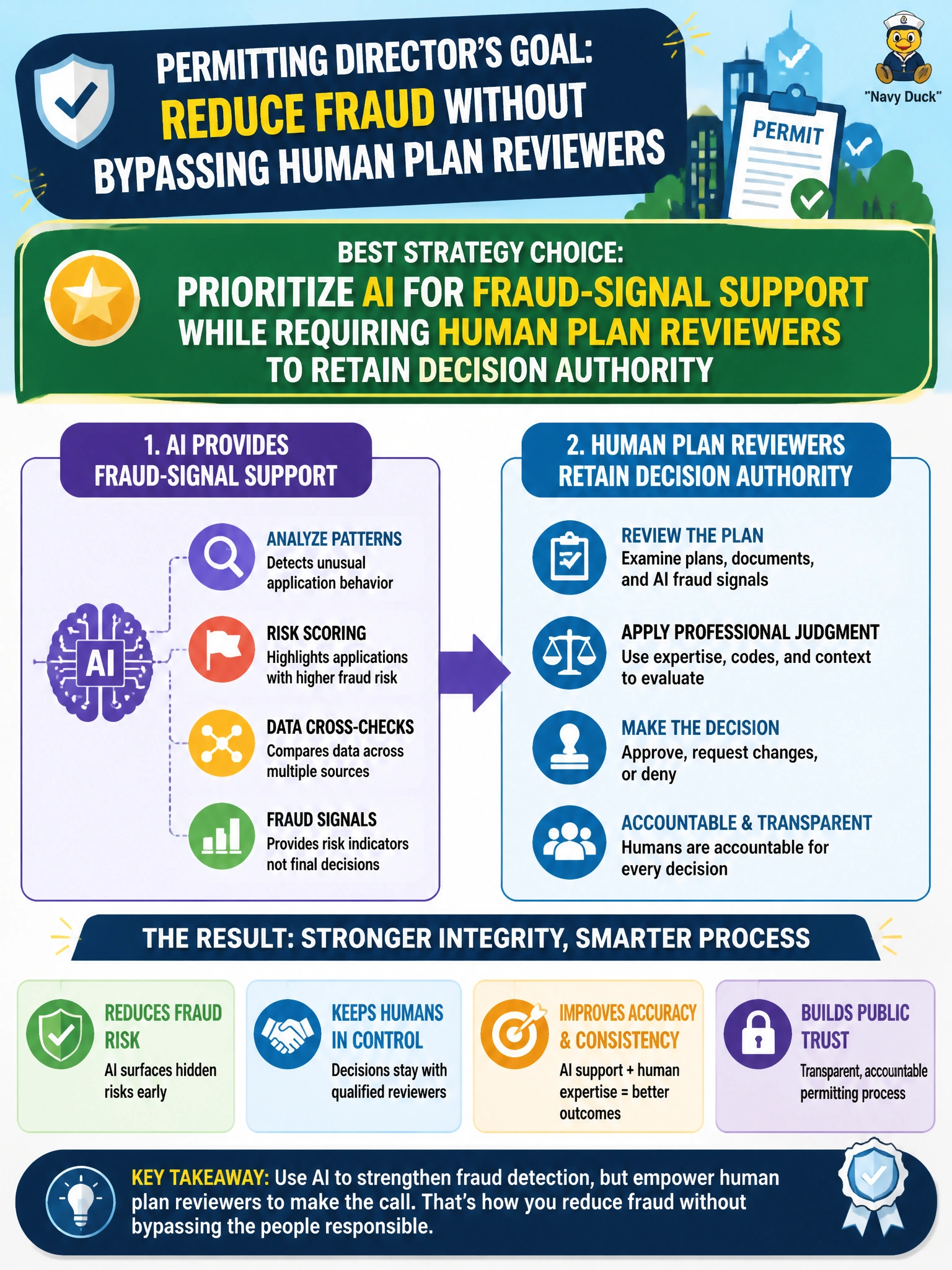
Short Explanation
Think co-pilot, not autopilot: AI can flag shady patterns, but humans still stamp the plans. Keep reviewers in the loop and score the program on fraud and fairness—not just whether the servers stayed up.
Full Explanation
Prioritizing AI for fraud-signal support while requiring human plan reviewers to retain decision authority best aligns municipal AI strategy with business objectives and mandatory oversight for consequential permitting decisions. Fraud-signal assistance can flag anomalies in plan sets or applicant patterns, improving integrity without surrendering final approval to an opaque model. Retaining human decision authority preserves appealability, professional judgment, and accountability when residents or contractors contest outcomes.
Fully automating permit approval with no human review to maximize speed fails because consequential civic decisions demand accountable humans and create due-process and error-amplification risk. Hiding AI recommendations from reviewers so they cannot challenge model output fails conceptually: undisclosed influence prevents meaningful oversight and defeats the purpose of human retention of authority. Measuring success only by model uptime while ignoring fraud or fairness outcomes fails because infrastructure availability is not a substitute for mission effectiveness or equity of municipal decisions.
Exam caveat: “human in the loop” must be substantive—reviewers need time, training, and visibility into why signals fired—not a rubber stamp after automatic approval.
Operational check: configure AI as decision-support with visible signals, keep final permit authority with named human reviewers, and add fairness/fraud outcome metrics alongside uptime in program reporting.
Prefer to study offline? Printable PDF study book + test engine ($7.50, unofficial). These questions stay free here.