
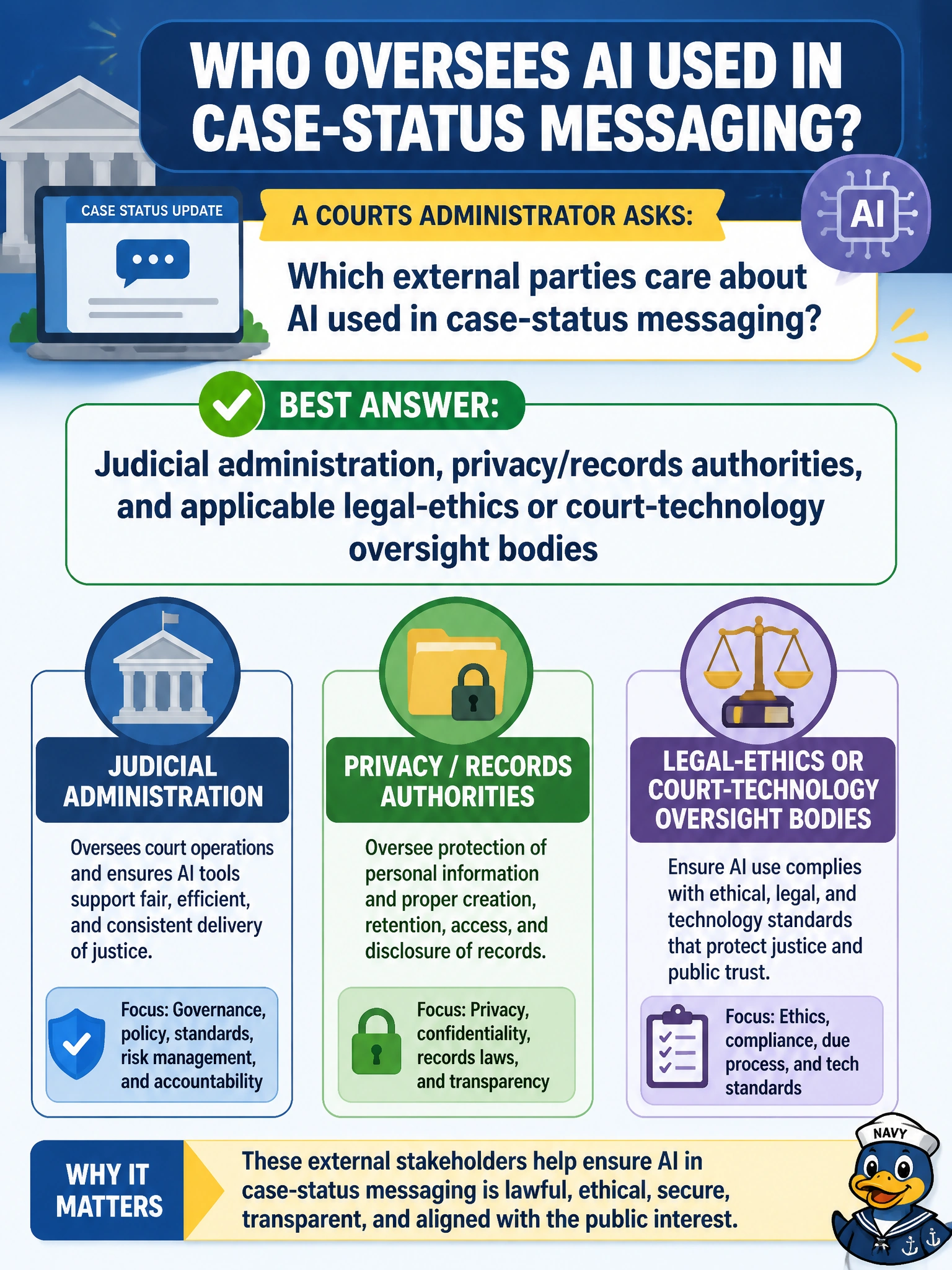
A courts administrator asks which external parties care about AI used in case-status messaging. Which answer best identifies relevant oversight stakeholders?
Select an answer to reveal the explanation.
Short Explanation
Courts touch justice, records, and people's rights. The parties who care are judicial administration, records keepers, privacy regulators, and the statutes that bind them.
Full Explanation
The external parties who care about AI used in court administration are judicial administration (case flow, docket integrity), privacy/records authorities (state courts oversight, records retention officers), and applicable statutes governing judicial data and AI disclosure. Judicial records are statutory property; AI that touches them must align with records retention, public-record exemptions, and appeal-rights workflows. State courts oversight bodies and municipal records management officers are the external stakeholders who set the governance guardrails. Statutes define what can be disclosed, when, and to whom—and they are non-negotiable external constraints.
Attorney licensing boards, legal-aid funding authorities, and applicable language-access oversight committees may support litigants, but they are not the external parties whose constraints must be satisfied to approve the AI system itself.
Procurement compliance offices, software-vendor audit authorities, and applicable public-communications review boards are procurement, vendor-audit, or communications functions focused on purchasing, software delivery, or public messaging, not external stakeholders in AI governance; they care about their specific contracts or communications duties, not the broader judicial AI posture.
Law-enforcement accreditation bodies, prosecutorial standards authorities, and applicable pretrial-services oversight councils oversee law-enforcement, prosecution, and pretrial operations, not judicial administration of case-status messaging; they set standards for their own operational domains but do not set the judicial AI governance guardrails.
Operational check: before any judicial AI goes live, confirm that the state courts oversight body and municipal records-retention authority have reviewed the AI's impact on case-flow integrity, record-retention obligations, and appeal access—not just IT security.
Prefer to study offline? Printable PDF study book + test engine ($7.50, unofficial). These questions stay free here.