
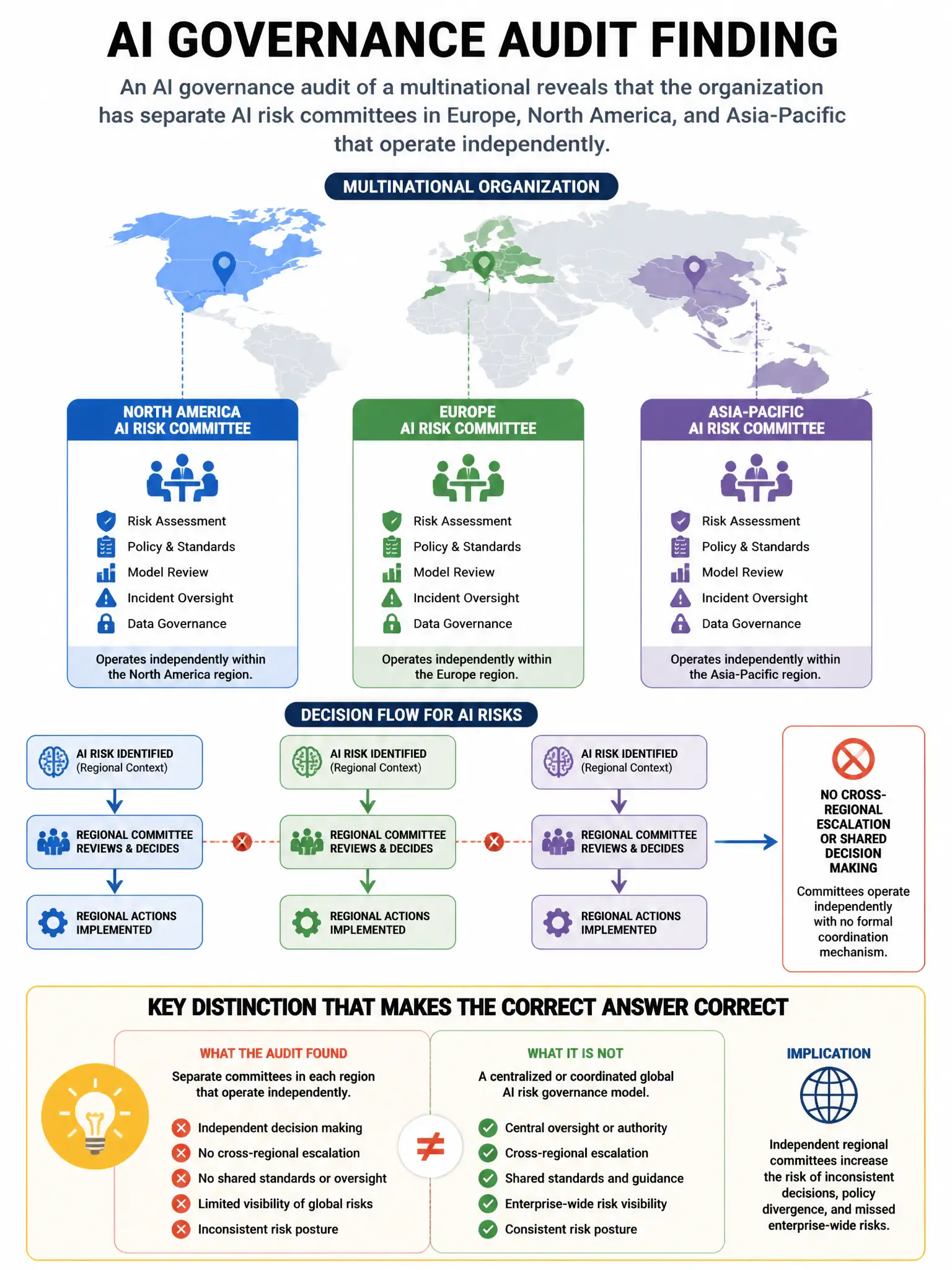
An AI governance audit of a multinational reveals that the organization has separate AI risk committees in Europe, North America, and Asia-Pacific that operate independently with no global coordination mechanism. Each region applies different risk thresholds, fairness standards, and approval criteria. What governance risk does this structure create?
Select an answer to reveal the explanation.
Short Explanation
Here's the deal — governance fragmentation is the real risk because inconsistent regional standards let high-risk AI slip through lenient approvals and create uneven exposure. You can't manage global AI risk holistically when each region sets its own rules.
Full Explanation
Governance fragmentation risk is correct because separate regional committees with different risk thresholds, fairness standards, and approval criteria create multiple compounding risks. The structure enables regulatory arbitrage, where globally deployed AI can be approved through the most lenient regional committee to avoid stricter requirements, and it produces uneven risk protection for customers and employees across regions. It also prevents the organization from managing its global AI risk profile holistically and can lead to non-compliance with strict regional regulations, such as the EU AI Act, for globally deployed systems. The duplication-of-effort concern is an operational efficiency issue, not the primary governance risk. The committee-overlap concern, where the same systems may be reviewed by multiple committees with conflicting outcomes, is a symptom of fragmentation rather than the full characterization. The communication-risk concern, where the board cannot receive a consolidated AI risk report without a central committee, is a governance transparency issue that is also a symptom of fragmentation.