
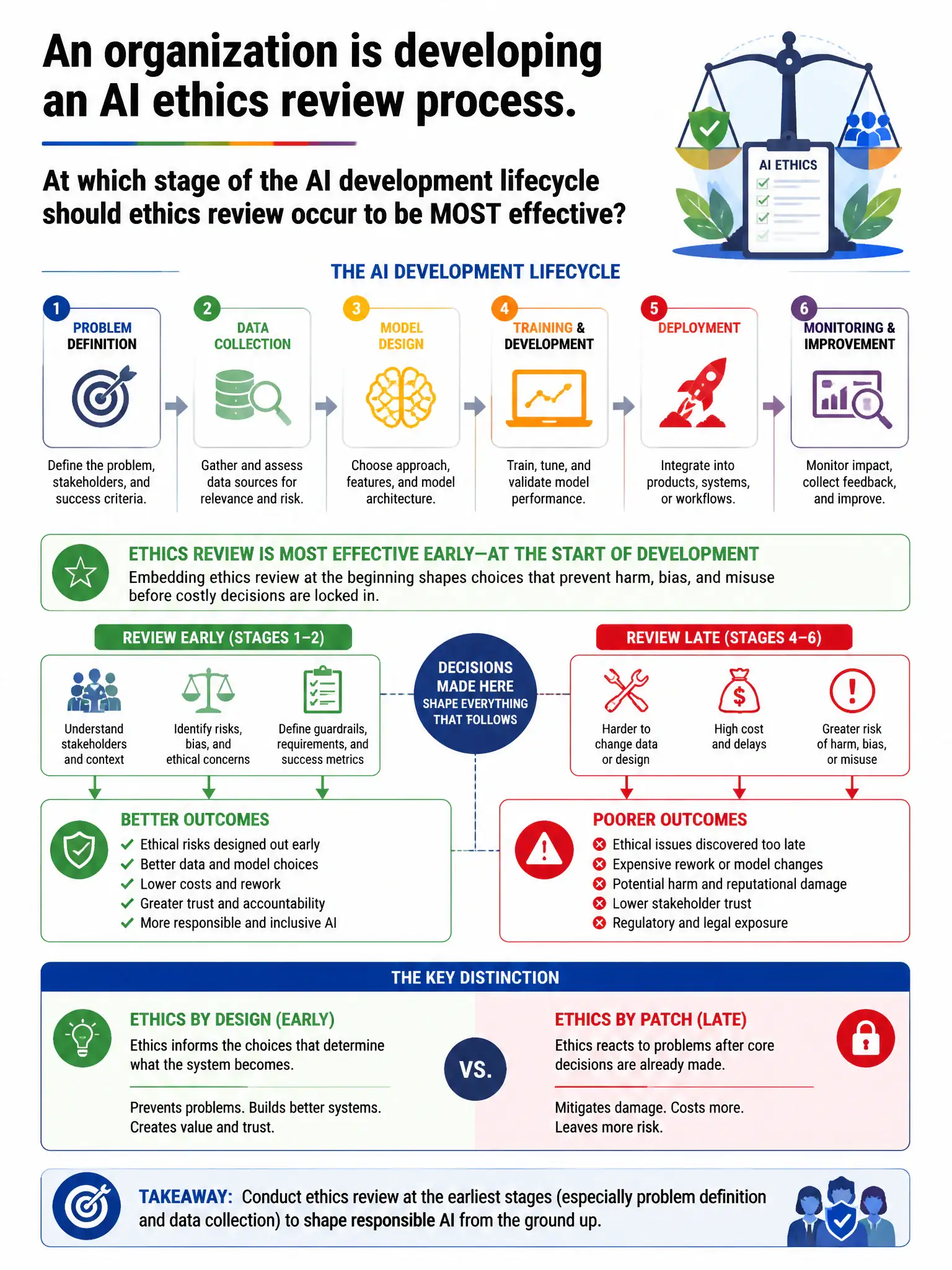
An organization is developing an AI ethics review process. At which stage of the AI development lifecycle should ethics review occur to be MOST effective?
Select an answer to reveal the explanation.
Short Explanation
Ethics review works best when it happens throughout the lifecycle, not just at one checkpoint. You need to catch use-case ethics, data bias, model fairness, pre-deployment impacts, and post-deployment harms as they arise. That lets you fix issues earlier and cheaper.
Full Explanation
Ethics review should occur throughout the lifecycle: ideation/design, data collection, model development, pre-deployment review, and post-deployment monitoring. Ethics risks arise at each stage and are cheapest to fix when introduced: ideation raises use-case ethics, data collection can introduce bias, development can create fairness issues, pre-deployment review assesses impacts, and monitoring detects ongoing harms. Waiting until after deployment is reactive and cannot prevent embedded harms. Reviewing only during data collection misses model, deployment, and operational risks. Final pre-deployment gate checks miss upstream risks that become expensive to remediate late.