
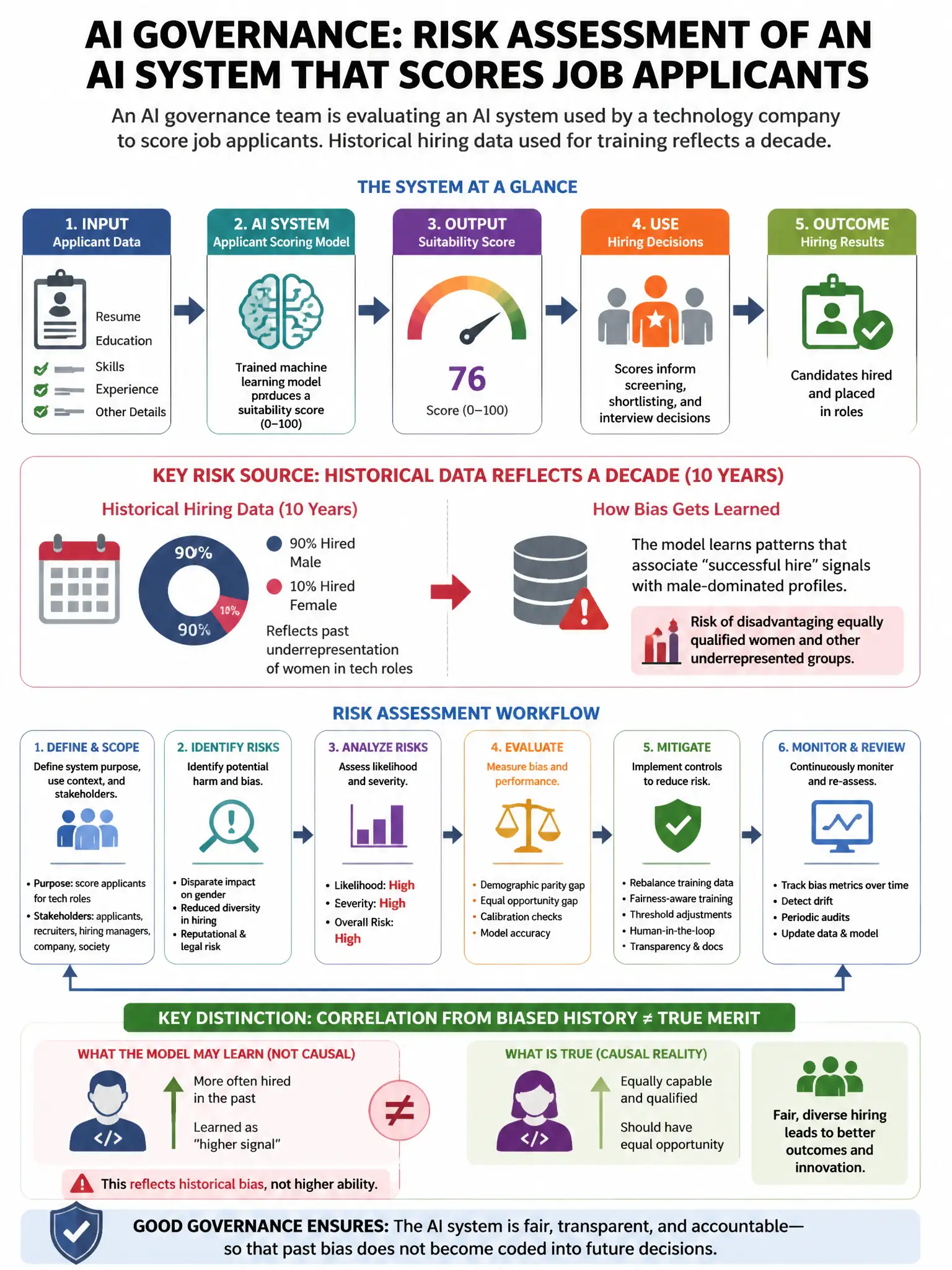
An AI governance team is conducting a risk assessment of an AI system that scores job applicants for a technology company. Historical hiring data used for training reflects a decade of predominantly male hiring in technical roles. Which risk does this create beyond ordinary model error?
Select an answer to reveal the explanation.
Short Explanation
Here's the deal — if you train a hiring model on a decade of male-dominated technical hiring, it encodes and perpetuates that bias, penalizing female applicants at scale and speed. That's amplification of historical gender bias, not just ordinary model error.
Full Explanation
The correct risk is amplification of historical gender bias: training a hiring model on historically biased data encodes those biases — the model learns that male candidates were historically successful and penalizes female candidates, amplifying and perpetuating past discrimination at scale and speed. The overfitting-to-male-candidates-due-to-excessive-model-regularization option is a technical modeling error unrelated to historical bias encoding. The data-poisoning-from-employees-who-manipulated-hiring-records option requires evidence of deliberate data manipulation. The model-staleness-because-the-technology-job-market-changed option is a temporal generalization risk, not the primary bias concern.