
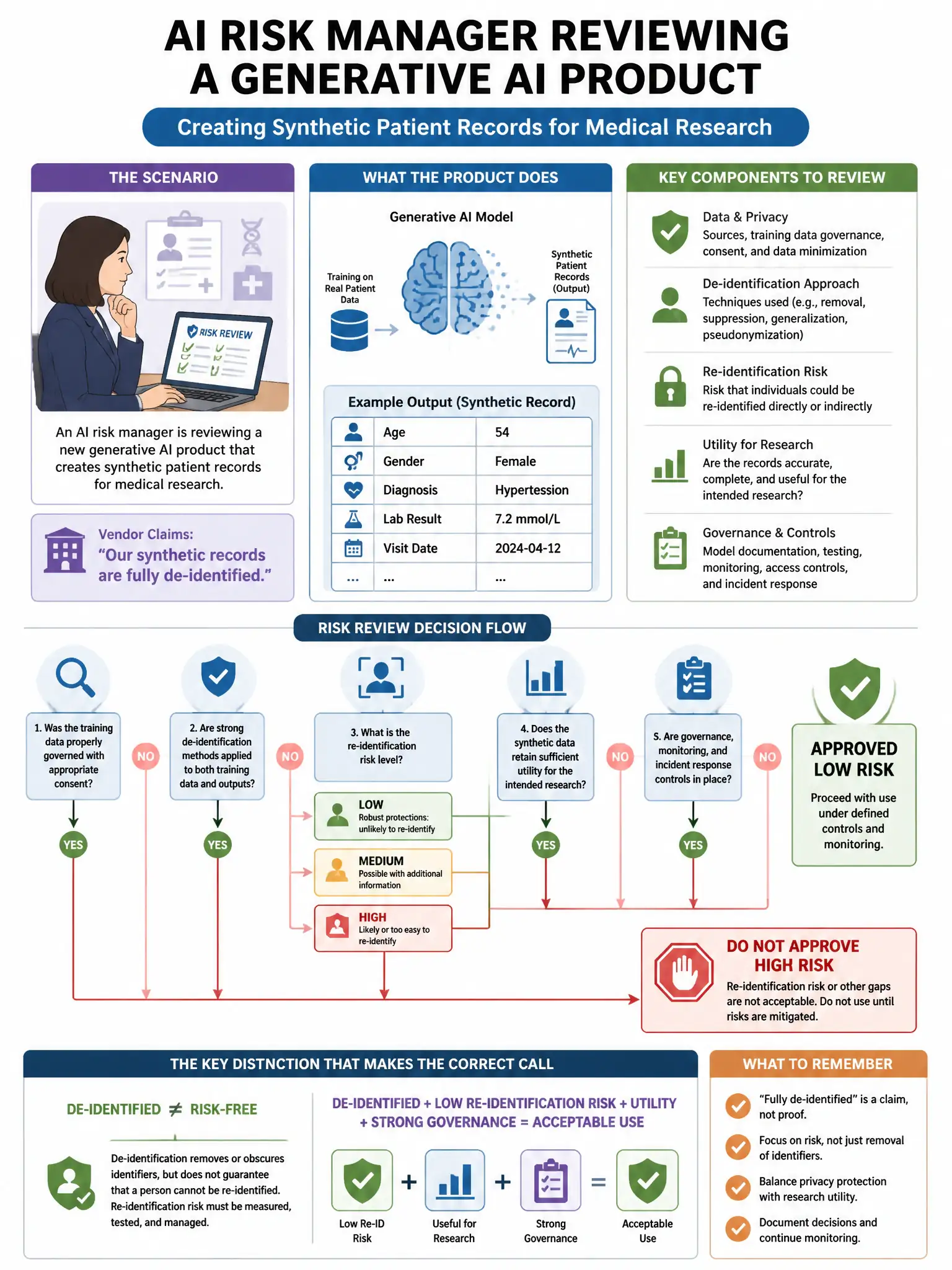
An AI risk manager is reviewing a new generative AI product that creates synthetic patient records for medical research. The product's vendor claims the synthetic records are 'fully anonymized' because they are AI-generated and not copied from real patient records. What is the PRIMARY risk assessment concern with this claim?
Select an answer to reveal the explanation.
Short Explanation
Here's the deal — synthetic records aren't automatically private just because they're AI-generated. If the model learned from real patient data, it can leak enough statistical clues for someone to infer a patient was in the training set or even re-identify them. You need formal privacy proof, like differential privacy, before trusting the 'fully anonymized' claim.
Full Explanation
The primary concern is membership inference and re-identification risk. Synthetic data generated by models trained on personal data inherits statistical properties of that data, so membership inference attacks can identify whether specific individuals' records contributed to training, and in some cases re-identification of synthetic records is possible. 'AI-generated' is not synonymous with 'fully anonymized.' Proper privacy assessment requires demonstrating that the synthetic data satisfies differential privacy or similar formal privacy guarantees. The concern that synthetic records may be lower quality than real records is a research utility concern, not the primary privacy risk. The concern that the vendor lacks ISO 27001 certification is an information security certification concern, not a privacy assessment of the synthetic records themselves. The concern that synthetic records may introduce bias into medical research is also a legitimate concern, but it is secondary to the re-identification risk that directly challenges the anonymization claim.