
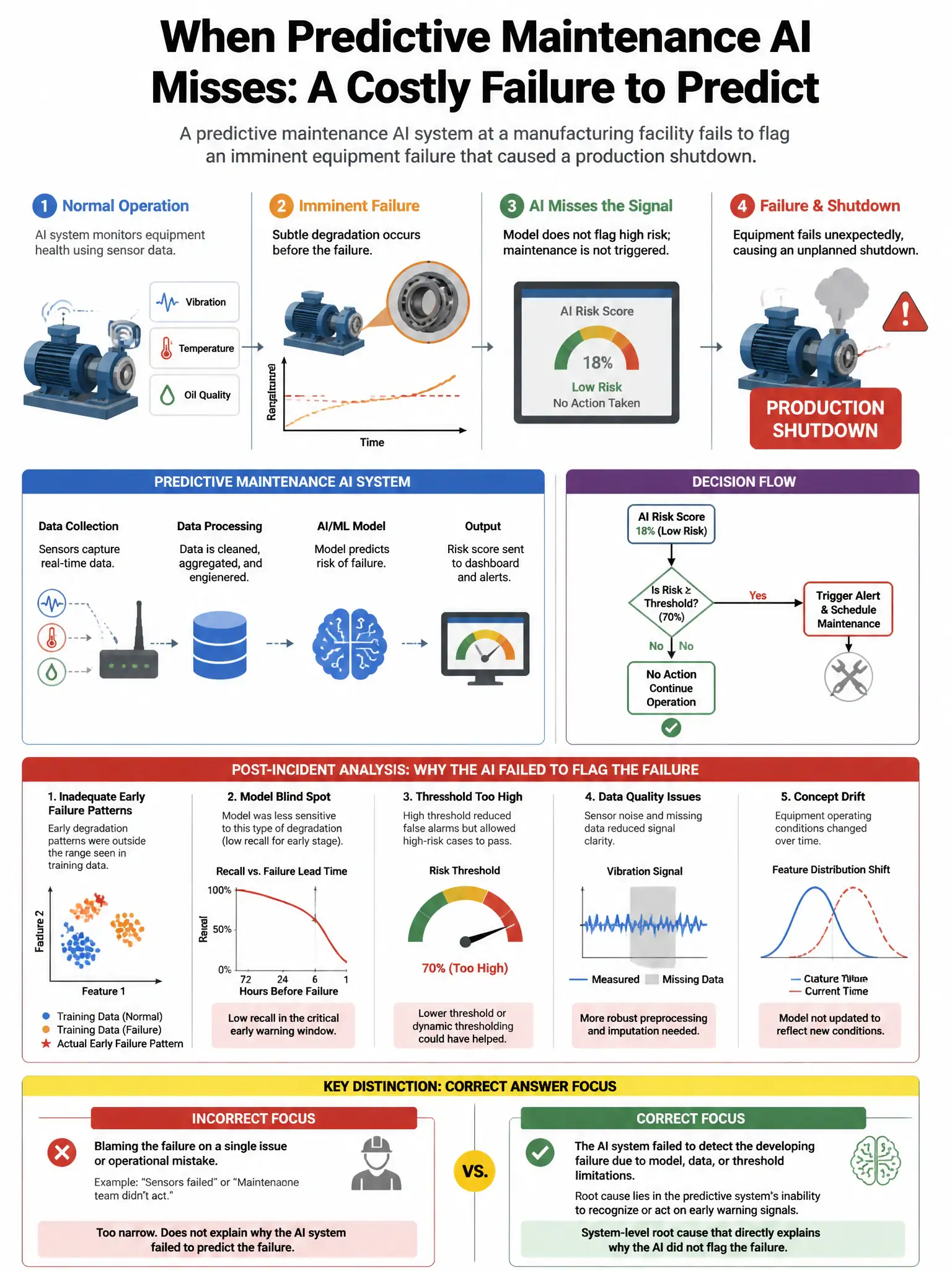
A predictive maintenance AI system at a manufacturing facility fails to flag an imminent equipment failure that caused a production shutdown. Post-incident analysis finds the failure mode was underrepresented in training data. How should this risk be classified?
Select an answer to reveal the explanation.
Short Explanation
You're looking at tail risk here because the training data underrepresents rare, high-impact failure modes, so the model misses them. Don't confuse that with overfitting to common failures, which is a different data problem.
Full Explanation
Tail risk from distribution gaps in training data for rare but high-impact events is correct because the model missed a rare catastrophic failure mode: the training distribution underrepresented low-frequency, high-severity events, leaving the model blind to them. Overfitting to high-frequency failure modes in the training dataset is not the root-cause classification; overfitting to common patterns can also cause missed rare events, but the stated cause is a data gap. Adversarial manipulation of sensor inputs by a disgruntled employee is wrong because it requires evidence of deliberate manipulation. Concept drift caused by recent equipment software upgrades is wrong because it requires evidence of a change in the underlying process.