
A financial services firm's Chief AI Officer is presenting AI risks to the board. Which risk communication approach BEST conveys the significance of AI model risk to a non-technical board?
Select an answer to reveal the explanation.
Short Explanation
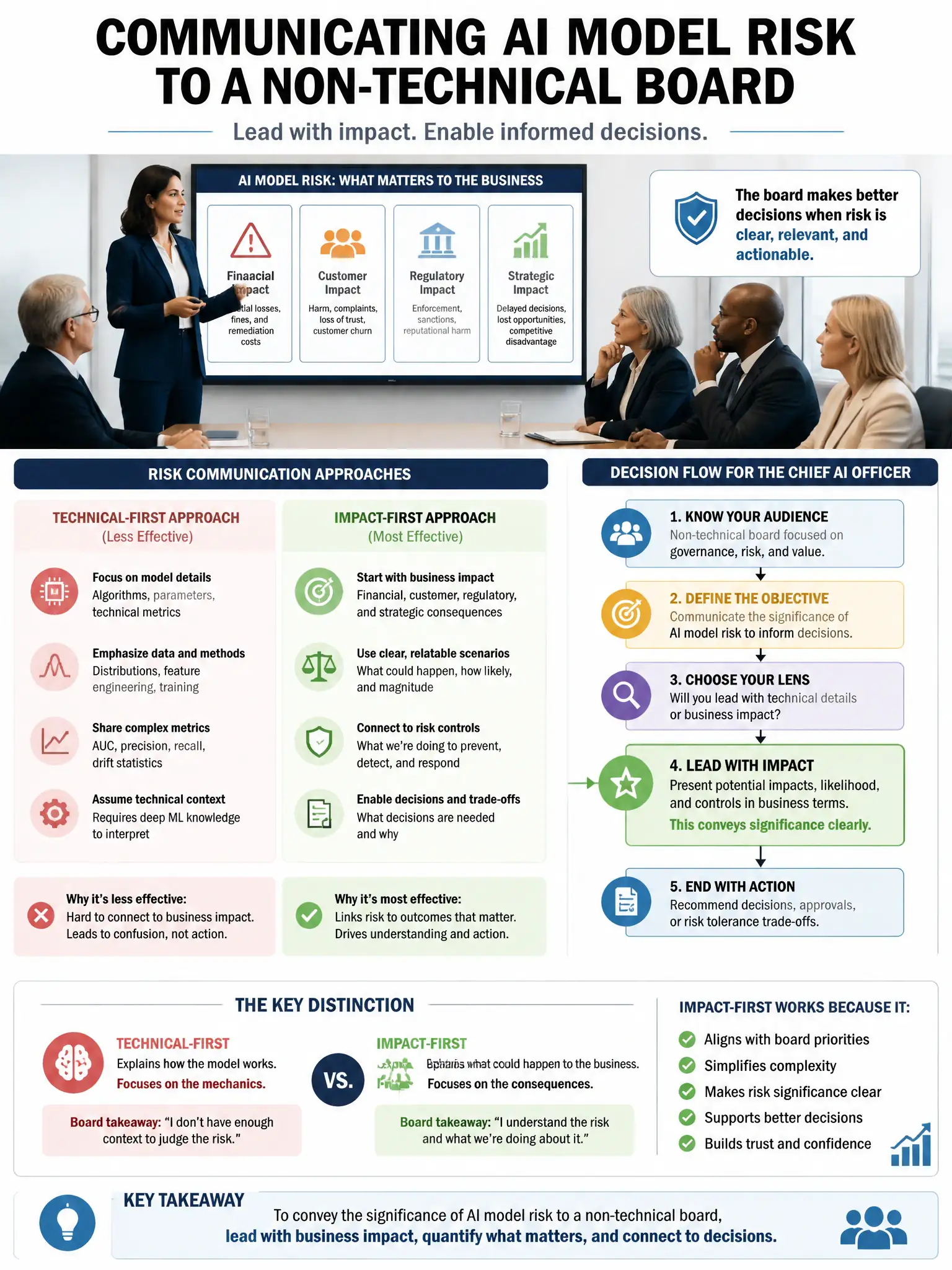
When you're briefing a non-technical board, you need to translate AI model risk into business consequences: financial impact, regulatory exposure, and customer harm. That gives directors the context they need to oversee risk and make governance decisions. Technical metrics and papers don't do that.
Full Explanation
Describing AI risks as financial impact, regulatory consequences, and customer harm scenarios is correct because board communication must translate technical AI risk into business terms that let non-technical directors oversee risk and make governance decisions. ROC-AUC curves and Kolmogorov-Smirnov statistics are inaccessible and do not translate risk into business consequences. The technical gradient boosting white paper is also inaccessible and does not connect model risk to board decisions. Open-source benchmark comparisons may show performance, but still fail to convey business significance to a non-technical board.