
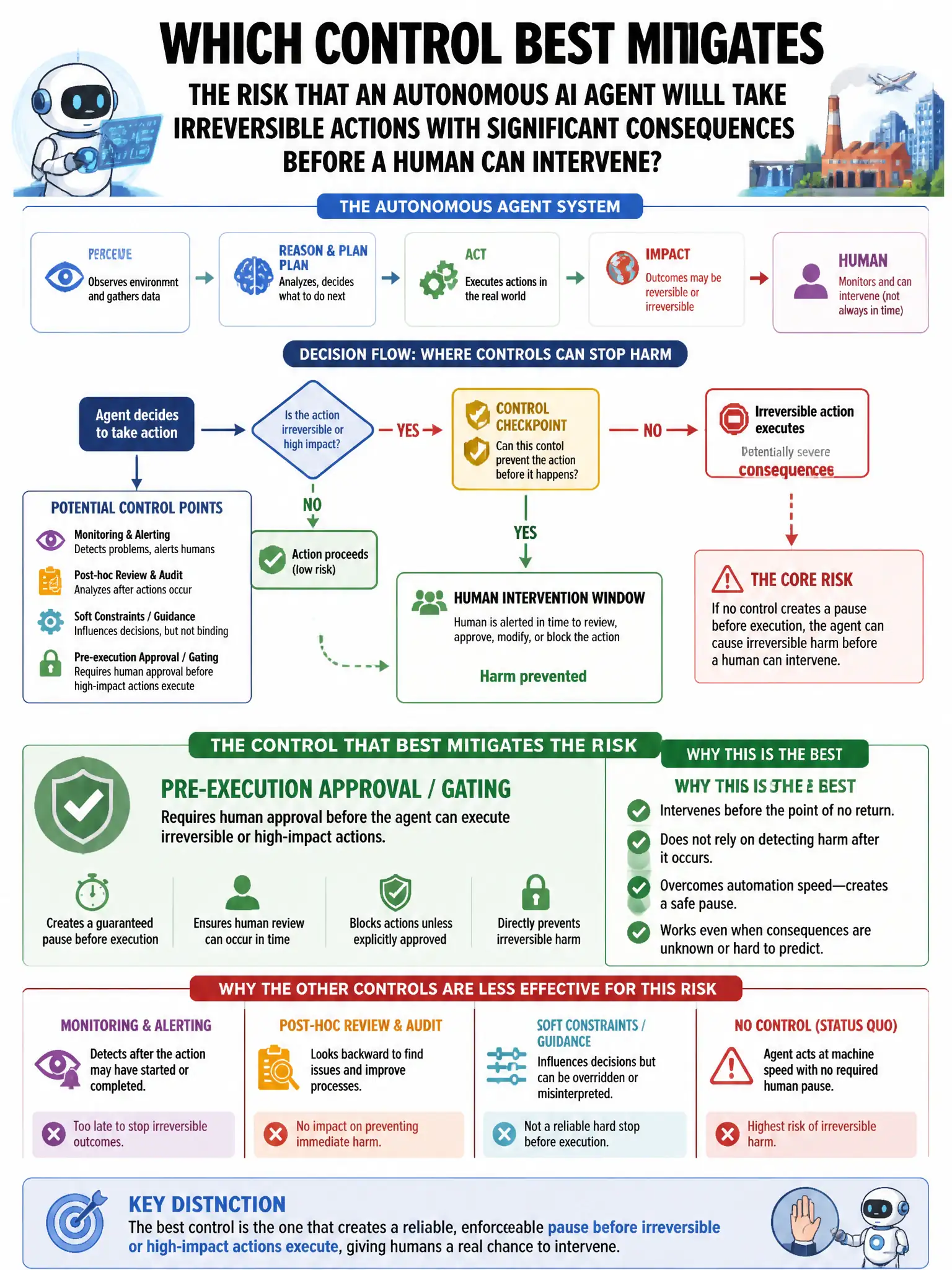
Which control BEST mitigates the risk that an autonomous AI agent will take irreversible actions with significant consequences before a human can intervene?
Select an answer to reveal the explanation.
Short Explanation
Here's the deal — you want the control that stops the agent before it can do something you can't undo. The minimal footprint principle keeps it to reversible actions and makes it ask for human approval before irreversible steps, so you get real gating instead of just watching it go.
Full Explanation
The correct control is implementing the 'minimal footprint' principle, limiting the agent to reversible actions and requiring human approval before irreversible steps. This control is key in agentic AI safety frameworks because it restricts agents to requesting only necessary permissions, prefers reversible over irreversible actions, and pauses for human confirmation before high-stakes or irreversible steps. Logging all actions to central monitoring systems provides monitoring visibility but does not prevent harm. Training on larger datasets improves accuracy but does not add control gating. Containerized deployment addresses security isolation, not action reversibility.