
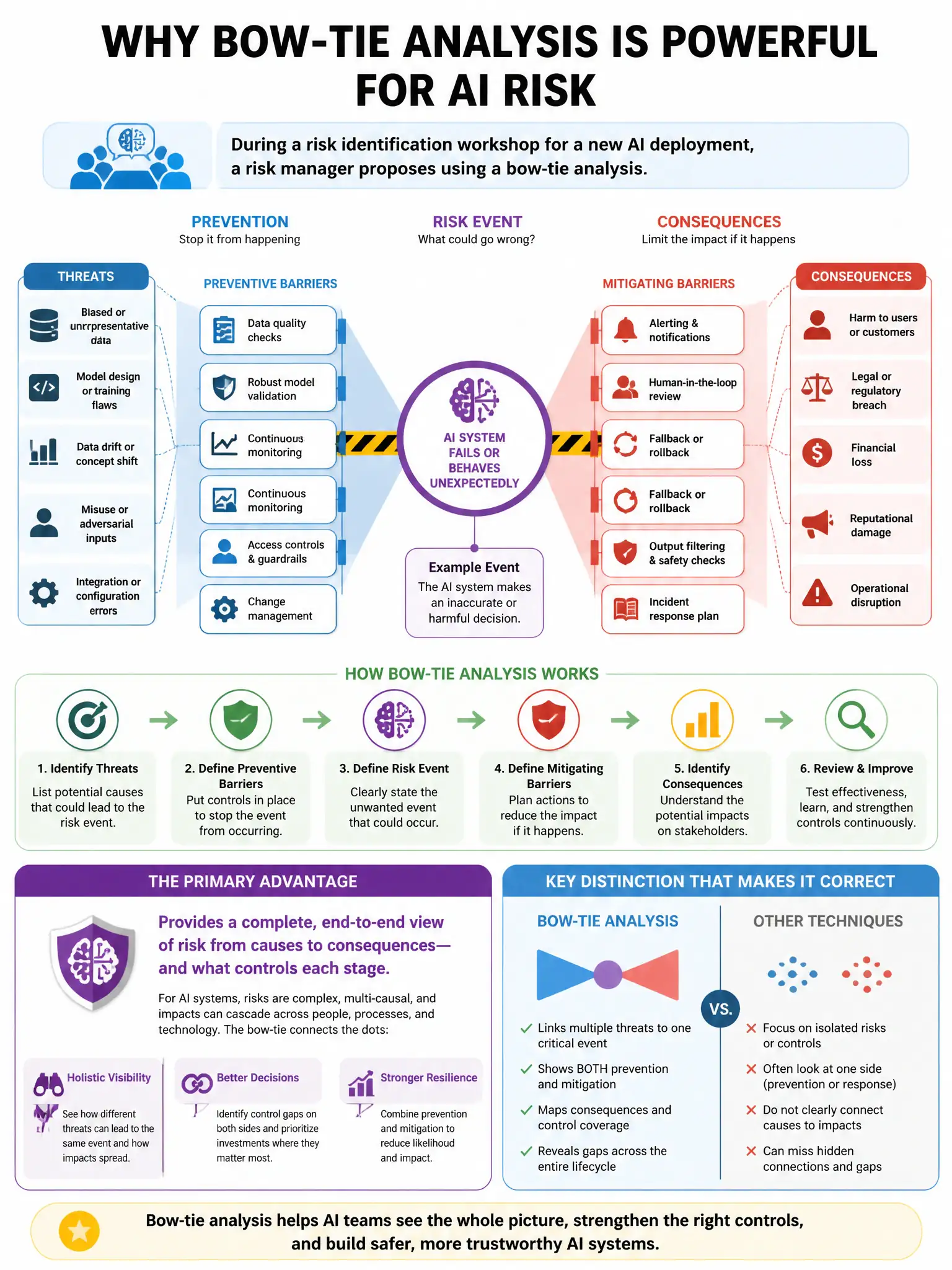
During a risk identification workshop for a new AI deployment, a risk manager proposes using a bow-tie analysis. What is the PRIMARY advantage of this technique for AI risk?
Select an answer to reveal the explanation.
Short Explanation
Bow-tie analysis gives you a visual map of the threats that can lead to an AI risk event and the consequences that follow it. That makes it useful for structured risk communication, not for Bayesian probability, data-quality testing, or compliance checklists.
Full Explanation
The correct advantage is that bow-tie analysis maps both threat pathways leading to a risk event and consequence pathways after it occurs. It visualizes threats, or causes, on the left side of a central risk event and consequences, or impacts, on the right, with controls mapped at each stage, which makes it useful for structured AI risk communication. The Bayesian inference option is wrong because bow-tie analysis is qualitative, not a probability tool. The statistical training-data option is wrong because it does not assess training data. The ISO/IEC 42001 checklist option is wrong because it is not a compliance checklist framework.