
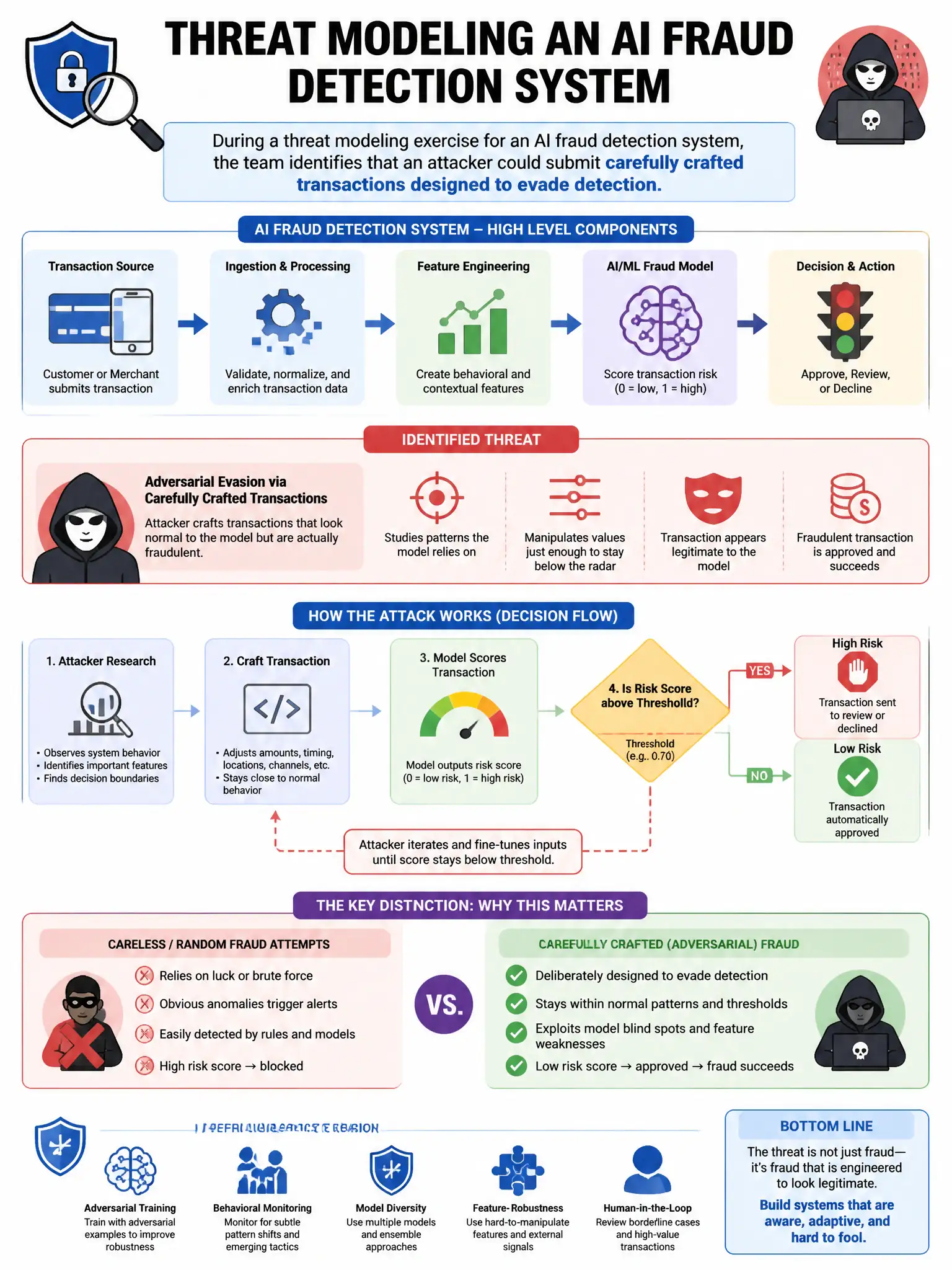
During a threat modeling exercise for an AI fraud detection system, the team identifies that an attacker could submit carefully crafted transactions designed to evade detection. What attack category does this represent?
Select an answer to reveal the explanation.
Short Explanation
Here's the deal — evasion attacks happen at inference time, when an attacker crafts inputs to make the model misclassify. In this case, the attacker tweaks transactions so the fraud detector misses them.
Full Explanation
The correct answer is the evasion attack at inference time, because evasion attacks occur when an adversary crafts inputs to cause a model to misclassify. Here, fraudulent transactions are carefully crafted to bypass fraud detection. Data poisoning during training is wrong because it corrupts training data, not production inputs. Model inversion at inference time is wrong because it attempts to reconstruct training data from model outputs, not evade detection. Membership inference during testing is wrong because it determines whether a specific record was in the training set.