
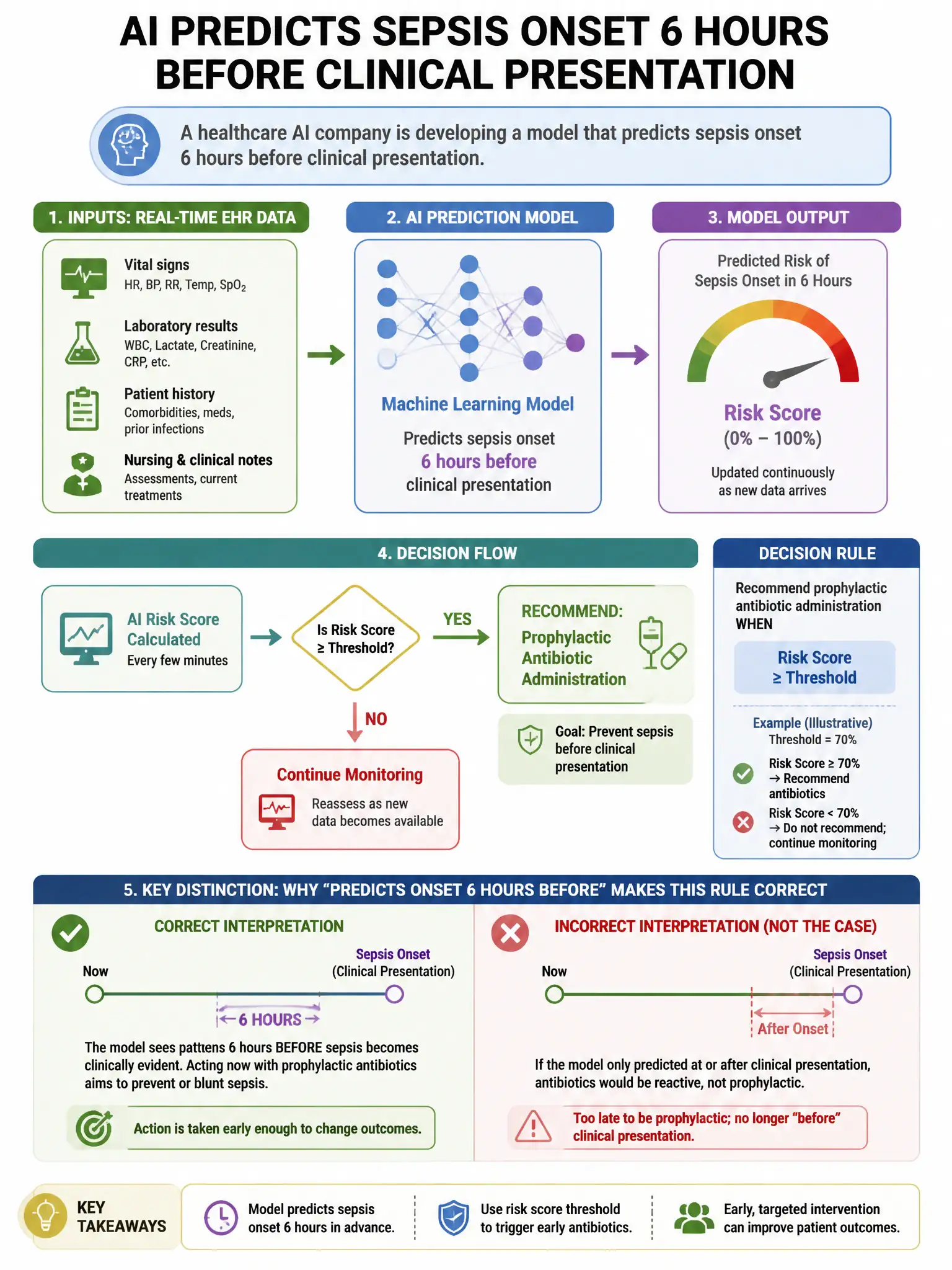
A healthcare AI company is developing a model that predicts sepsis onset 6 hours before clinical presentation. The model will recommend prophylactic antibiotic administration when it detects high sepsis risk. What governance structure is MOST appropriate for this model given its clinical impact?
Select an answer to reveal the explanation.
Short Explanation
Here's the deal — when an AI recommends prophylactic antibiotics based on a predictive risk score, you're dealing with software as a medical device, so you need FDA clearance, prospective clinical validation, physician oversight, and post-market surveillance. Standard IT change management alone won't cut it for a clinical treatment recommendation system.
Full Explanation
The appropriate governance structure is the medical device regulatory approval pathway, such as FDA 510(k) or De Novo classification, combined with clinical validation in prospective trials, physician oversight for all treatment recommendations, and ongoing post-market surveillance. An AI model that recommends specific drug administration based on predictive risk scores functions as Software as a Medical Device and requires FDA regulatory clearance in the United States, along with prospective clinical validation, physician oversight to prevent autonomous drug administration, and post-market surveillance for patient safety. Standard IT change management controls with quarterly model performance review are wholly inadequate for a clinical treatment recommendation system. AI ethics board review and publication of model performance in a peer-reviewed journal are important elements but do not fulfill regulatory requirements. Implementation under the hospital's existing clinical decision support software exemption without additional regulatory process does not apply to systems that recommend specific treatment actions.