
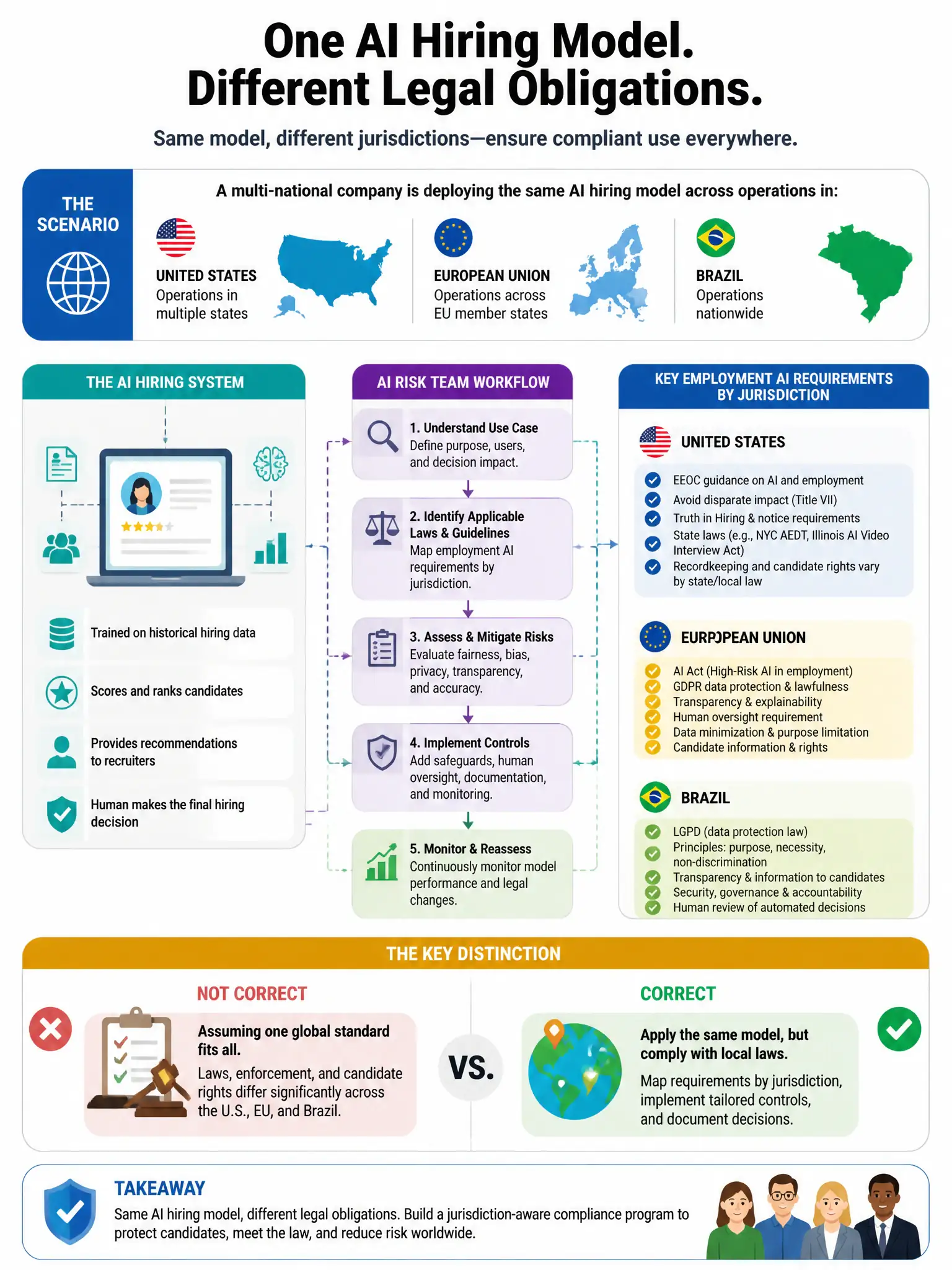
A multi-national company is deploying the same AI hiring model across operations in the United States, European Union, and Brazil. The AI risk team must ensure compliance with employment AI regulations in all jurisdictions. Which approach BEST manages cross-jurisdictional AI compliance risk?
Select an answer to reveal the explanation.
Short Explanation
Here's the deal — you can't just copy one rulebook everywhere. You need to map each jurisdiction's AI and employment rules, implement controls that satisfy the most stringent applicable requirements, and document compliance for each place.
Full Explanation
The best approach is a jurisdiction-by-jurisdiction compliance mapping, implementation of controls that satisfy the most stringent applicable requirements, and maintenance of documentation of compliance with each jurisdiction's specific AI and employment law obligations. Multi-jurisdictional AI compliance requires understanding each jurisdiction's specific requirements (EU AI Act + GDPR, U.S. EEOC/CFPB/state AI laws, Brazil LGPD + employment laws) and implementing controls that satisfy all applicable requirements. In practice, this often means implementing the most stringent requirements across all jurisdictions where they do not conflict. Deploying the most permissive jurisdiction's compliance framework globally to minimize operational complexity creates compliance failures in stricter jurisdictions. Seeking legal opinions only for the EU jurisdiction because it has the most developed AI regulatory framework misses U.S. and Brazilian requirements. Limiting the AI model's use to jurisdictions where AI hiring tools are explicitly permitted under local law may be unnecessarily restrictive and overlooks jurisdictions where use is regulated but permitted with appropriate controls.