
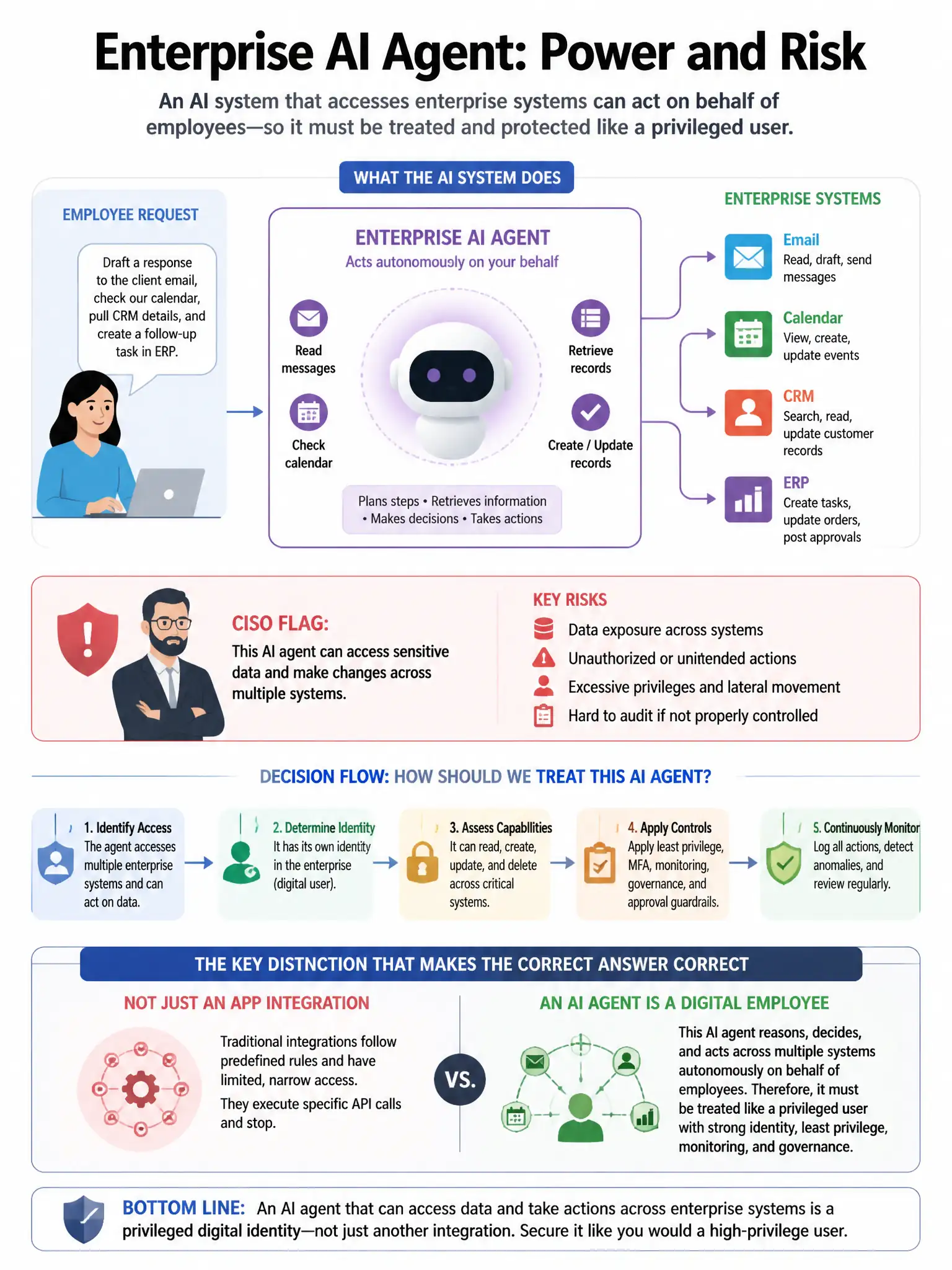
A company is building an AI system that will access multiple enterprise systems (email, calendar, CRM, ERP) to autonomously complete tasks on behalf of employees. The CISO flags that the AI agent's access permissions are as broad as the highest-privileged user in the system. Which security principle is being violated?
Select an answer to reveal the explanation.
Short Explanation
Here's the deal — you're seeing a least privilege violation because the AI agent has the same broad access as the highest-privileged user instead of only the permissions it needs for its tasks. That overprivileged setup blows up the blast radius of any mistake, hallucination, or prompt injection.
Full Explanation
The least privilege principle is correct because granting an AI agent the same permissions as the highest-privileged user violates the requirement that any system or user be given only the minimum permissions necessary to fulfill their function. An overprivileged AI agent dramatically expands the blast radius of any error, hallucination, or prompt injection attack. The defense-in-depth option, which says the AI agent should have multiple security layers protecting its access, is relevant but does not describe the permission-breadth problem. The separation-of-duties option, which says the AI agent should not be able to both initiate and approve transactions, addresses conflicting role control rather than excessive permissions. The non-repudiation option, which says the AI agent's actions should be attributable to a specific user, addresses accountability rather than access scope. The violation described is specifically a least privilege violation.